

The Rules Change At The City Line
Tree regulation in this market is municipal. Not county, not state. Each city wrote its own ordinance at its own time, and nothing obliged any of them to agree with a neighbor.
So the same removal, on the same species, at the same size, can be free in one city and carry a five-figure mitigation obligation twenty minutes away. None of that is discoverable from a quote, and none of it is guessable from experience in another city.
Ordinance work is part of our commercial tree services in Plano, and these pages exist because we read all nine documents rather than calling the city and hoping. Every figure on them comes from the ordinance itself, and the primary documents are held on file.
What Actually Differs
Four things, and a city can be strict on one and permissive on another, which is why “which city is toughest” has no useful answer.
What Counts As Protected

A threshold in inches, and it isn’t the same number anywhere. Dallas protects at 8 inches diameter, several cities at 6 inches caliper, and one defines a protected tree by height as well as trunk size. Below the line the tree may not be regulated at all.
What The Permit Even Is
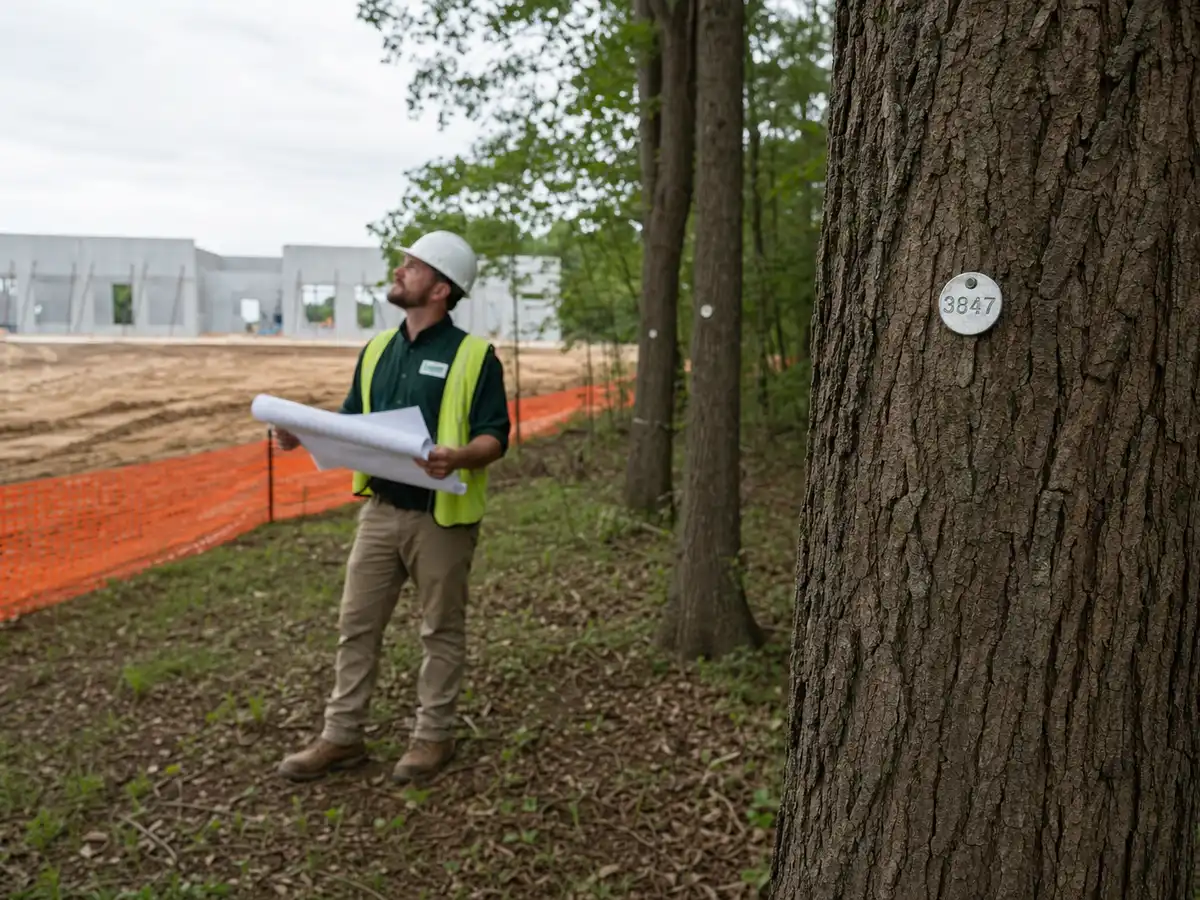
In Plano the preservation plan IS the permit. In Frisco there’s a separate tree removal permit. In Wylie the buildable area can be cleared without one. The document you need isn’t the same document from city to city.
What You Owe Afterwards

Inch for inch, a percentage of what came out, a ratio by species class, or a running credit ledger. Two cities double the obligation at a single inch of trunk growth, which makes the timing of a planned removal a budget decision.
Penalties Are The Part Nobody Reads
The enforcement provisions sit at the back of these documents and they’re where the range is widest. Garland charges a civil penalty of $250 per diameter inch, and it applies to injuring a tree rather than only to removing one. Wylie prosecutes as a misdemeanour, at $100 per caliper inch on conviction.
Four of the nine write damage into the prohibition alongside removal, using language like “effectively destroy through damaging”. Dallas goes furthest, defining removal to include any act that will more likely than not cause a tree to decline and die within five years, and naming topping and soil compaction explicitly.
That matters on a construction site more than anywhere else, because the trench and the haul route are exactly the things that kill a tree slowly enough for everybody to assume they were fine.
How To Use These Pages
Start with the city the property sits in. Each page covers what’s protected, what document you need, how mitigation is calculated, what protection is required during construction, and what the penalties are, with the ordinance section cited so you can check it.
If you manage property in more than one of these cities, read two. The differences between neighbors are the ones that cost money, precisely because they’re the ones nobody expects.
And if the answer you need isn’t on the page, ask. These documents run to twenty pages each and the pages here cover what commercial owners actually hit, not everything the code contains.
The Instrument, City By City.
What each city actually uses to regulate a tree, taken from its own code. No two of these are the same document.
Plano
Article 17 of the Zoning Ordinance. The preservation plan IS the permit, replacement runs inch for inch from 8 to 30 inches and 1.5:1 above that, and a fee in lieu is available with the Director's approval.
Frisco
Subsection 4.01 of the Zoning Ordinance. A separate Tree Removal Permit, mitigation banded as a percentage of diameter removed from 0 to 300 percent, and a survey needing two seals rather than one.
Dallas
Article X, Landscape and Tree Conservation. Protected at 8 inches, mitigation waived across the development footprint up to 70 percent of the site, and topping defined and regulated by name.
Garland
A Tree Management Plan plus Removal Authorization, class-based replacement ratios from 2:1 down to 0.25:1, and a civil penalty of $250 per diameter inch.
Allen
Land Development Code Article VII. A credit ledger rather than a ratio, where removal costs exactly double what preservation earns, and a 90 day clock on the permit.
McKinney
Unified Development Code Article 4. Three protected tiers, mitigation doubling above 17 inches, and a perimeter zone beside existing housing where protected trees may not be altered at all.
Carrollton
Chapter 155. Replacement at 100 percent of the diameter removed, clear-cutting prohibited outright, and a survival obligation running two years past the end of the project.
Wylie
Zoning Ordinance Article 7. Enforced criminally as a misdemeanor at $100 per caliper inch, and protection is defined to exclude trees standing in easements, rights-of-way or the buildable area.
Richardson
No private-property tree ordinance at all. The tree chapter covers public trees only, which makes documentation the owner's protection rather than the city's.
What The Rules Actually Ask For
The provisions themselves, explained once rather than nine times: what counts as protected, what a permit is called here, and what has to exist before a tree comes out.
- Tree Ordinance Compliance Across Collin, Dallas And Denton Counties
- Tree Mitigation Plans And What A Removal Really Costs
- Tree Removal Permits And What Each City Actually Calls It
- What Counts As A Protected Tree And Where The Line Sits
- Tree Preservation Plans: What Goes In One And Who Signs It
- Tree Protection During Construction On Commercial Sites
- Paying A Fee Instead Of Planting Replacement Trees
- Who Approves A Tree Removal, And How A Refusal Is Appealed
- Perimeter Zones, Floodplain Limits And Protected Natural Areas
- Street Trees, Rights-Of-Way And Trees On Public Property
- Tree Due Diligence Before You Buy Or Lease A Site
- When Tree Work Belongs In A Construction Schedule
- Tree Rules On An Operating Property, With No Construction
- Ordinances Get Amended, And The Version Matters
- Tree Ordinance Rules In HOA Common Areas
- Screening, Buffers And The Trees That Have To Stay
- Putting Tree Protection In A Contractor Scope Of Work
- Parking Lots, Paving And The Trees Underneath Them
- Storm Removals And What The Ordinance Still Wants After
- Trees In Easements And Who Actually Controls Them
- Choosing Replacement Trees, And Why Species Caps Exist
- Tree Ordinance Terms, Translated Into Plain Language
- How To Find Out Which Tree Rules Apply To Your Site