Skip To Content
  • Serving Plano and Collin, Dallas, and Denton Counties
(214) 668-8346
A Legacy Tree Care arborist in a red hard hat talking with two people in business clothes on the edge of a commercial parking area, one of them holding a folder, with office buildings and mature trees behind them

Commercial Property Only

Commercial Tree Service For Property Managers, Boards And Developers

The work is the same. What you're accountable for isn't.

We work on commercial property only, for seven kinds of client across Collin, Dallas and Denton Counties. What separates them isn't the trees, it's who asks you about them afterwards.

(214) 668-8346

Crews dispatch in business hours.

Request A Property Walkthrough

Quick Walkthrough Request

Rather talk it through? (214) 668-8346.

  • Insured & Bonded
  • Serving the Plano Area Since 2005
  • Emergency Dispatch
  • Commercial Property Specialists

Nobody Buys Tree Work For The Trees

A property manager calling about a leaning oak isn’t buying a removal. They’re buying the removal of a problem that has their name on it. An HOA board calling about the same tree is buying a decision they can defend at a meeting. A general contractor is buying a plan review that doesn’t come back.

Same tree, same crew, same cuts. Three completely different definitions of the job going well, and a company that can’t tell them apart will satisfy one of the three by accident.

That’s what these pages are for. Not to describe seven versions of commercial tree service, because there aren’t seven. To describe what changes around it.

Two Things Change, And Only Two.

Every difference between the clients we work for reduces to one of these. Everything else is the same arboriculture on a different lawn.

  • Who Asks You About It

    A Legacy Tree Care arborist pointing up into a tree while a property manager in business dress looks up with him, in a commercial parking area

    An owner, a board, a tenant, a claims adjuster or a plan reviewer. Whoever it is decides what has to exist in writing and how far ahead it has to exist, and that’s a bigger driver of how we work than the trees are.

  • What The Site Does All Day

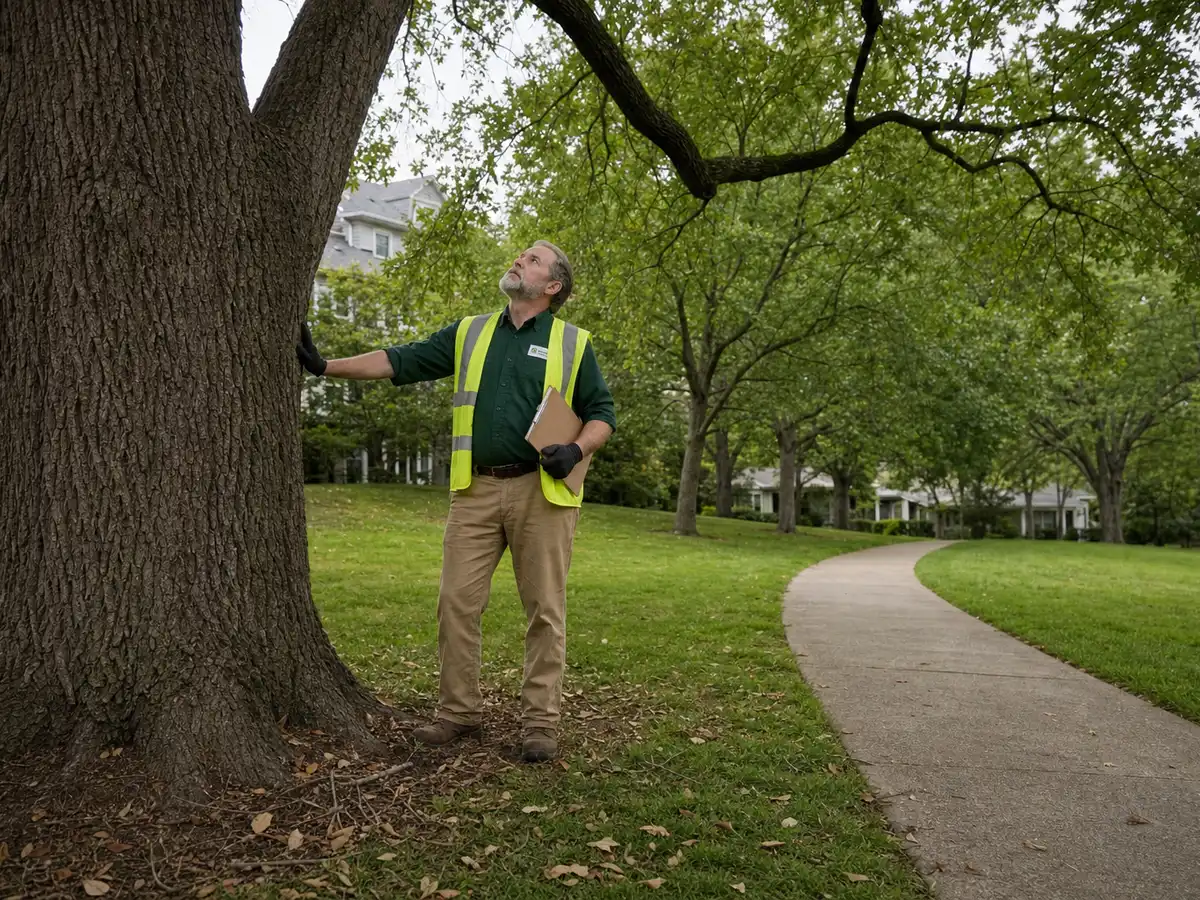
    A Legacy Tree Care arborist with a hand on a large tree trunk and a clipboard under his arm, looking up into the canopy in a landscaped common area

    Trading hours, truck movements, employees at desks, residents walking dogs. This decides the window, the access and how much of the job is traffic control rather than tree work.

  • Nothing Else, Really.

    A Legacy Tree Care arborist talking with a site manager on graded ground before construction, beside a tree enclosed by orange protective fencing

    A reduction cut is a reduction cut. Anyone selling you a proprietary methodology for your sector is selling you the same pruning standard with a different cover sheet on it.

What The Role Decides

Accountability sets the paperwork, and the paperwork is most of what separates commercial tree work from the residential version. A homeowner who takes a tree out answers to nobody. Everyone on this page answers to somebody.

For a property manager that somebody is an owner who wasn’t there, which means the record has to stand on its own months later. For a board it’s the membership, and the question is rarely what was done but why it cost that. For a developer it’s a plan reviewer with the authority to stop the job, and the currency is weeks rather than dollars.

We write for the audit, not for the invoice. What we found, what we recommend, why, and what happens if nothing is done. It’s the same document in all three cases and it gets read by three different people for three different reasons.

What The Property Decides

The site’s job while we’re on it sets everything practical: when we can start, what has to be coned off, whether a lift can reach, and how much of the day is spent moving equipment rather than cutting.

This is where the cost differences that look mysterious actually come from. A retail center that can only be worked between five and ten in the morning is a different job from a corporate campus that empties on a Friday, and the trees might be identical. A warehouse apron with turning trucks needs clearance measured to an operational number rather than an aesthetic one. A municipal site needs the documentation whether or not anybody asks for it, because eventually somebody will.

None of that changes what a good cut looks like. All of it changes what the day costs and what has to be agreed before the crew arrives.

Most Clients Are Two Of These

The list below is split the way the work actually splits, by who signs and by what the property does. Read whichever line describes you and then read the other one too, because almost everybody is on both axes at once.

A manager running an industrial park is a property manager reading about warehouse aprons. A board overseeing a mixed-use development is an HOA board reading about retail hours. Where the two pull against each other, the role wins, because the role is what you’ll be asked about after the trucks have gone.

The Seven We Write For

By Who Is Signing

What you're accountable for, and who asks you about it.

  • Commercial Property Managers

    You carry the tree risk on somebody else's asset, which makes the written record as valuable as the work. Budgets are set annually, so what you need most is to know what next year holds before you have to ask for it.

  • HOA Boards

    You're volunteers spending other people's money, and every decision can be questioned at a meeting. A recommendation you can hand to an owner who disagrees is worth more than the cheapest bid.

  • Developers And Contractors

    For developers, GCs and civil engineers the exposure is schedule rather than maintenance. The survey and the preservation plan gate the site plan, and produced late they hold up a plan review that costs far more in weeks than the survey ever cost in fees.

By What The Property Does

What the site is used for all day, which decides what the work has to work around.

  • Corporate Campuses

    Large mature canopy, an audience of employees who notice everything, and usually a single owner occupier who thinks in decades. The work here is preservation far more often than removal.

  • Retail Centers

    Trading hours decide everything. Parking lot canopy over the bays your tenants depend on, sightlines to signage that tenants raise constantly, and a work window that's early morning or nothing.

  • Industrial And Warehouse

    Truck movements and turning circles come first. Clearance over dock aprons and fire lanes is a real operational number rather than an aesthetic one, and detention ponds put trees in wet ground.

  • Municipal And Public Sector

    Procurement rules, public accountability and a duty of care to people who didn't choose to be there. Documentation isn't a nice to have; it's frequently the reason the file exists.

Frequently Asked Questions

No. Commercial property only, which includes HOA common areas and the grounds of multifamily communities but not individual homes. It isn't a size rule, it's that the work is genuinely different: commercial jobs are scheduled around somebody else's operation, they generate documentation that has to survive a board meeting or a claim, and they're bought by someone spending money that isn't theirs. Those are different skills from residential tree work, and a company doing both usually does one of them as an afterthought.

Both, and that's normal rather than a problem. The role decides what you're accountable for and who asks you about it; the property type decides what the work has to work around. A manager at a retail center is buying documentation like every other manager, and is also buying an early morning work window like every other retail center. If the two ever conflict, the role wins, because the role is what you're asked about.

Not by category. What moves a number is access, what's underneath the tree, what the city requires by way of permits and mitigation, and what hours the work has to happen in. That last one is where the difference between clients shows up in the price: a retail center that can only be worked before opening costs more to schedule than a corporate campus with an empty weekend, and neither of those is a markup.

For small pruning they very likely can. The line worth watching is anything that needs a diagnosis, a permit, or a document. A landscape crew isn't usually carrying the certification to write a condition report a board will accept, the insurance to work at height over occupied parking, or the ordinance reading to know that a removal on your site triggers mitigation. Those are the three places where the cheap version becomes the expensive version.

You get the reasoning in writing before anything happens, including what changes if the work is deferred a year. That document exists so the decision can be defended by somebody who wasn't standing under the tree, which is the whole point on commercial property. Where a tree is genuinely fine we'll say so, and that's a perfectly ordinary outcome of a walkthrough rather than a wasted visit.

Routinely, and it's usually the arrangement that works best. They hold the grounds and the mowing, we hold the canopy and anything requiring an arborist. The only thing worth agreeing up front is who's responsible for mulch rings, string trimmer damage at the base of trunks and irrigation near root plates, because that boundary is where most avoidable tree damage on managed property actually comes from.

A walk of the property, ideally with whoever will be living with the result. Bidding tree work from a list of line items produces numbers that aren't comparable, because two companies will scope the same tree differently and the cheaper scope is often the one that leaves the problem in place. If you need a scope written before it goes out, we'll write one you can send to anybody, including our competitors.

Ask anyway. The seven are where the writing is, not the boundary of the work. Schools, medical campuses, churches, self storage, hotels and mixed use all sit somewhere between two of these in practice, and the questions they raise are the same ones: who signs, who asks about it afterwards, and what the site is doing while the crew is on it.

Where To Start

Three Ways To Take This To A Decision

Most of these decisions get made by somebody who then has to show their work to somebody else. All three produce something you can hand over.

Something Is Wrong Now

Call. You'll reach a person at any hour. We respond immediately during business hours, and first thing the next morning if you call overnight.

(214) 668-8346

You Want To Know What You Have

An arborist walks the property and you get the condition in writing, in a form that survives a board meeting or a budget review.

Request A Walkthrough

Nothing Is Wrong Yet

Get on file before the season. Properties we already hold move faster on a storm night, because the crew isn't spending the first hour learning the site.

Set Up A Vendor Agreement

Commercial property only, fully responsible for the outcome, and we call 15 to 30 minutes before we arrive. The insurance clears before a truck moves. (214) 668-8346.

Request A Walkthrough

Tell Us About The Property

We'll walk the site, put the condition of every tree in writing, and give you a scope you can take to a board or a budget meeting. No obligation, and no pressure to decide on the spot.

If a limb is down or a lane is blocked right now, calling is faster than a form.

Call (214) 668-8346

  • Insured & Bonded
  • Serving the Plano Area Since 2005
  • Emergency Dispatch
  • Commercial Property Specialists

Send Us The Details

Tell us the property type and what you're seeing. We'll come back with next steps.

Request A Property Walkthrough
A limb over the entrance, a tree that looks unwell, a permit deadline, storm cleanup, an annual contract you want quoted, or getting set up as a pre-approved vendor before storm season.
Request A Walkthrough Call Now