

Two Regimes That Reach The Same Boundary
Tree preservation asks what you may remove. Screening asks what has to be there and keep doing its job. They’re written in different parts of a code, reviewed against different drawings, and on the edge of a commercial site they both land on the same strip of ground.
A property can comply with one and breach the other, which is a surprisingly common outcome when the tree submission and the landscape plan are prepared by different people at different times.
Richardson Is The Clearest Case
It has no tree preservation regime for private commercial property, and it does have landscape requirements, which makes it a clean illustration of the difference.
Site development there requires an approved landscape plan for apartment, nonresidential and mixed uses. The standards cover irrigation, screening walls, planters, maintenance and replacing dying plant material.
Read that list carefully and the obligation is continuous rather than one-off. Replacing dying plant material isn’t a construction requirement, it’s an operating one, and it applies for as long as the site exists.
Where Screening Actually Bites
Three situations that turn a landscape line item into a compliance question.
The Screen That Stopped Screening

A buffer planted two decades ago is now mature trees with gaps where individuals died. The obligation is to a screen that works, not to the original planting plan, so the gaps are the issue rather than the survivors.
The Tree In The Wall's Way
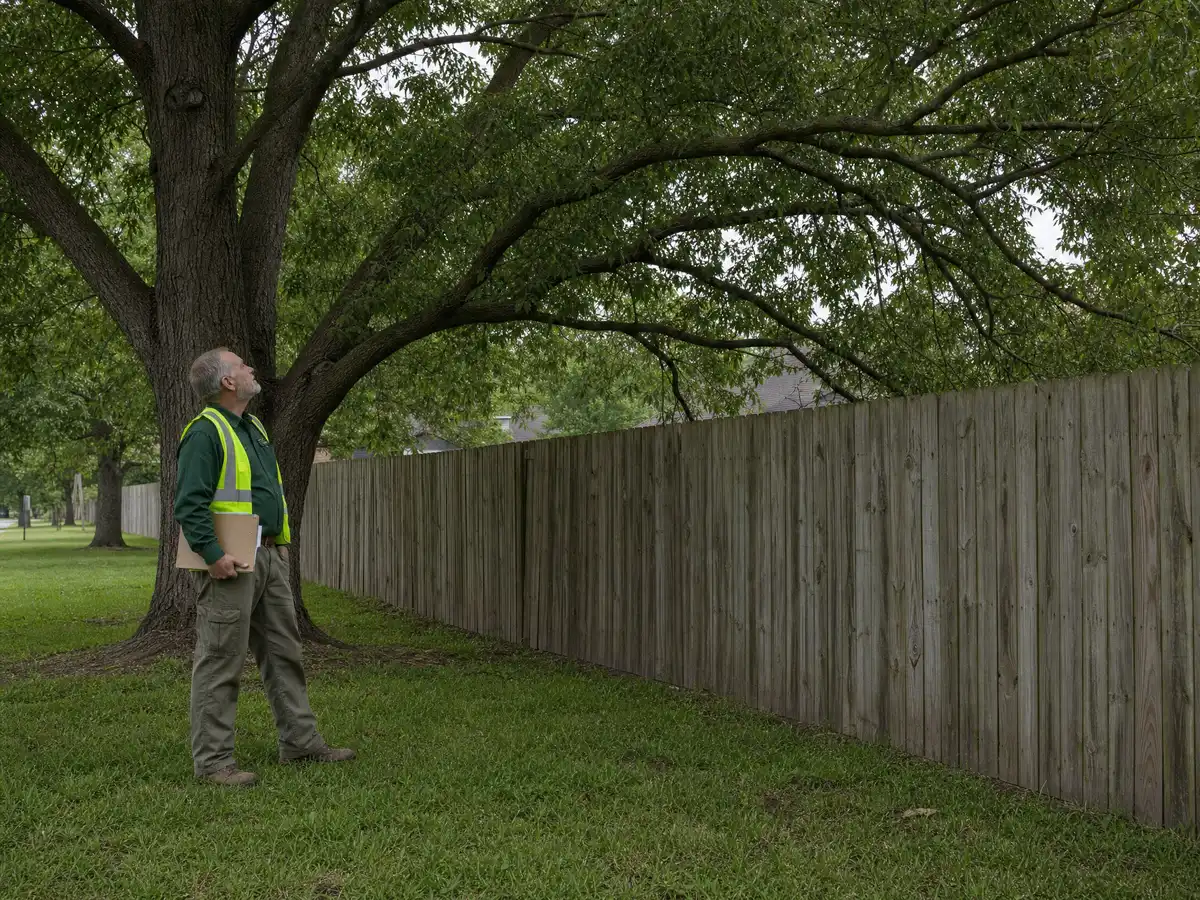
A protected tree sitting on the line where a required screening wall has to go is a genuine conflict between two rules. Garland writes down how it resolves; most cities leave it to be argued.
The Height Nobody Checked

Plano caps living screens and berm retaining walls at forty inches inside the required landscape edge. Higher screening has to sit further back, which is a layout constraint rather than a planting choice.
Garland Anticipates The Conflict
Most codes leave you to work out what happens when a preserved tree stands exactly where a required screening wall must go. Garland doesn’t.
Its Planning Director may permit removal of trees within a perimeter zone on a finding that includes their standing too close to a property line to allow placement of a fence or screening wall along that line. Other grounds in the same provision cover trees too close together and trees not healthy enough to survive a reasonable period.
That’s a city acknowledging its own rules can collide, and naming who decides. Worth knowing before designing around a tree that a screening requirement is going to remove anyway.
Height Is A Layout Question In Plano
Plano’s limits are positional rather than absolute, which catches people who read only the number.
Within the required landscape edge, living screens and retaining walls used for berming may not exceed forty inches. Screens, retaining walls and screening walls above forty inches but no greater than eight feet may be placed beyond the required landscape edge or the front yard setback, whichever is greater.
So the answer to “how tall can our screening be” is a question about where it sits, and the drawing decides it rather than the specification.
Get The Two Drawings To Agree
The practical failure is rarely a rule anybody broke. It’s a landscape plan showing a screen where the tree plan shows preserved trees, or a preserved tree exactly where a wall is drawn.
Both documents describe the same twenty feet of ground and they’re reviewed by different people. Comparing them before either is submitted takes an afternoon and removes the most predictable review comment either one will attract.
The Rest Of What The Rules Ask For
The provisions themselves, explained once rather than nine times: what counts as protected, what a permit is called here, and what has to exist before a tree comes out.
- Tree Ordinance Compliance Across Collin, Dallas And Denton Counties
- Tree Mitigation Plans And What A Removal Really Costs
- Tree Removal Permits And What Each City Actually Calls It
- What Counts As A Protected Tree And Where The Line Sits
- Tree Preservation Plans: What Goes In One And Who Signs It
- Tree Protection During Construction On Commercial Sites
- Paying A Fee Instead Of Planting Replacement Trees
- Who Approves A Tree Removal, And How A Refusal Is Appealed
- Perimeter Zones, Floodplain Limits And Protected Natural Areas
- Street Trees, Rights-Of-Way And Trees On Public Property
- Tree Due Diligence Before You Buy Or Lease A Site
- When Tree Work Belongs In A Construction Schedule
- Tree Rules On An Operating Property, With No Construction
- Ordinances Get Amended, And The Version Matters
- Tree Ordinance Rules In HOA Common Areas
- Screening, Buffers And The Trees That Have To Stay
- Putting Tree Protection In A Contractor Scope Of Work
- Parking Lots, Paving And The Trees Underneath Them
- Storm Removals And What The Ordinance Still Wants After
- Trees In Easements And Who Actually Controls Them
- Choosing Replacement Trees, And Why Species Caps Exist
- Tree Ordinance Terms, Translated Into Plain Language
- How To Find Out Which Tree Rules Apply To Your Site
- See All City Tree Ordinances