Skip To Content
  • Serving Plano and Collin, Dallas, and Denton Counties
(214) 668-8346
Two Legacy Tree Care arborists measuring the trunk of a mature oak with a diameter tape and checking it against a site plan, outside a commercial office building

Read From The Ordinance Itself

The Dallas Tree Ordinance, Explained For Commercial Property

Article X. The waiver is the whole game.

Dallas regulates trees through Article X, and it's the most demanding code in this market. It's also the only one here that hands most of your site back to you, if you understand the waiver.

(214) 668-8346

Crews dispatch in business hours.

Request A Property Walkthrough

Quick Walkthrough Request

Rather talk it through? (214) 668-8346.

  • Insured & Bonded
  • Serving the Plano Area Since 2005
  • Emergency Dispatch
  • Commercial Property Specialists

Dallas Isn’t Like The Suburbs Around It

Every other city in this market regulates trees with a threshold and a replacement ratio. Dallas regulates the whole property and then hands most of it back, and understanding that inversion is worth more than any other single fact about Article X.

The code is more demanding than anything in the surrounding suburbs. It protects more trees, defines damage more broadly, and takes pruning seriously enough to name it. It also contains the most generous relief mechanism in the market, and sites lose the benefit of it routinely by not knowing the arithmetic.

This page is Article X as approved by City Council on June 27, 2018, which is the most recent version the city’s own page records.

What Article X Protects

Three categories, and the differences between them decide what your site owes.

  • Protected At Eight Inches

    A Legacy Tree Care arborist holding a diameter tape around a large tree trunk while carrying a clipboard, at a commercial property

    Any species not on the unprotected list, at a minimum eight-inch diameter. Also a tree in a stand projecting canopy over a building site, and any tree planted as a replacement tree, which means yesterday’s mitigation becomes today’s obligation.

  • Significant, And Never Waived.

    A Legacy Tree Care climber working high in the union of a large tree while a second arborist tends the line from the ground, on a corporate campus

    Post oaks at twelve inches; cedar elm, pecan, green ash, the walnuts and all other oaks at twenty-four. The development waiver never applies to one, so a significant tree in the building pad carries its mitigation regardless.

  • Damage Counts As Removal

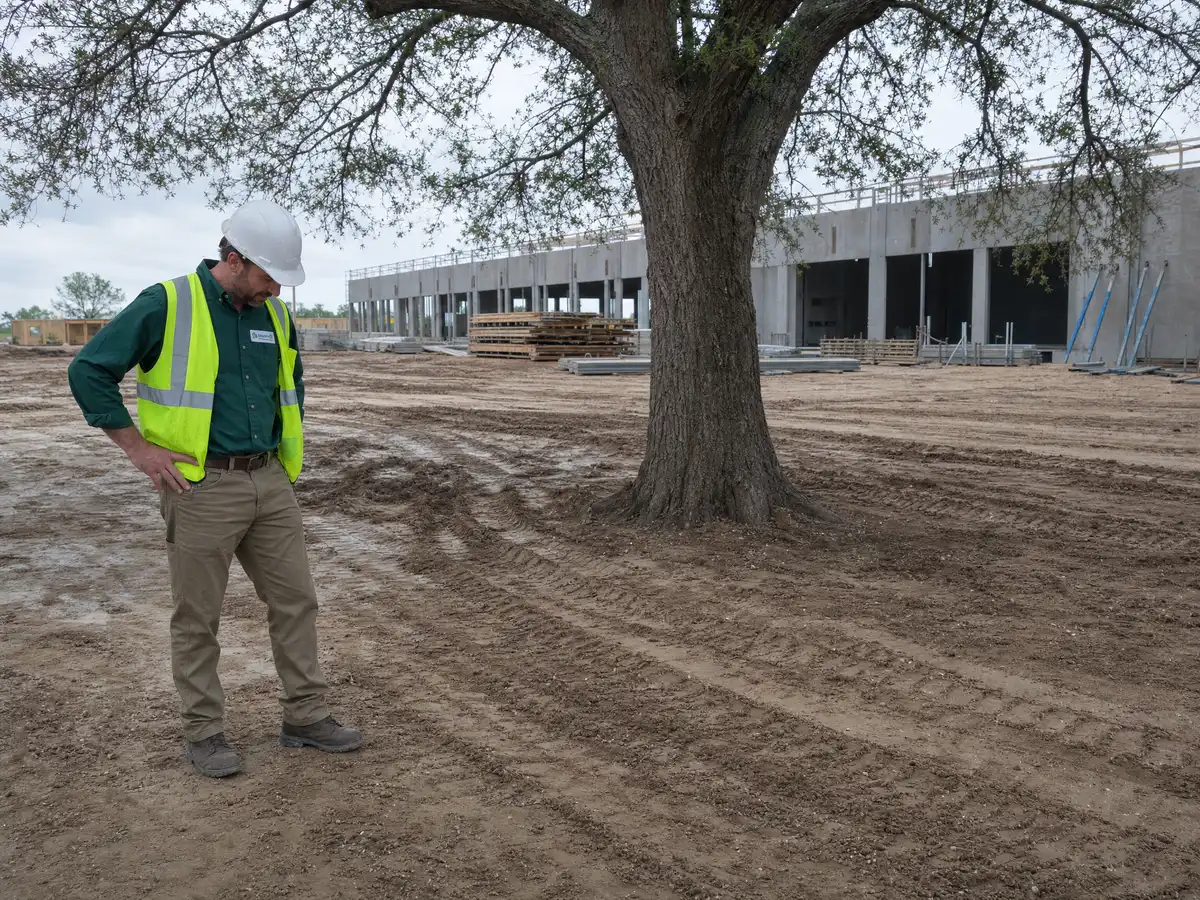
    A Legacy Tree Care arborist looking down at vehicle ruts compacted into bare soil across the root zone of a mature tree, on a construction site

    Article X counts damage as removal, and names soil compaction among the acts that qualify. That makes a haul route across a root zone a compliance question rather than a housekeeping one, on a site where nobody thought a tree had been touched.

The Waiver, And The Two Ways To Lose It.

Mitigation is waived for protected trees removed inside the development impact area. That’s the provision that makes building in Dallas viable, and it comes with limits that are arithmetic rather than judgment.

Seventy percent is the ceiling. The building official can’t waive mitigation for an area greater than seventy percent of the tree removal property, and past that it applies pro rata. The code works its own example: an eighty-five percent impact area means fifteen percent of the removed trees must be mitigated.

Surplus parking is the second leak, and it’s the one nobody expects. The waiver doesn’t extend to parking beyond what’s required, reduced pro rata on the excess. Again the code does the sum: four hundred and fifty spaces required against five hundred and twenty-one provided leaves 15.78 percent of the mitigation unwaived. Generous parking has a tree cost, and it’s calculable at design stage rather than discoverable at review.

Pruning Is A Code Matter Here

Every arborist will tell you topping is bad practice. In Dallas it’s also potentially a violation, which is a different conversation entirely.

Article X defines removing or seriously injuring a tree as an intentional or negligent act that will more likely than not cause it to decline and die within five years, and the listed examples include excessive pruning, topping and soil compaction. None of those look like removal on the day they happen. All of them can end a tree inside the five-year window the code cares about.

The practical consequence lands on construction sites. A trench through a root plate, a haul route compacting the root zone, or a crew “tidying” a retained tree can each satisfy that definition long after the machine that did it has left the site.

The Reforestation Fund

Mitigation can be met by payment into the Reforestation Fund rather than by planting. The director administers it to purchase trees for public property, to create and update an urban forest master plan, and to fund the staff managing that work.

On a dense infill site this is frequently the only workable route, because a large replacement obligation has to physically fit somewhere and an urban Dallas parcel often has nowhere to put it. Worth pricing at design stage rather than after a planting plan has been rejected for lack of room, which is the expensive order to discover it in.

The Instrument, City By City.

What each city actually uses to regulate a tree, taken from its own code. No two of these are the same document.

  • Plano

    Article 17 of the Zoning Ordinance. The preservation plan IS the permit, replacement runs inch for inch from 8 to 30 inches and 1.5:1 above that, and a fee in lieu is available with the Director's approval.

  • Frisco

    Subsection 4.01 of the Zoning Ordinance. A separate Tree Removal Permit, mitigation banded as a percentage of diameter removed from 0 to 300 percent, and a survey needing two seals rather than one.

  • Garland

    A Tree Management Plan plus Removal Authorization, class-based replacement ratios from 2:1 down to 0.25:1, and a civil penalty of $250 per diameter inch.

  • Allen

    Land Development Code Article VII. A credit ledger rather than a ratio, where removal costs exactly double what preservation earns, and a 90 day clock on the permit.

  • McKinney

    Unified Development Code Article 4. Three protected tiers, mitigation doubling above 17 inches, and a perimeter zone beside existing housing where protected trees may not be altered at all.

  • Carrollton

    Chapter 155. Replacement at 100 percent of the diameter removed, clear-cutting prohibited outright, and a survival obligation running two years past the end of the project.

  • Wylie

    Zoning Ordinance Article 7. Enforced criminally as a misdemeanor at $100 per caliper inch, and protection is defined to exclude trees standing in easements, rights-of-way or the buildable area.

  • Richardson

    No private-property tree ordinance at all. The tree chapter covers public trees only, which makes documentation the owner's protection rather than the city's.

  • See All City Tree Ordinances

Frequently Asked Questions

The Landscape and Tree Conservation Regulations as approved by City Council on June 27, 2018. The city's own Article X page lists that approval as the most recent and no amendment after it, which is as far as currency can be confirmed from outside: the codified current text sits on American Legal, which blocks automated access. Before anything is filed on a specific site, check the codified version for changes since.

Any tree of a species not on the unprotected list, with a minimum eight-inch diameter. Two additions catch people out: a tree in a stand projecting canopy over a building site counts, and so does any tree that was itself planted as a replacement tree. That last one means yesterday's mitigation planting becomes today's protected tree.

Possibly not, and Dallas is unusually explicit about it. The article lists unprotected species including Callery pear, chinaberry, Chinese tallow, tree-of-heaven, all palms, and Ilex species other than yaupon and possumhaw holly. Establishing what's on a site before assuming everything counts is frequently the cheapest hour on the project.

A higher category with its own threshold, and the practical point is that the development waiver never applies to one. Post oaks qualify at twelve inches; American elm, bois d'arc, cedar elm, chittamwood, common persimmon, eastern red cedar, green ash, pecan, the walnuts, white ash and all other oaks qualify at twenty-four. A significant tree in the middle of your building pad is a mitigation obligation regardless of the footprint.

It can, and Dallas is the only city in this market that says so explicitly. Article X defines removing or seriously injuring a tree as an intentional or negligent act that will more likely than not cause it to decline and die within five years, and names excessive pruning, topping and soil compaction among the acts that qualify. Topping a protected tree is therefore a code matter rather than an aesthetic argument.

Mitigation is waived for trees removed inside the development impact area, up to seventy percent of the tree removal property. Past that it applies pro rata: the code's own example is that an eighty-five percent impact area means fifteen percent of removed trees must be mitigated. It's a genuine relief mechanism rather than a technicality, and it's the single most valuable provision on a Dallas commercial site.

Yes, and this is where sites lose the benefit without noticing. The waiver doesn't extend to parking beyond what's required, and the reduction is pro rata on the excess. The code works it through: four hundred and fifty spaces required against five hundred and twenty-one provided means 15.78 percent of the mitigation isn't waived. Designing in surplus parking has a tree cost attached to it.

Yes. Mitigation may be met by payment into the Reforestation Fund, which the director administers to plant trees on public property and to fund urban forest work. On a dense infill site with nowhere to put replacement stock this is often the only workable route, and it's worth pricing early rather than discovering it after a planting plan has been rejected for lack of room.

Where To Start

Three Ways To Settle The Compliance Question

Ordinance work usually has a date attached, and what closes it out is a document rather than a conversation.

Something Is Wrong Now

Call. You'll reach a person at any hour. We respond immediately during business hours, and first thing the next morning if you call overnight.

(214) 668-8346

You Want To Know What You Have

An arborist walks the property and documents what is standing on it, which is the record a permit application or a mitigation calculation gets built on.

Request A Walkthrough

Nothing Is Wrong Yet

Get on file before the season. Properties we already hold move faster on a storm night, because the crew isn't spending the first hour learning the site.

Set Up A Vendor Agreement

Commercial property only, fully responsible for the outcome, and we call 15 to 30 minutes before we arrive. The insurance clears before a truck moves. (214) 668-8346.

Request A Walkthrough

Tell Us About The Property

We'll walk the site, put the condition of every tree in writing, and give you a scope you can take to a board or a budget meeting. No obligation, and no pressure to decide on the spot.

If a limb is down or a lane is blocked right now, calling is faster than a form.

Call (214) 668-8346

  • Insured & Bonded
  • Serving the Plano Area Since 2005
  • Emergency Dispatch
  • Commercial Property Specialists

Send Us The Details

Tell us the property type and what you're seeing. We'll come back with next steps.

Request A Property Walkthrough
A limb over the entrance, a tree that looks unwell, a permit deadline, storm cleanup, an annual contract you want quoted, or getting set up as a pre-approved vendor before storm season.
Request A Walkthrough Call Now