

The Cycle Does The Work, Not The Visit.
Commercial pruning gets bought reactively. A limb hangs low over a fire lane, a tenant complains about a sightline, or a branch comes down in a storm, and somebody calls for a crew.
That pattern produces the worst version of this work. Long gaps mean large cuts, large cuts mean large wounds, and a tree that gets a heavy reduction every several years accumulates exactly the decay pockets and weak regrowth that eventually justify removing it.
A tree on a sensible cycle is pruned lightly, often, and cheaply. The individual visit costs less and the tree lasts longer, which is an unusual combination and the reason this page opens the way it does.
What The Four Operations Actually Are
“Trimming” isn’t a specification, and quotes that say only that are impossible to compare. The work divides into four named operations, and a scope should say which ones apply.
| Operation | What It Does |
|---|---|
| Crown cleaning | Removal of dead, dying, diseased and broken wood. The lowest-risk work on this list and usually the highest value per dollar on an occupied site |
| Crown thinning | Selective removal of live branches to reduce density. Easy to overdo, and overdone is where most long-term damage comes from |
| Crown raising | Removal of lower branches for clearance over lanes, walkways, signage and vehicles. The operation most commercial sites actually need |
| Crown reduction | Reducing height or spread using cuts back to appropriate lateral branches. The most demanding of the four and the one most often done badly |
Topping isn’t on that list and never will be. It isn’t a fifth technique, it’s the absence of one.
Where Pruning Becomes A Regulatory Question
Most owners assume ordinances care about removals. Several of the cities we work in treat damage as equivalent, and pruning is one of the ways damage happens.
Dallas defines a causation standard covering acts more likely than not to cause a tree to decline and die within five years, and it names excessive pruning and topping expressly. Elsewhere, injuring a protected tree can carry the same penalty per diameter inch as removing it.
Which means a cheap crew with a heavy hand isn’t only an arboricultural problem on a protected tree. It’s a mitigation obligation that arrives later, on a tree nobody removed. What each city actually requires is worth establishing before scheduling work on protected trees.
Three Ways Commercial Pruning Goes Wrong
None of these look like mistakes at the time. All three are visible from the ground afterwards.
Cut Hard, Then Left Alone.
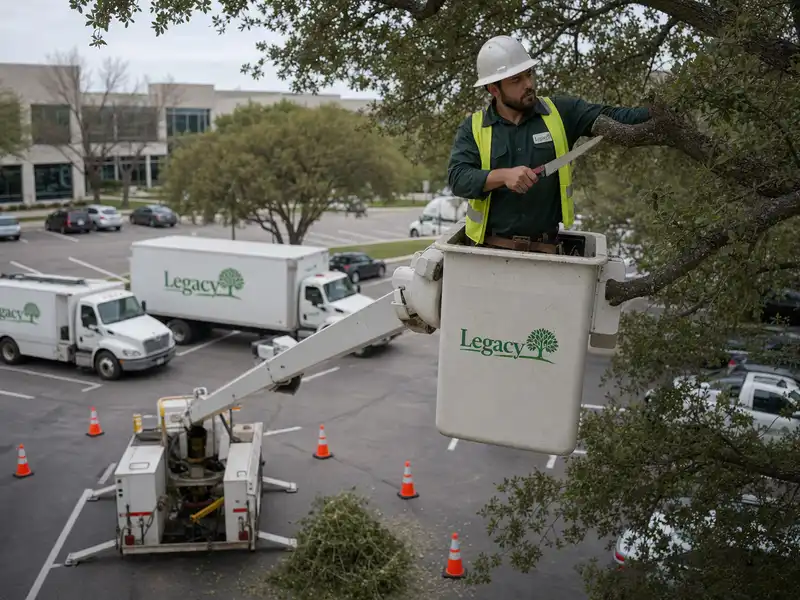
A heavy reduction every several years costs more per visit and leaves larger wounds than light work on a shorter cycle. The saving is imaginary and the decay isn’t.
Structure Left Until It's Expensive

A competing stem removed at eight years is one small cut. The same defect at twenty-five is a cabling job, and at forty it’s a failure over whatever is parked underneath.
Clearance Chased One Side

Repeatedly raising one face of a canopy for a lane or a sign leaves a lopsided crown loaded away from the cuts. The clearance problem is solved and a lever has been built.
How Often Is Honest
There’s no single interval, and anyone quoting one without seeing the trees is selling a schedule rather than assessing a property.
What can be said generally: young trees benefit from a shorter cycle than most managers expect, often every two to three years, because the work at that age is structural and the cuts are small. Mature trees on established property usually move to a longer cycle, with crown cleaning as the recurring item and anything heavier driven by condition rather than by the calendar.
Species matters too. Oaks in this region carry a real seasonal constraint because of oak wilt transmission risk, so pruning them is a timing decision rather than a scheduling convenience.
What A Comparable Quote Contains
Commercial pruning quotes vary more in scope than in price, which makes the cheapest number difficult to interpret.
A quote worth comparing names which of the four operations are included, on which trees, to what clearance, and to what standard. It says whether debris and chip cleanup are in the price. It states insurance and who is credentialed on site. And it says when the work happens, because on occupied property the timing is part of the cost.
Ours are written that way so they can be set beside anybody else’s line by line. That’s harder to do in this trade than it sounds.
Working Around Tenants
On an operating commercial property the pruning is rarely the hard part. Access is.
Dropping a lane, staging a chipper, and keeping people away from a work area beneath a canopy all have to happen without stopping the business underneath. Early mornings, weekends and overnight work are normal for us and are priced into the quote rather than added to it afterwards.
We call 15 to 30 minutes before we arrive, every time. It sounds small and it’s the difference between a manager who can move two cars and warn a tenant, and one who finds out a crew is on site when somebody complains about it.
The cost worth comparing isn’t the crew hour. It’s the crew hour set against what a closed lane or a blocked entrance costs you during trading time.
The Rest Of What We Do
Eleven services for commercial property. Most sites need two or three.