Skip To Content
  • Serving Plano and Collin, Dallas, and Denton Counties
(214) 668-8346
Two Legacy Tree Care arborists measuring the trunk of a mature oak with a diameter tape and checking it against a site plan, outside a commercial office building

Read From The Ordinance Itself

The Carrollton Tree Ordinance, Explained For Commercial Property

No clear-cutting. And the clock runs past handover.

Carrollton replaces at one hundred percent of the diameter removed, prohibits clear-cutting outright, and keeps you responsible for preserved trees for two years after the project ends.

(214) 668-8346

Crews dispatch in business hours.

Request A Property Walkthrough

Quick Walkthrough Request

Rather talk it through? (214) 668-8346.

  • Insured & Bonded
  • Serving the Plano Area Since 2005
  • Emergency Dispatch
  • Commercial Property Specialists

One Hundred Percent, Whatever The Size.

Most cities in this market band their replacement ratio, so what you owe depends on which size bracket a tree falls into. Carrollton doesn’t. Replacement is one hundred percent of the diameter removed, at every size.

What changes with size is the stock you have to plant it in. A 4 to 12 inch DBH tree is replaced at minimum three-inch caliper, greater than 12 up to 30 inches at minimum four-inch, and above 30 inches at minimum six-inch.

That makes Carrollton the easiest ordinance in this market to budget, because the percentage never moves. It also removes the timing game entirely: there’s no threshold to stay under, so no advantage in removing a tree before it grows into a worse band.

Three Provisions That Decide The Project

None of them is about the size of a tree, which is where most attention goes.

  • No Clear-Cutting At All

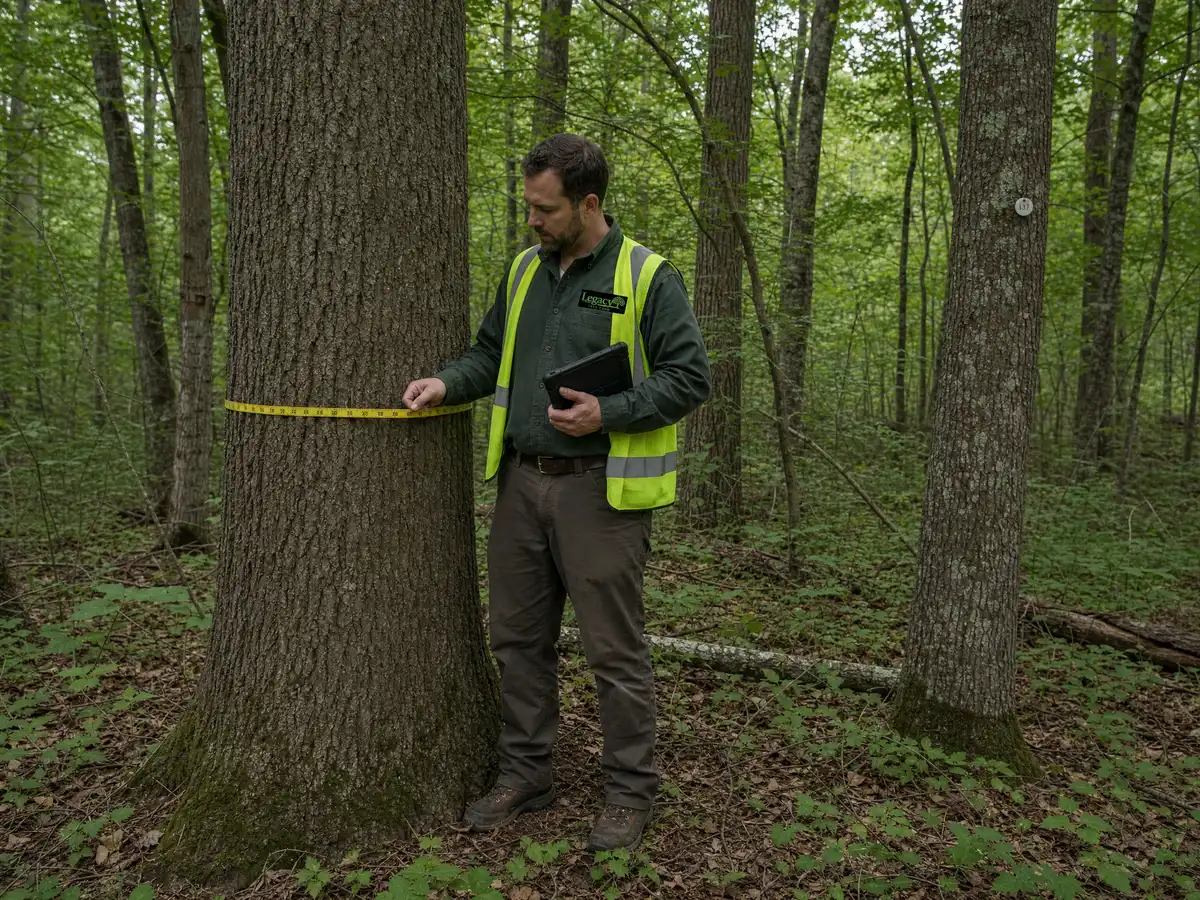
    A Legacy Tree Care arborist measuring a tree trunk with a diameter tape while holding a tablet, among dense woodland on undeveloped land

    Chapter 155 opens with it: no clear-cutting of land is allowed. Not a threshold, not a ratio, a prohibition. Any approach that starts by clearing and sorts the trees out afterwards is unavailable here.

  • Damaging Counts As Removal

    A Legacy Tree Care arborist kneeling beside an open trench where cut root ends are exposed in the soil face, next to a mature tree on a construction site

    No person may cut down, destroy, remove or move, or effectively destroy through damaging, any tree without a permit. The trench and the haul route are covered by the same sentence as the saw.

  • Two Years Past Handover

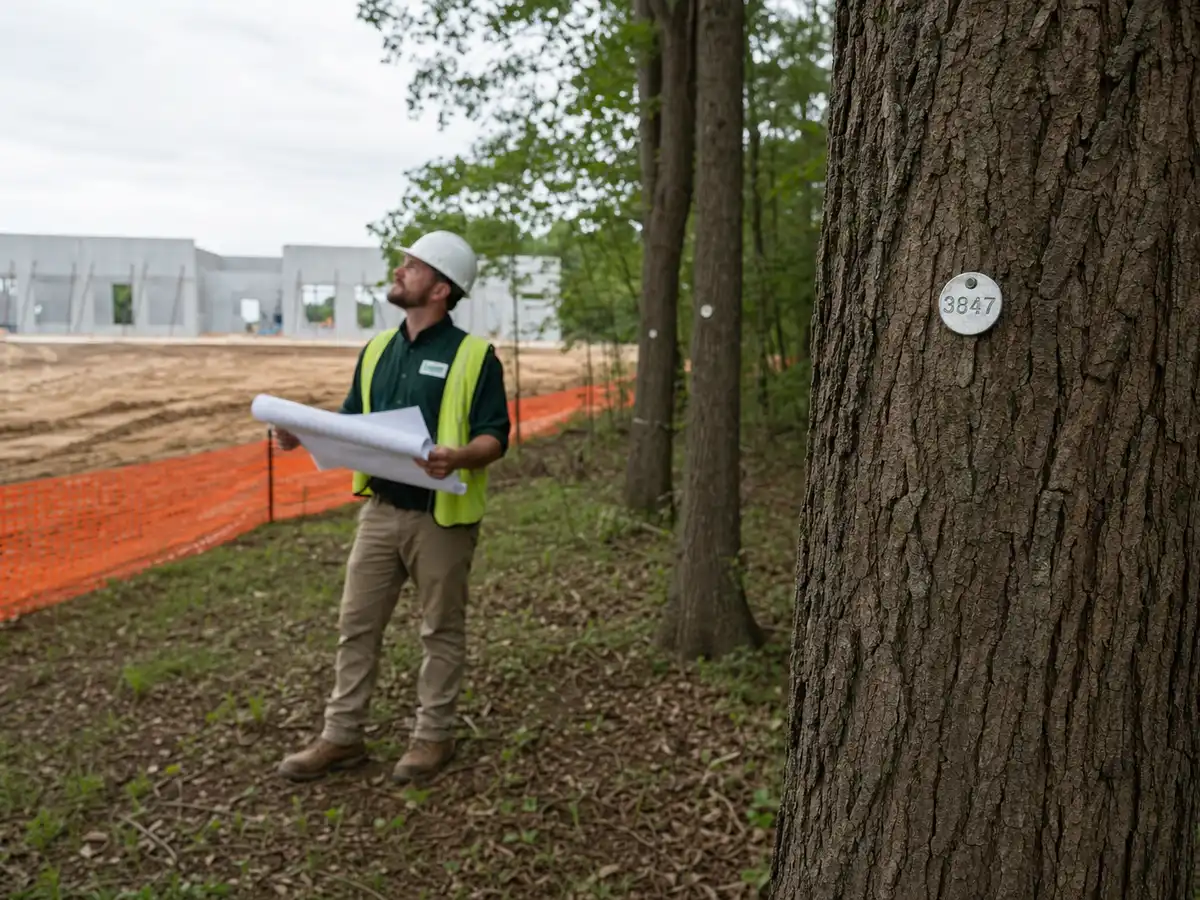
    A numbered metal survey tag on a tree trunk, with a Legacy Tree Care arborist behind holding an open site plan and looking up into the canopy at a construction site

    A tree identified on the Tree Preservation Plan that dies within two years from the end of the project has to be replaced. The obligation outlives the contractor’s involvement by a comfortable margin.

The Two-Year Clause Is The Expensive One

Read quickly, it sounds like it covers the trees you planted. It also covers the trees you kept, which is a much larger exposure.

The replacement is owed at the same one hundred percent of diameter, and it’s sized on the tree that died rather than on anything you chose. So a mature specimen preserved on paper, damaged during construction and lost eighteen months later becomes an obligation sized on exactly the tree you were trying to save.

That timing isn’t arbitrary and it isn’t generous. Construction damage kills slowly: a compacted root zone or a severed root plate typically shows as thinning canopy and dieback one to three years afterwards. Two years lands squarely inside the window where the damage becomes visible, which is presumably the point.

Practically, it means protection during the build isn’t a box to tick for the inspection. It’s the thing standing between you and a bill that arrives after everyone has demobilized.

The Permit Never Travels Alone

A Carrollton tree removal permit isn’t a standalone application you can file when you get to it. Chapter 155 ties it to whatever else is happening: a development permit to fill or grade, a plat application, or on already-platted property a new construction permit or a zoning case.

It also has to be submitted in conjunction with a Tree Preservation Plan.

The effect is that the tree question arrives with the development rather than behind it, which is helpful if you planned for it and expensive if you didn’t. There’s no point in the process where trees are a separate conversation you can have later with somebody else.

Where The Replacements Go

Replacement trees are to be located on the subject site whenever possible. Where there’s genuinely no suitable location, the City Manager or designee may approve an alternative, and one of those is payment into the Tree Restoration Fund.

The city uses that fund for planting on public rights-of-way, park land and other municipally-owned property, and it must be spent within two years of the Council’s action on the request.

One constraint worth planning around before ordering stock: no more than 34 percent of the replacement trees may be of the same species when 12 or more are required. On a large obligation that rules out the cheapest option, which is one species bought in bulk, and it wants deciding at design stage rather than at the nursery.

The Instrument, City By City.

What each city actually uses to regulate a tree, taken from its own code. No two of these are the same document.

  • Plano

    Article 17 of the Zoning Ordinance. The preservation plan IS the permit, replacement runs inch for inch from 8 to 30 inches and 1.5:1 above that, and a fee in lieu is available with the Director's approval.

  • Frisco

    Subsection 4.01 of the Zoning Ordinance. A separate Tree Removal Permit, mitigation banded as a percentage of diameter removed from 0 to 300 percent, and a survey needing two seals rather than one.

  • Dallas

    Article X, Landscape and Tree Conservation. Protected at 8 inches, mitigation waived across the development footprint up to 70 percent of the site, and topping defined and regulated by name.

  • Garland

    A Tree Management Plan plus Removal Authorization, class-based replacement ratios from 2:1 down to 0.25:1, and a civil penalty of $250 per diameter inch.

  • Allen

    Land Development Code Article VII. A credit ledger rather than a ratio, where removal costs exactly double what preservation earns, and a 90 day clock on the permit.

  • McKinney

    Unified Development Code Article 4. Three protected tiers, mitigation doubling above 17 inches, and a perimeter zone beside existing housing where protected trees may not be altered at all.

  • Wylie

    Zoning Ordinance Article 7. Enforced criminally as a misdemeanor at $100 per caliper inch, and protection is defined to exclude trees standing in easements, rights-of-way or the buildable area.

  • Richardson

    No private-property tree ordinance at all. The tree chapter covers public trees only, which makes documentation the owner's protection rather than the city's.

  • See All City Tree Ordinances

Frequently Asked Questions

A tree removal permit, and the prohibition is drawn widely: no person may cut down, destroy, remove or move, or effectively destroy through damaging, any tree without one. That phrase about damaging matters on a construction site, because it means the regulated act includes ending a tree slowly rather than only felling it.

Alongside something else, always. Chapter 155 ties it to a development permit to fill or grade, to a plat application, or on already-platted property to a new construction permit or a zoning case. It also has to be submitted in conjunction with a Tree Preservation Plan, so the tree question arrives with the development rather than after it.

One hundred percent of the diameter removed, at every size. What changes with size is the minimum stock: a 4 to 12 inch DBH tree is replaced with minimum three-inch caliper, greater than 12 up to 30 inches with minimum four-inch, and above 30 inches with minimum six-inch. The percentage never moves, which makes Carrollton unusually easy to budget compared with cities that band the ratio.

No. Chapter 155 opens the preservation section with a flat statement that no clear-cutting of land is allowed. That isn't a threshold or a ratio, it's a prohibition, and it applies before any construction or development on a site containing protected trees.

For two years, yes. Replacement trees are required both to remove a protected tree and to replace a tree identified on a Tree Preservation Plan that dies within two years from the end of the project. Construction damage usually kills slowly, and two years is comfortably inside the window where a compacted root zone or a severed root plate shows up as decline.

Not where the obligation is large. No more than 34 percent of the replacement trees may be of the same species when 12 or more are required, unless the City Manager or designee approves otherwise. On a big mitigation that rules out the cheapest approach, which is a single species bought in bulk.

Replacement trees are to be located on the subject site whenever possible, and where there's no suitable location the City Manager or designee may approve an alternative. One of those routes is payment into the Tree Restoration Fund, which the city uses for planting on rights-of-way, park land and other municipal property, and which must be spent within two years of the Council's action on the request.

There's a route, and it runs through the permit rather than around it: permits may be issued with verification that the protected tree is damaged or diseased. Verification is the operative word, which means the condition needs establishing by somebody qualified before the saw arrives rather than asserted afterwards.

Where To Start

Three Ways To Settle The Compliance Question

Ordinance work usually has a date attached, and what closes it out is a document rather than a conversation.

Something Is Wrong Now

Call. You'll reach a person at any hour. We respond immediately during business hours, and first thing the next morning if you call overnight.

(214) 668-8346

You Want To Know What You Have

An arborist walks the property and documents what is standing on it, which is the record a permit application or a mitigation calculation gets built on.

Request A Walkthrough

Nothing Is Wrong Yet

Get on file before the season. Properties we already hold move faster on a storm night, because the crew isn't spending the first hour learning the site.

Set Up A Vendor Agreement

Commercial property only, fully responsible for the outcome, and we call 15 to 30 minutes before we arrive. The insurance clears before a truck moves. (214) 668-8346.

Request A Walkthrough

Tell Us About The Property

We'll walk the site, put the condition of every tree in writing, and give you a scope you can take to a board or a budget meeting. No obligation, and no pressure to decide on the spot.

If a limb is down or a lane is blocked right now, calling is faster than a form.

Call (214) 668-8346

  • Insured & Bonded
  • Serving the Plano Area Since 2005
  • Emergency Dispatch
  • Commercial Property Specialists

Send Us The Details

Tell us the property type and what you're seeing. We'll come back with next steps.

Request A Property Walkthrough
A limb over the entrance, a tree that looks unwell, a permit deadline, storm cleanup, an annual contract you want quoted, or getting set up as a pre-approved vendor before storm season.
Request A Walkthrough Call Now