

Mitigation Is Where The Money Actually Is
Permits get the attention. Mitigation gets the invoice.
The permit is a process question: what to submit and how long it takes. Mitigation is an arithmetic question, and the arithmetic is set by a city ordinance that stops at the city line. Two identical office parks eight miles apart, same trees, same removal, can carry obligations that differ by a factor of three.
What follows is how each of the nine cities in our service area computes it. Every line came from that city’s own code.
Nine Cities, Nine Formulas.
| City | How Mitigation Is Computed |
|---|---|
| Plano | Inch for inch from 8 to 30 inches, then 1.5:1 above 30. The preservation plan is the permit |
| Frisco | A percentage of diameter at DBH, banded at 0, 100, 150 and 300% for the largest trees |
| Garland | Class-based ratios by species, from 2:1 down to 0.25:1 |
| Carrollton | 100% of the DBH removed, with replacement stock scaling 3, 4 and 6 inches |
| Allen | A credit ledger rather than a ratio. You owe only if the net goes negative |
| McKinney | 1:1 up to 16 inches, 1:2 from 17 inches and above |
| Dallas | Ratio-based, but a waiver covers the build footprint and is capped at 70% of the site |
| Wylie | No ratio at all. Enforcement is criminal, at $100 per caliper inch on conviction or equivalent replacement |
| Richardson | Nothing to compute. There’s no private-property regime to mitigate against |
No two of those are the same instrument, and that’s not a quirk of how the table is written. Ratios, percentages, ledgers, species classes and criminal penalties are five genuinely different ways of pricing the same act.
The Inch That Doubles What You Owe
Two cities step their obligation up at a single diameter, and both steps are knowable from a tape measure before anything is decided.
Measured Before It's Decided

Diameter is the input to every formula on this page. Garland steps up at eighteen inches and McKinney’s ratio doubles at seventeen, and McKinney rounds fractions to the nearest whole number, so sixteen and a half counts as seventeen.
The Exemption List First
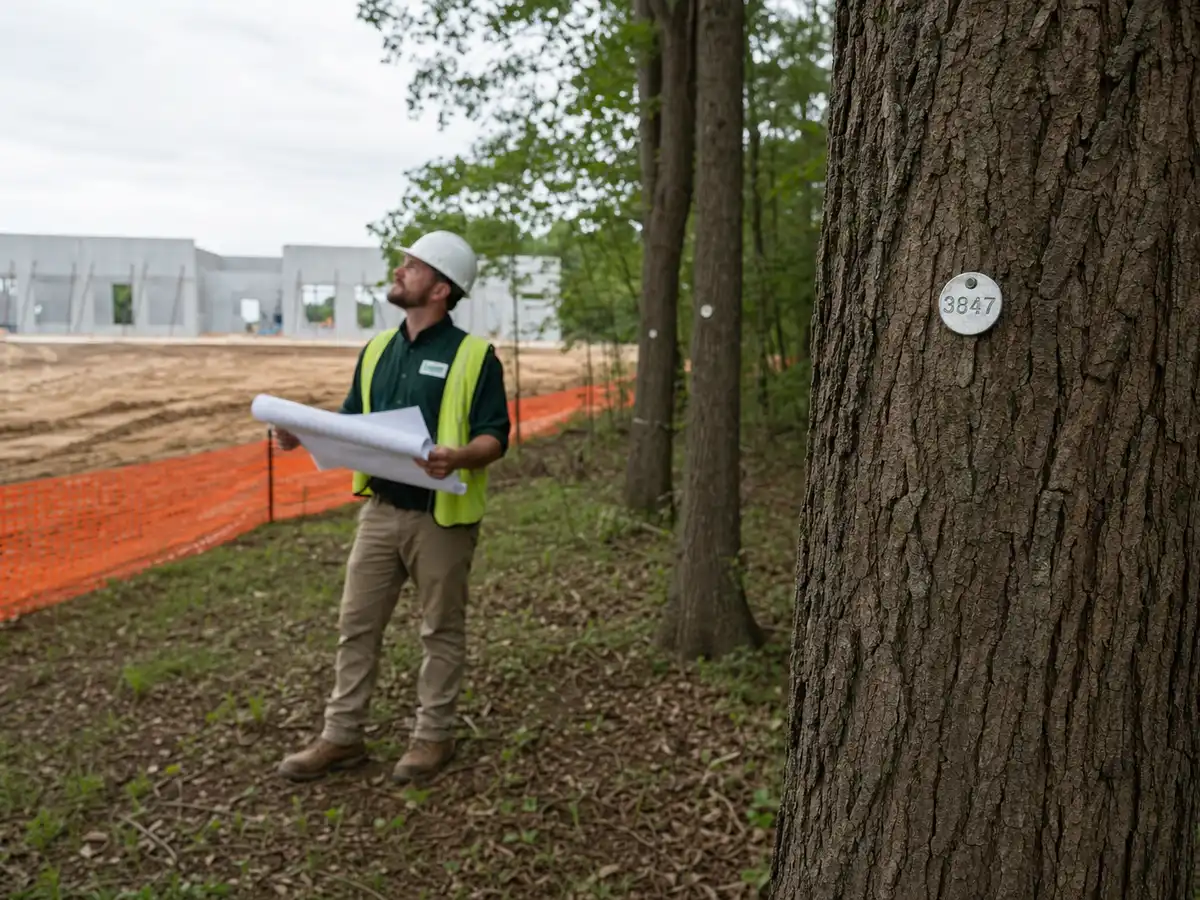
On most commercial sites the exemptions move the number further than the ratio does. Which trees fall outside protection, and where the development footprint sits, usually decides more of the bill than the multiplier applied to what’s left.
Planted And Then Kept Alive

The obligation doesn’t end at planting. Carrollton carries two years past project completion, Allen three under a mitigation agreement, and Dallas makes the replacement a protected tree in its own right.
The Waivers Are Worth More Than The Ratios
Dallas is the clearest case. It waives mitigation across the development impact area, which sounds generous until you read the limits, and the limits are where commercial sites land.
The building official can’t waive mitigation for more than 70% of the tree removal property. Past that it applies pro-rata, and the code carries its own worked example: at an 85% impact area, 15% of the trees removed must be mitigated. Non-required parking is excluded on the same basis, with a second worked example of 450 spaces required against 521 provided. And the waiver never reaches a significant tree.
McKinney gets to a similar place by a different route. Its exemptions are broad enough that commercial mitigation cost is driven almost entirely by its largest specimen trees and by whatever sits outside the footprint. Wylie doesn’t exempt so much as define around it: trees in easements, rights-of-way and the buildable area of a lot fall outside the protected set to begin with.
Read the carve-outs before the multiplier. A 2:1 ratio on trees that turn out to be exempt costs nothing, and a 1:1 ratio on a site with no waiver available costs a great deal.
Injuring A Tree And Removing One Aren’t Different Things
Four of these cities write injury into the same prohibition as removal, which catches sites that never intended to remove anything at all.
Garland’s civil penalty of two hundred and fifty dollars per diameter inch applies to a tree removed or injured, and it names failing to comply with tree protection as the trigger. Wylie’s misdemeanor provision covers a tree that dies from a failure to follow required protection measures. Dallas goes furthest, with a five-year decline standard that expressly includes topping and soil compaction.
Which means the trench that severed a root plate and the compaction under a laydown yard are both mitigation events, eighteen months later, when the tree finally shows it.
What A Mitigation Plan Has To Show
The document itself isn’t complicated once the measurements exist: what’s there, what’s going, what the ordinance charges for it, and what settles the obligation. The work is in the inputs, not the format.
That means diameters measured rather than estimated, species identified accurately enough to survive a class-based ratio, the footprint drawn against the trees rather than the other way around, and the exemption list applied before anything is priced.
Do that at design stage and mitigation becomes a figure you plan around. Do it after the permit condition arrives and it becomes the thing that moves the schedule.
The Rest Of What The Rules Ask For
The provisions themselves, explained once rather than nine times: what counts as protected, what a permit is called here, and what has to exist before a tree comes out.
- Tree Ordinance Compliance Across Collin, Dallas And Denton Counties
- Tree Mitigation Plans And What A Removal Really Costs
- Tree Removal Permits And What Each City Actually Calls It
- What Counts As A Protected Tree And Where The Line Sits
- Tree Preservation Plans: What Goes In One And Who Signs It
- Tree Protection During Construction On Commercial Sites
- Paying A Fee Instead Of Planting Replacement Trees
- Who Approves A Tree Removal, And How A Refusal Is Appealed
- Perimeter Zones, Floodplain Limits And Protected Natural Areas
- Street Trees, Rights-Of-Way And Trees On Public Property
- Tree Due Diligence Before You Buy Or Lease A Site
- When Tree Work Belongs In A Construction Schedule
- Tree Rules On An Operating Property, With No Construction
- Ordinances Get Amended, And The Version Matters
- Tree Ordinance Rules In HOA Common Areas
- Screening, Buffers And The Trees That Have To Stay
- Putting Tree Protection In A Contractor Scope Of Work
- Parking Lots, Paving And The Trees Underneath Them
- Storm Removals And What The Ordinance Still Wants After
- Trees In Easements And Who Actually Controls Them
- Choosing Replacement Trees, And Why Species Caps Exist
- Tree Ordinance Terms, Translated Into Plain Language
- How To Find Out Which Tree Rules Apply To Your Site
- See All City Tree Ordinances