

The Canopy Went In With The Office Corridor
Richardson’s residential growth ran through the 1970s and slowed in the 1980s. Its commercial development increased throughout the 1980s. The population tells the same story from another angle: about 1,300 people in 1950, roughly 56,000 by 1972, and 74,840 by 1990.
So the trees on a Richardson office park went in with the office park, and most of them are now around forty years old. Canopy age decides what the work actually is, and forty is the age at which a codominant union that has been fine since 1987 becomes a real question, root plates begin to move, and a tree planted three feet from a curb has run out of room.
This is the opposite of the newer cities north of here. In Frisco the job is establishing young trees properly. In Richardson the job is deciding, tree by tree, which of the mature ones are worth keeping and what it takes to keep them.
A City That Fills Up During The Day
Richardson has around 119,000 residents. Its daytime population was measured at 156,065 by the North Central Texas Council of Governments, which is more people on the ground at midday than live here.
They arrive at the Telecom Corridor, where more than 5,000 businesses operate inside 28 square miles. State Farm employs around 8,000 people here, AT&T around 5,000, Blue Cross and Blue Shield of Texas about 3,100, and UT Dallas about 2,674. Fossil, Lennox International, RealPage, Samsung Mobile and Fujitsu’s US network arm are all headquartered in the city.
That changes the risk arithmetic rather than the biology. The same defective limb over an empty lot and over a State Farm parking lot at 8am aren’t the same problem, and the difference is who is underneath it. Occupancy is why campus work here gets scheduled around people rather than around the crew.
Nothing Stops You Removing A Tree Here
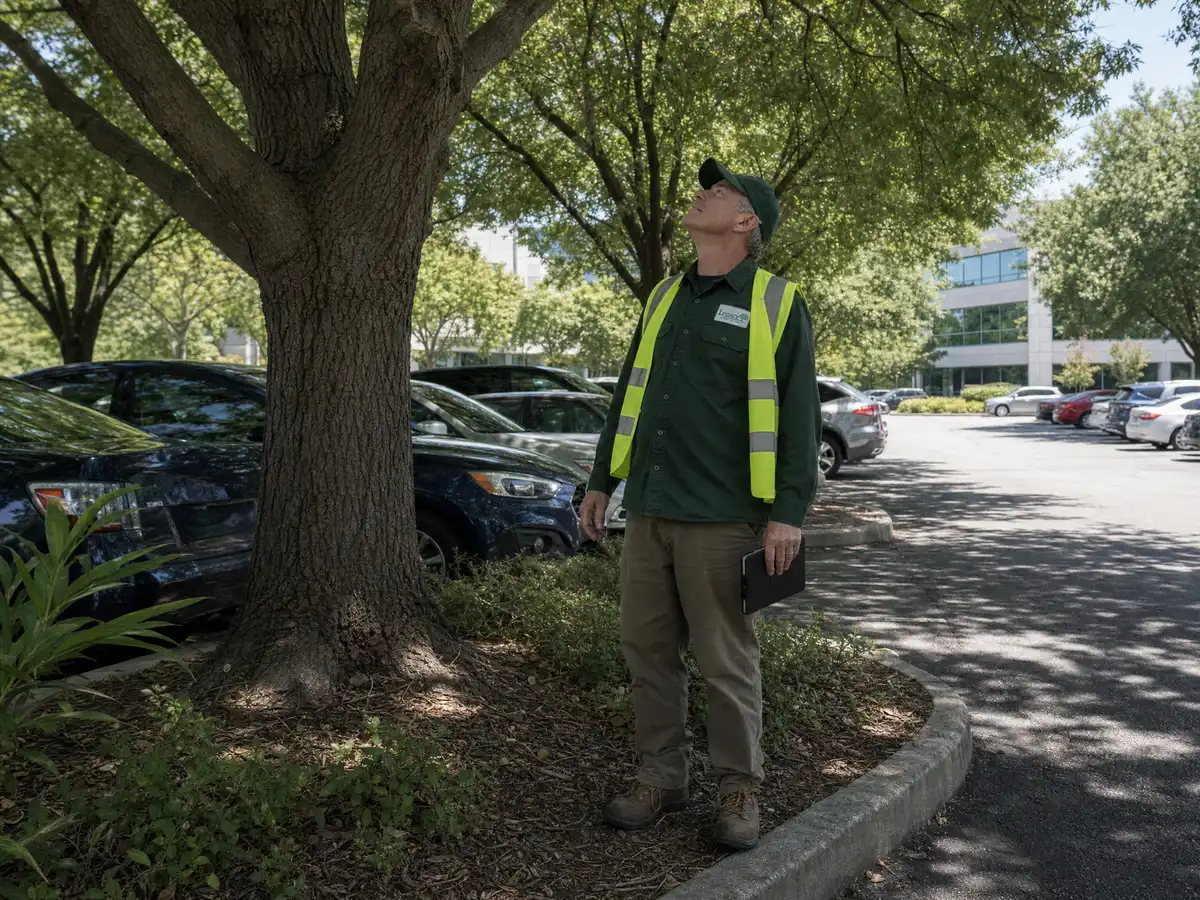
Richardson is the one city we cover with no tree permit regime for commercial property. Plano has Article 17, Garland has Article 4, Frisco won’t approve a removal without a survey. Here, a healthy forty year old tree can be taken down on Monday because it dropped leaves on Friday, and no one at the city will ask.
That sounds like freedom and mostly functions as a trap, for two reasons.
The first is that the restraint has to come from the owner. In cities with a permit, the process itself forces somebody to look at the tree and write down what it is. Remove that and nothing external prompts anyone to look until a tree is already a problem.
The second is that no permit isn’t the same as no liability. Nothing about the absence of a city process changes what’s expected of a property owner who knew, or should have known, that a tree was defective. We have a separate page on exactly what fills the gap here, and it’s worth reading before assuming the absence of rules means the absence of exposure.
Redevelopment Is Happening On Top Of It
The other thing that makes Richardson unusual is that the city is actively rebuilding its commercial core, and has published where.
There are three tax increment financing districts. The first, created in 2006, runs along both sides of the US 75 corridor from Campbell Road south to Spring Valley Road, then west along Spring Valley toward Coit. Two more, created in 2011, sit between the President George Bush Turnpike and Renner Road on either side of the DART line. Galatyn Park and CityLine both came out of this, and the DART Silver Line added stations at UT Dallas and CityLine.
Redevelopment and a mature canopy is the collision that defines commercial tree work here. Trees old enough to be failing anyway, on sites where somebody is about to trench, regrade and repave around them. A root plate that has been quietly moving for a decade doesn’t need much help.
The Ground It All Sits On
Worth knowing on any North Texas commercial site. Richardson is on the Blackland Prairie, and per the USDA soil series description for Houston Black, the Texas state soil, this ground has high shrink-swell potential, with cracks half an inch to four inches wide at a foot down that stay open 90 to 150 days in most years.
The same document lists the native vegetation as tallgrass prairie with scattered elm, mesquite and hackberry. Nearly every tree on a Richardson campus was planted, into ground that opens and closes for a third of every year. Forty years of that is what has been working the root plates loose.
Who Calls Us In Richardson
Corporate campuses along the Telecom Corridor, usually about a specific mature tree somebody has started worrying about. Property managers of 1980s office parks, where the whole canopy reached decision age at once. HOA boards in the older neighborhoods, and developers working inside the TIF districts who need to know what’s on a site before they design around it.
We work on commercial property only, we walk the site before we quote, and we call 15 to 30 minutes before we arrive, which on an occupied campus matters more than it sounds.
What Richardson Properties Usually Need First
Everything we do is available in Richardson. These three come up most, because a forty year old campus canopy on a site somebody wants to redevelop asks for different work than a new one.
Cabling And Bracing

A forty year old tree with a codominant union is the classic Richardson problem. Support is often the difference between keeping the tree that makes the frontage look established and starting again with something that takes twenty years to matter.
Arborist Consulting

Where there's no permit process, nobody outside the property is going to raise a concern for you. A written assessment is the only thing that turns a hunch about a tree into something a board can act on or decline on the record.
Mature Tree Health Care
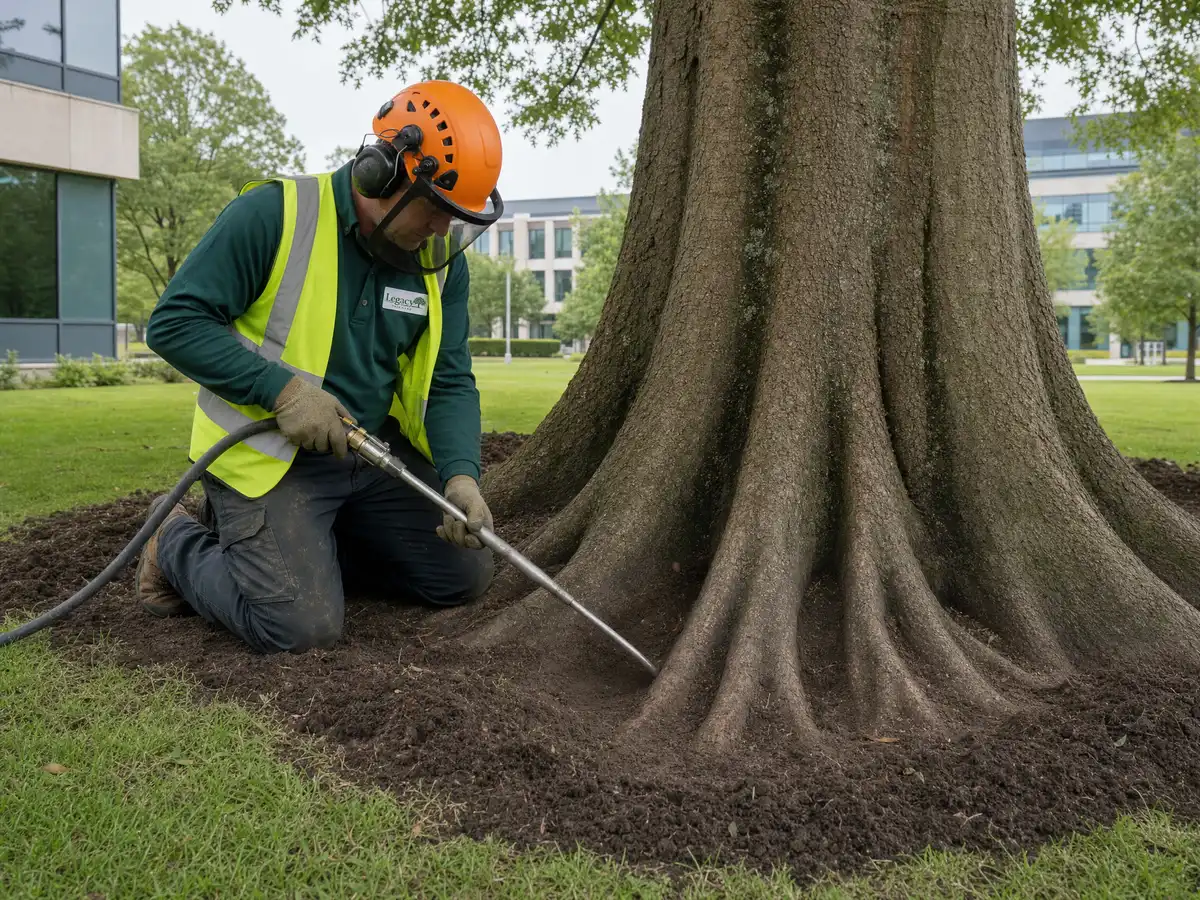
Campus trees planted in the 1980s are usually declining for reasons that are still correctable: a buried root flare, compacted soil under years of parking, irrigation that trained roots shallow. Correctable is cheaper than replaceable.
Everything Else We Do In Richardson
When It Can't Wait
Straight-line winds in spring, on a canopy old enough to have real defects in it.
Knowing What You Have
The default here, because nothing external will tell you a tree is a problem until it has already been one.
- Tree Survey and Preservation Plans
Keeping What's Worth Keeping
Worth more in Richardson than in the newer cities. A specimen tree on a campus frontage is at the age where keeping it becomes a decision rather than an assumption.
- Commercial Tree Trimming and Pruning
Taking Out What Isn't
No permit stands between you and this, which is exactly why it should follow an assessment rather than a quote.
- Commercial Tree Removal
- Crane Assisted Tree Removal
- Commercial Stump Grinding and Removal
- Commercial Land Clearing