

The Plan Rides Along With Something Else
A preservation plan is rarely reviewed on its own, and that changes what it’s commercially. It’s not a tree document. It’s a condition on whatever it’s attached to.
Carrollton requires it alongside a fill or grade development permit, a preliminary, final or administrative plat, or on already-platted ground a new construction permit or a zoning case. Wylie’s Tree Management Plan goes in with any development plan, site plan, plat, clearing and grading plan, erosion control plan or public improvement plan.
Which means a preservation plan that comes back for revision doesn’t hold up the trees. It holds up the plat, or the grading permit, or the construction start behind it.
Frisco Wants Two Signatures, Not One.
A registered surveyor establishes where the protected trees are. A registered landscape architect or certified arborist attests to what they are and how big.
Located By A Surveyor
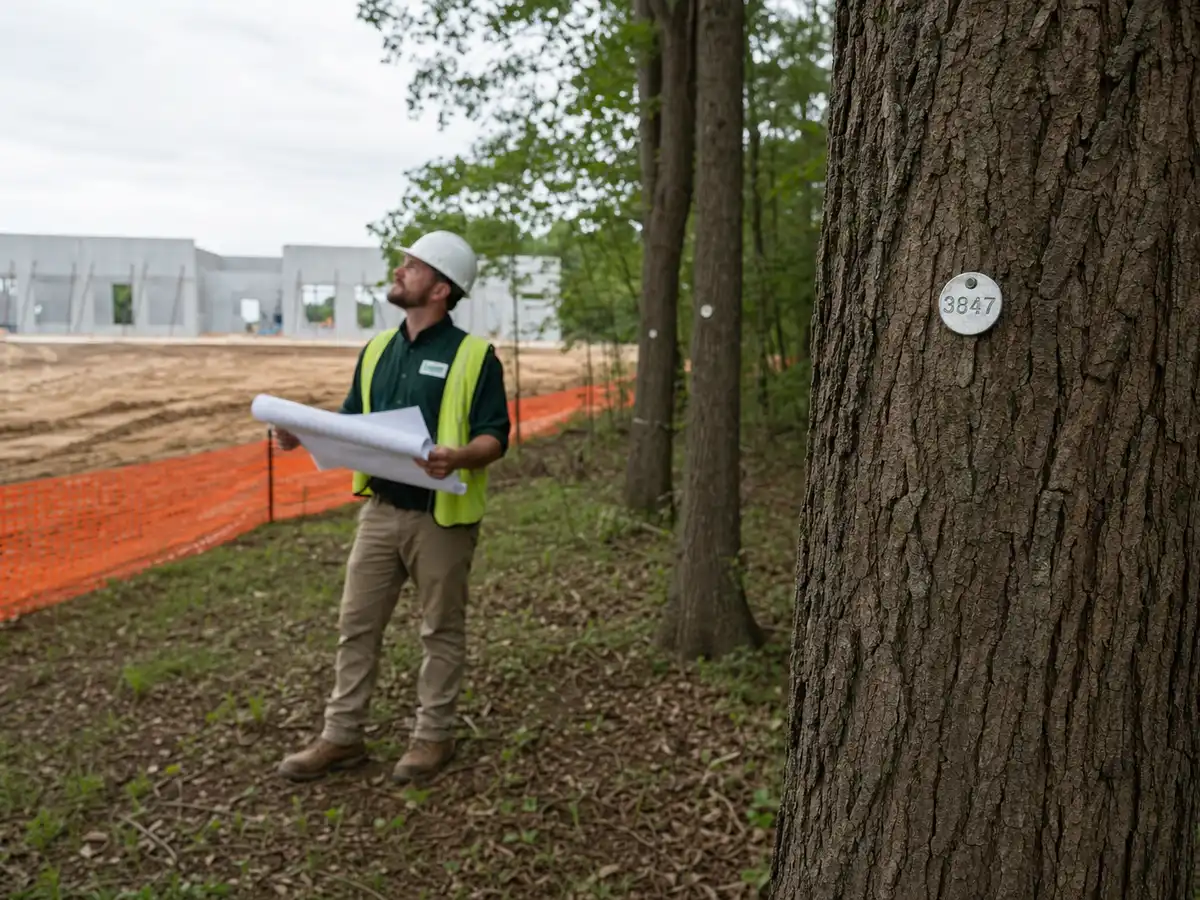
Position on the plan is a survey question, and Frisco treats it as one. Trees plotted approximately are the single most common reason a plan and a grading drawing disagree once the fence goes up.
Identified By An Arborist

Species and size are a different discipline and carry a different signature. Where a city prices replacement by species class, a loose identification isn’t a detail, it’s the multiplier applied to every inch on the schedule.
Credited For What Stays
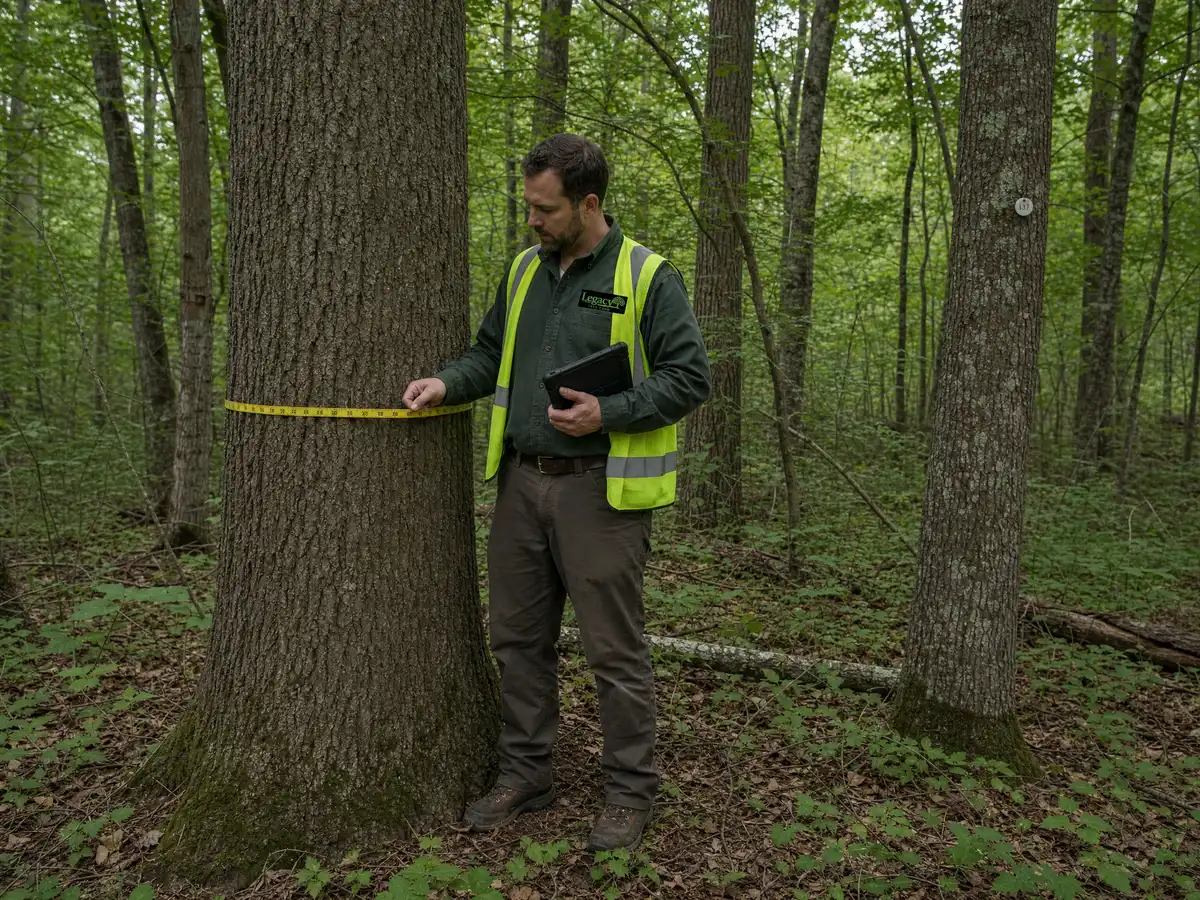
Preservation earns credit in Allen, inch-per-inch credit in McKinney for keeping a tree that was exempt anyway, and transplant credit in Garland. Most plans record what’s leaving far more carefully than what’s staying.
The Credits Are The Underused Half
Every one of these plans documents removals meticulously, because removals are what get charged for. The preservation side gets less attention and is often where the arithmetic improves.
Allen doesn’t compute a ratio at all. It runs a ledger where preserving a protected tree earns positive credit per caliper inch and removing one costs negative credit, and an obligation only exists if the net goes negative. A plan that documents preservation carefully can land at zero on a site that assumed it owed something.
McKinney gives inch-per-inch credit for preserving a tree that would have been exempt. Keeping a tree inside the building pad footprint, where removal would have cost nothing, still earns credit against the trees you do remove elsewhere.
Garland credits moving rather than replacing, and the scale rewards size: one inch of credit per inch under six inches DBH, two from six to twelve, three from twelve to twenty-four, and five at twenty-four inches or more.
Replacement Stock Is Specified, Not Assumed.
The plan has to say what goes back, and the cities are more particular than most schedules allow for.
Frisco wants a minimum three-inch caliper drawn from the city’s own recommended canopy shade tree list, with street trees at three and a half and replaced by the adjacent property owner. Carrollton scales the minimum by what was taken, at three, four and six inches. McKinney specifies four-inch and six-inch caliper at twelve feet in height. Garland caps any single species at 30% of the replacements.
Those constraints multiply. A large obligation, a minimum stock size, a species cap and a recommended list together can decide the planting plan almost entirely, which is a better thing to discover at design stage than at procurement.
What Actually Gets A Plan Returned
In our experience it’s rarely the drawing. It’s the four things underneath it.
A survey without the seals the city requires. Species identified loosely enough that a class-based ratio can’t be applied with confidence. Diameters taken at the wrong point on the trunk, which quietly moves trees across a threshold. And protection details showing a fence line the grading plan plainly contradicts, which a reviewer reads as a plan nobody cross-checked.
All four are cheap to fix in advance. All four are slow to fix once they’re a review comment sitting on top of a plat.
The Rest Of What The Rules Ask For
The provisions themselves, explained once rather than nine times: what counts as protected, what a permit is called here, and what has to exist before a tree comes out.
- Tree Ordinance Compliance Across Collin, Dallas And Denton Counties
- Tree Mitigation Plans And What A Removal Really Costs
- Tree Removal Permits And What Each City Actually Calls It
- What Counts As A Protected Tree And Where The Line Sits
- Tree Preservation Plans: What Goes In One And Who Signs It
- Tree Protection During Construction On Commercial Sites
- Paying A Fee Instead Of Planting Replacement Trees
- Who Approves A Tree Removal, And How A Refusal Is Appealed
- Perimeter Zones, Floodplain Limits And Protected Natural Areas
- Street Trees, Rights-Of-Way And Trees On Public Property
- Tree Due Diligence Before You Buy Or Lease A Site
- When Tree Work Belongs In A Construction Schedule
- Tree Rules On An Operating Property, With No Construction
- Ordinances Get Amended, And The Version Matters
- Tree Ordinance Rules In HOA Common Areas
- Screening, Buffers And The Trees That Have To Stay
- Putting Tree Protection In A Contractor Scope Of Work
- Parking Lots, Paving And The Trees Underneath Them
- Storm Removals And What The Ordinance Still Wants After
- Trees In Easements And Who Actually Controls Them
- Choosing Replacement Trees, And Why Species Caps Exist
- Tree Ordinance Terms, Translated Into Plain Language
- How To Find Out Which Tree Rules Apply To Your Site
- See All City Tree Ordinances