Skip To Content
  • Serving Plano and Collin, Dallas, and Denton Counties
(214) 668-8346
A Legacy Tree Care arborist in a red hard hat talking with two people in business clothes on the edge of a commercial parking area, one of them holding a folder, with office buildings and mature trees behind them

Commercial Property Only

Tree Care For HOA Boards And Community Associations In Plano, TX

It isn't your money. It's your decision.

Boards buy tree work under conditions no other client faces: volunteers, spending dues, on trees that owners can see from their kitchen windows and will ask about at the next meeting.

(214) 668-8346

Crews dispatch in business hours.

Request A Property Walkthrough

Quick Walkthrough Request

Rather talk it through? (214) 668-8346.

  • Insured & Bonded
  • Serving the Plano Area Since 2005
  • Emergency Dispatch
  • Commercial Property Specialists

The Tree Is Rarely The Hard Part

A board decision about a tree is a decision about money that belongs to the people who elected you. It gets made in public, minuted, and remembered by whoever disagreed with it.

So the arboriculture is usually the easy half. Whether a tree should come out is answerable in an afternoon. Whether the board can show why it should come out, six months later, to an owner who liked that tree, is a different problem entirely, and it’s the one that costs boards their evenings.

Everything below is built around that second problem, because nobody else is solving it for you.

What Boards Actually Run Into

Three situations account for most of the tree questions that reach a board, and none of them is really about pruning.

  • How Do You Know It's Safe?

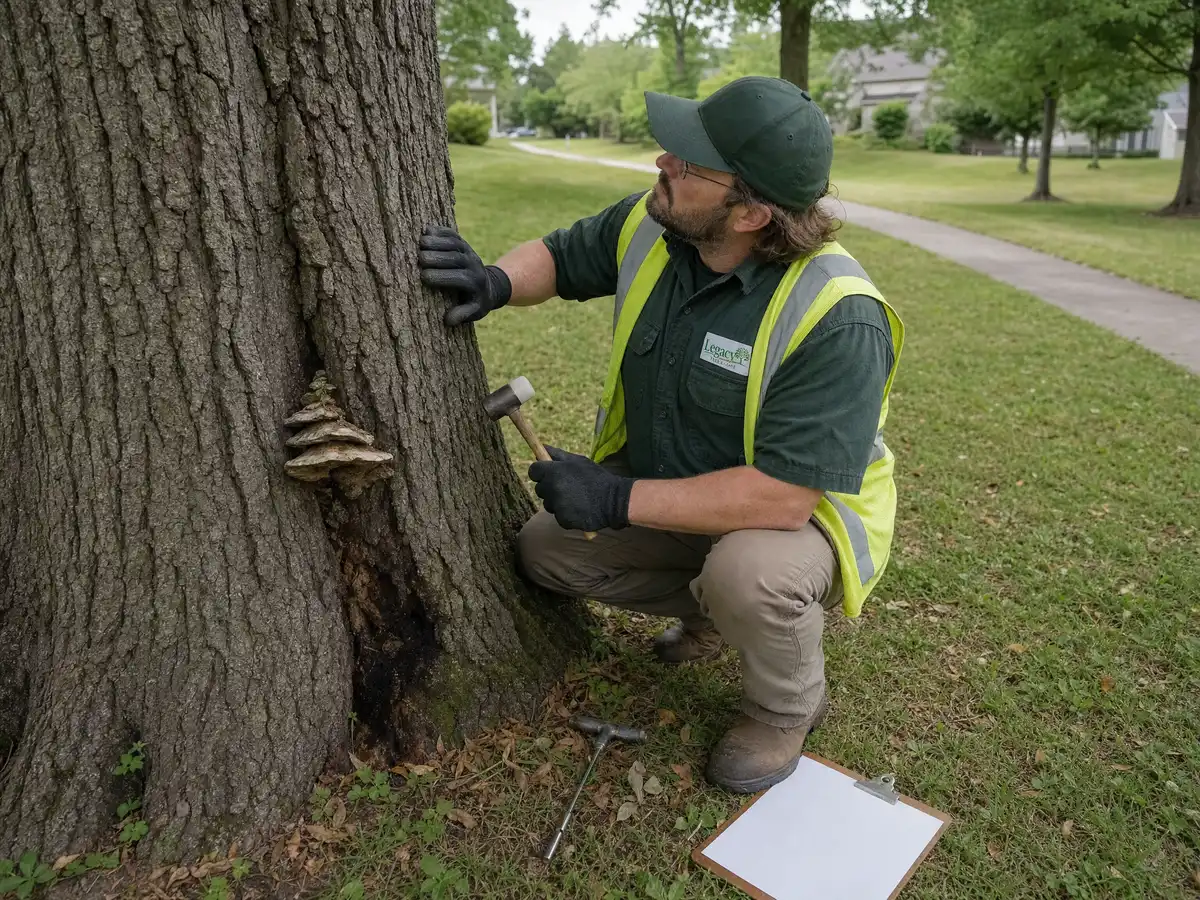
    A Legacy Tree Care arborist kneeling to sound a tree trunk with a mallet, beside a bracket fungus growing from the bark and a clipboard on the ground

    The question behind most board tree items. It’s answerable, and the answer is evidence rather than opinion: what was found, where, and what it means. A tree that looks alarming is often sound, and the one nobody mentioned is sometimes not.

  • Whose Tree Is It?

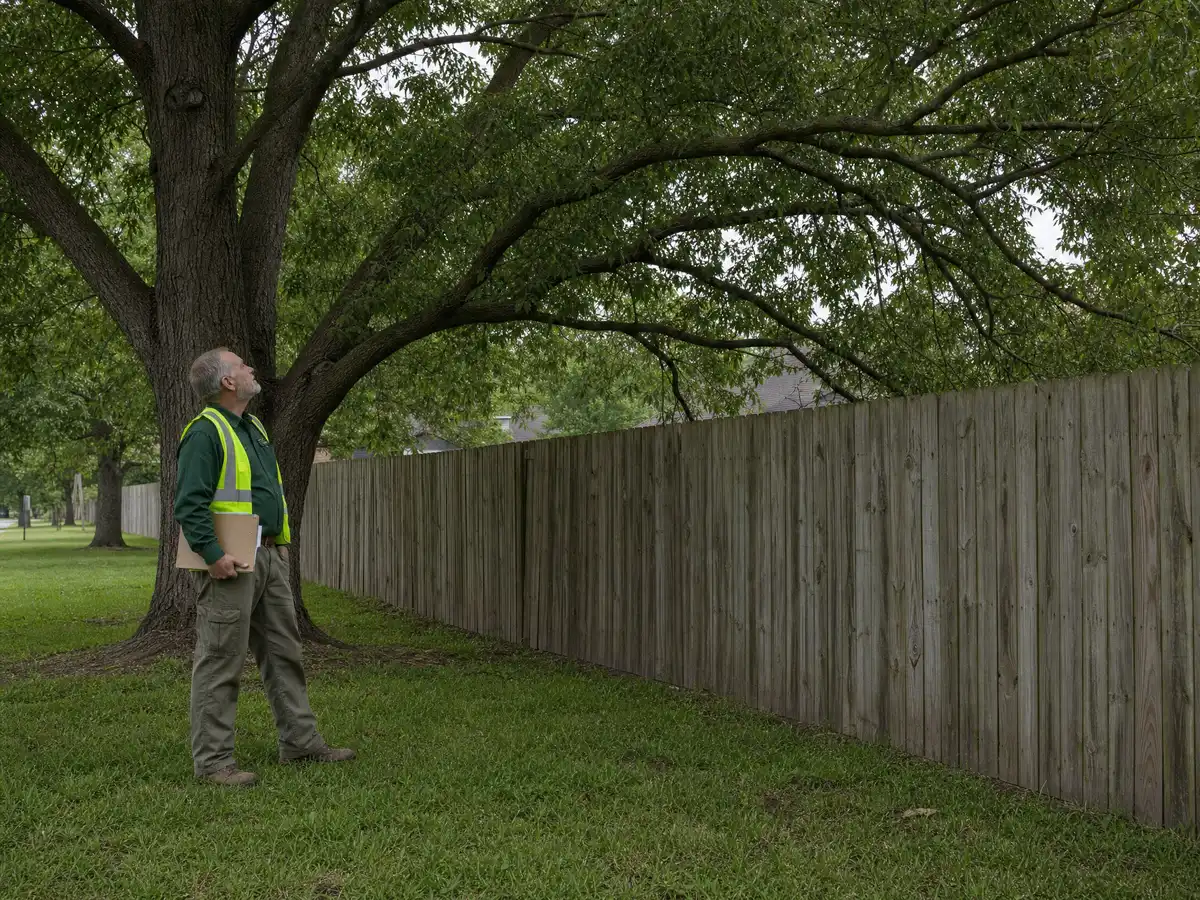
    A Legacy Tree Care arborist holding a folder and looking up at a tree canopy extending across a wooden boundary fence

    Common area on one side, private lot on the other, and a canopy that ignores the line. The physical facts settle faster than the argument does: which tree, where the stem stands, how far it reaches, what condition it’s in.

  • What Does It Cost Us Later?

    A Legacy Tree Care arborist showing an open bound report with photographs to two board members, standing on grass beneath a large tree

    The question reserve studies handle worst. A canopy planted at build-out reaches its expensive decade all at once, and a board that knows which decade that is can fund it instead of assessing for it.

Why The Cheapest Bid Usually Isn’t

Boards are expected to take multiple bids, and tree bids are close to the worst case for that discipline: two companies will scope the same tree differently, so the numbers aren’t measuring the same work.

The low bid on a removal may exclude the stump, the haul-off, or the traffic control your walking path needs. The low bid on a prune may be a crew taking whatever comes off easily, which isn’t the same as a reduction cut in the right place and can leave the tree worse than it was. Neither is dishonest. They’re answers to a question nobody wrote down.

The fix is to write the scope before it goes out, ideally by somebody with no stake in who wins. We’ll do that and hand it to you to send anywhere, including to our competitors. Boards that work this way tend to find the spread between bids narrows sharply, which is the point: at that stage you’re choosing a contractor rather than guessing at a specification.

Trees Are A Reserve Item Nobody Reserves For

Most reserve studies treat the canopy as landscaping, and landscaping is treated as an operating expense. That works right up until the year it doesn’t.

A community planted at build-out has a canopy of near-identical age, which means it arrives at the expensive part of its life all at once rather than one tree at a time. Trees are also unusual among your assets: a roof gets cheaper to ignore for a while and then expensive, whereas a structurally defective tree gets more expensive every year it stands, and there’s no scheduled replacement date to plan around.

An assessment gives your reserve specialist something better than a placeholder. Which trees are approaching work, roughly when, and what the range looks like. That converts a future special assessment into a line in a funding plan, which is a far easier thing to explain at an annual meeting.

What You Get, And What It’s Written For.

A walk of the common areas, then a written condition assessment: what was found, what we recommend, why, and what changes if the work waits a year. It’s written to be forwarded, because it’ll be. An owner who disagrees, an insurer, a reserve specialist and next year’s board will all read it without us there to explain it.

Where a tree is in good condition we’ll say so, in writing, with a date on it. A year in which the answer is that nothing needs doing is a perfectly good outcome, and having that on file is worth considerably more than it costs the first time somebody asks what the board did about the trees.

Who Else We Write For

The same work, answering to somebody different.

See all seven, and the two things that change between them

Frequently Asked Questions

Usually it depends on where the trunk stands rather than where the canopy reaches, but the answer lives in your plat and your governing documents rather than in arboriculture, so the honest first step is to look. What we can settle quickly is the physical question: which tree, whose side the stem is on, how far the canopy extends and what condition it's in. That turns a boundary argument into a documented one, which is usually where it stops being an argument.

Have the scope written before it goes out, by somebody with no interest in who wins it. Tree bids are famously not comparable: two companies will scope the same tree differently, and the cheaper number is often the one that leaves the problem standing. We'll write a scope you can send to anybody, including our competitors, and boards that do this usually find the spread narrows sharply once everyone is pricing the same work.

That's the common case, and it's why tree work so often arrives as a special assessment rather than as a planned expense. Trees are one of the few community assets that get more expensive as they age rather than simply wearing out, and a canopy planted at build-out tends to reach its expensive decade all at once. A baseline assessment gives your reserve specialist something to work from instead of a placeholder.

Then the recommendation needs to survive being read by them, which is what the written version is for. It sets out what was found, why removal was recommended, what the alternatives were and what happens if nothing is done. Somebody who disagrees with a decision will often accept it once they can see the reasoning, and a board that can hand over a document is in a different position from one that can only report a conclusion.

Yes, and it's frequently worth an evening. Questions that would take three email rounds get settled in ten minutes when the person who walked the property is in the room. If the meeting is remote or the schedule won't allow it, the written assessment is built to be read without us, which is the point of writing it that way.

The useful work is the assessment, not a pre-emptive trim. Storm damage is decided years earlier by structure: included bark in a major union, a limb that outgrew its attachment, a root plate compromised by a trench nobody recorded. Those are findable in advance and fixable cheaply. Removing sound wood off a healthy canopy in the name of storm preparation is a cost with no benefit, and in some cases a harm.

That's a question for your attorney and your carrier rather than for an arborist, and anyone answering it confidently from the tree side is guessing. What we can tell you is what the tree's condition was, when, and whether it was documented, because that's the fact everyone else's answer will turn on. It's also the reason a dated assessment is worth more than it costs.

That describes most of the boards we work with. You don't need to learn arboriculture; you need somebody to tell you which of your trees are fine, which need something this year, and which are worth watching, in language you can put in minutes. Where a tree is in good condition we'll say so plainly, and a year where the answer is that nothing needs doing is a perfectly good outcome to report.

Where To Start

Three Ways To Take This To A Decision

Most of these decisions get made by somebody who then has to show their work to somebody else. All three produce something you can hand over.

Something Is Wrong Now

Call. You'll reach a person at any hour. We respond immediately during business hours, and first thing the next morning if you call overnight.

(214) 668-8346

You Want To Know What You Have

An arborist walks the property and you get the condition in writing, in a form that survives a board meeting or a budget review.

Request A Walkthrough

Nothing Is Wrong Yet

Get on file before the season. Properties we already hold move faster on a storm night, because the crew isn't spending the first hour learning the site.

Set Up A Vendor Agreement

Commercial property only, fully responsible for the outcome, and we call 15 to 30 minutes before we arrive. The insurance clears before a truck moves. (214) 668-8346.

Request A Walkthrough

Tell Us About The Property

We'll walk the site, put the condition of every tree in writing, and give you a scope you can take to a board or a budget meeting. No obligation, and no pressure to decide on the spot.

If a limb is down or a lane is blocked right now, calling is faster than a form.

Call (214) 668-8346

  • Insured & Bonded
  • Serving the Plano Area Since 2005
  • Emergency Dispatch
  • Commercial Property Specialists

Send Us The Details

Tell us the property type and what you're seeing. We'll come back with next steps.

Request A Property Walkthrough
A limb over the entrance, a tree that looks unwell, a permit deadline, storm cleanup, an annual contract you want quoted, or getting set up as a pre-approved vendor before storm season.
Request A Walkthrough Call Now