

The Permit Isn’t Always Called A Permit
People searching for a tree removal permit in this market are asking a reasonable question that has an awkward answer: in several of these cities, no such document exists, and the removal is still controlled.
The control moved somewhere else. Into a preservation plan that gets approved as part of the site plan, into a management plan that rides along with a grading submission, or onto a different official’s desk. The obligation is the same size. It’s just wearing a different name, and looking for the wrong name is how sites end up cutting first.
What Each City Issues
| City | The Instrument That Controls Removal |
|---|---|
| Plano | No separate permit. The approved preservation plan is the authorization |
| Frisco | A separate Tree Removal Permit, approved by the Director. Protected trees may not be removed or transplanted without one |
| Garland | A Tree Management Plan, plus a Removal Authorization |
| Carrollton | A tree removal permit alongside a Preservation Plan |
| Allen | A tree removal permit, and the only one here with a deadline attached to the work |
| McKinney | A Tree Preservation Plan, or a Limited Purpose Permit |
| Dallas | An Article X tree removal permit |
| Wylie | A Tree Management Plan, filed with the development submission |
| Richardson | Nothing for private commercial property |
Four different names for the same act, and in Plano’s case no name at all. That’s the practical reason a contractor familiar with one city gets caught in the next one.
Dead, Dying And Dangerous Have Their Own Door.
Every city here has a route for a tree that can’t wait. Almost none of them is a route around the paperwork.
Applied For Before It's Cut

The sequence is the part that costs money. A tree removed before the instrument is in hand is an enforcement question rather than an application, and in Garland and Wylie that question is answered with a penalty rather than a fee.
Dead Is Worth Documenting

Frisco’s own sample survey carries a dead Live Oak removed at 0%, annotated as not mitigated. Condition established and recorded on the survey is what earns that, and it has to exist before the application, not after a refusal.
Fenced Before The Grader Arrives
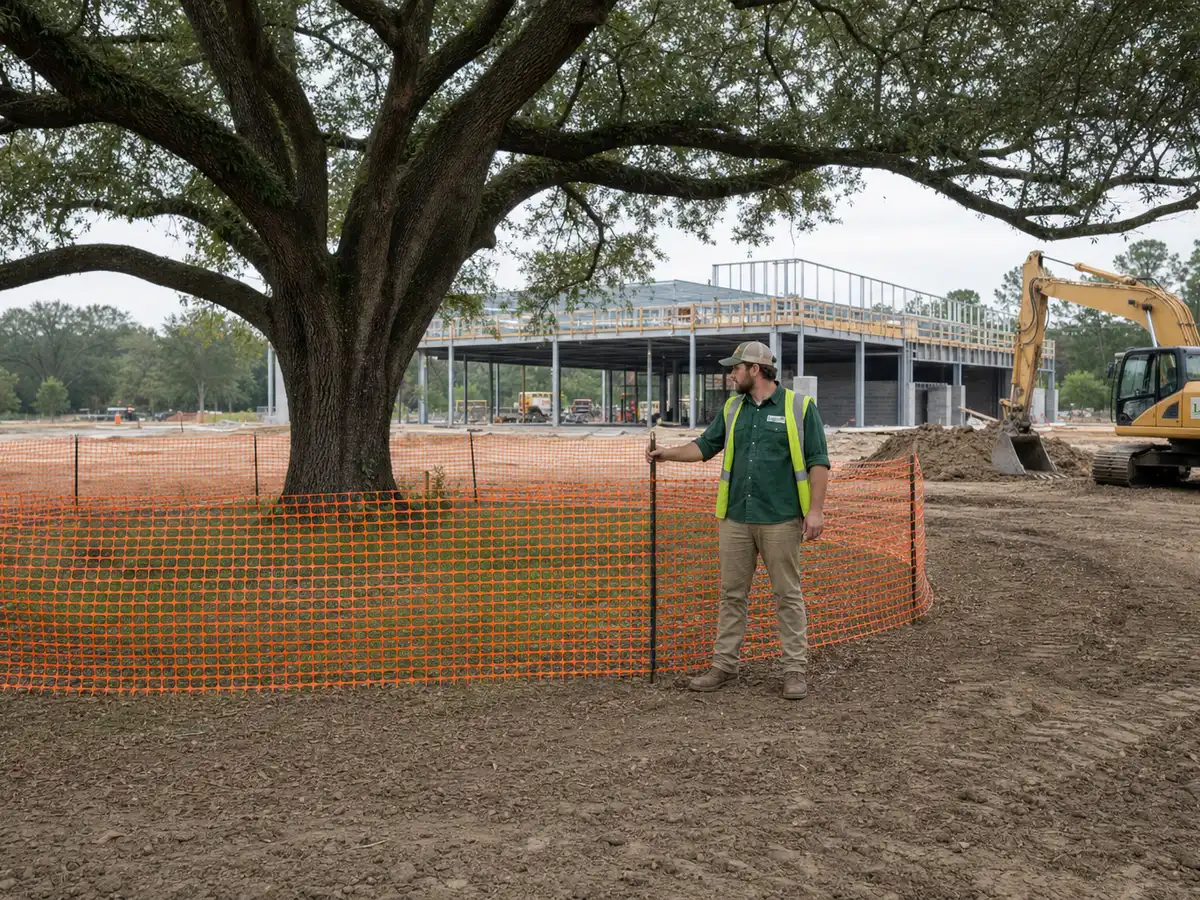
Approval usually carries protection conditions for everything staying. Frisco wants four-foot fencing at the drip line, installed by the owner and inspected before the pre-construction meeting or the grading permit.
Allen Runs A Clock Nobody Else Runs
Most cities here care whether you were permitted. Allen also cares when you finished.
Trees approved for removal must be completely removed from the site within 90 days of the date on the permit. It can be extended one time, by 30 days. If the work isn’t finished inside that, a new permit has to be applied for and issued before it can continue.
Which turns a permitted removal into a scheduling constraint rather than an open authorization. On a phased site it’s worth pulling the permit against the phase that will actually do the work, not against the design.
An Emergency Changes The Order, Not The Obligation.
Allen is explicit about it: emergency removal without a permit is allowed to the extent necessary, the owner has to apply immediately afterward, and mitigation still applies.
That last clause is the one that surprises people. The emergency bought the sequence, so the tree came down before the paperwork rather than after it. It didn’t buy the tree. Whatever that diameter would have cost in mitigation, it still costs.
The practical consequence is that the storm night is worth photographing. Condition, failure, and what made it necessary are all easier to establish while the tree is on the ground than in an application written three weeks later from memory.
Who Is Allowed To Prepare It
Where a city specifies the preparer, it isn’t a formality. Frisco’s checklist calls for a detail tree survey prepared by or under the supervision of a landscape architect or certified arborist, which means an accurate survey by an unqualified preparer is still a returned submission.
Allen goes further on the hazard route and wants an arborist’s certification plus a city inspection before a damaged, dying or hazardous tree can be permitted. That’s two credentialed opinions on the same tree, and the city’s own is the one that decides.
What Actually Goes In The File
Underneath nine sets of forms, the substance is consistent. A survey of what’s there. An identification of what’s protected. A plan of what’s going and why. The mitigation arithmetic. Protection measures for everything staying.
Assemble those five and most of what any of these cities ask for is already written. What changes is the order they want it in, the person who signs it, and the name on the cover, which is exactly the sort of thing worth checking once rather than assuming from the last project.
The Rest Of What The Rules Ask For
The provisions themselves, explained once rather than nine times: what counts as protected, what a permit is called here, and what has to exist before a tree comes out.
- Tree Ordinance Compliance Across Collin, Dallas And Denton Counties
- Tree Mitigation Plans And What A Removal Really Costs
- Tree Removal Permits And What Each City Actually Calls It
- What Counts As A Protected Tree And Where The Line Sits
- Tree Preservation Plans: What Goes In One And Who Signs It
- Tree Protection During Construction On Commercial Sites
- Paying A Fee Instead Of Planting Replacement Trees
- Who Approves A Tree Removal, And How A Refusal Is Appealed
- Perimeter Zones, Floodplain Limits And Protected Natural Areas
- Street Trees, Rights-Of-Way And Trees On Public Property
- Tree Due Diligence Before You Buy Or Lease A Site
- When Tree Work Belongs In A Construction Schedule
- Tree Rules On An Operating Property, With No Construction
- Ordinances Get Amended, And The Version Matters
- Tree Ordinance Rules In HOA Common Areas
- Screening, Buffers And The Trees That Have To Stay
- Putting Tree Protection In A Contractor Scope Of Work
- Parking Lots, Paving And The Trees Underneath Them
- Storm Removals And What The Ordinance Still Wants After
- Trees In Easements And Who Actually Controls Them
- Choosing Replacement Trees, And Why Species Caps Exist
- Tree Ordinance Terms, Translated Into Plain Language
- How To Find Out Which Tree Rules Apply To Your Site
- See All City Tree Ordinances