Skip To Content
  • Serving Plano and Collin, Dallas, and Denton Counties
(214) 668-8346
A Legacy Tree Care arborist in a red hard hat talking with two people in business clothes on the edge of a commercial parking area, one of them holding a folder, with office buildings and mature trees behind them

Commercial Property Only

Commercial Tree Service For Municipal And Public Sector Property In Plano, TX

The file is public. Write it that way.

Public property carries a duty of care to people who never chose to be there, and a paper trail that anybody can ask to see. Both change what a tree assessment has to be.

(214) 668-8346

Crews dispatch in business hours.

Request A Property Walkthrough

Quick Walkthrough Request

Rather talk it through? (214) 668-8346.

  • Insured & Bonded
  • Serving the Plano Area Since 2005
  • Emergency Dispatch
  • Commercial Property Specialists

Everything You Write Down Is Potentially Public

On private property a tree report has one reader and a filing cabinet. On public property it has one reader today and an unknown number later, because it can be requested, quoted, and read by somebody with no idea what the property looks like.

That isn’t a reason to write less. It’s a reason to write differently: no internal shorthand, no conclusion without the observation that produced it, and nothing that reads differently out of context than in it. A report that only makes sense to the person who commissioned it becomes a liability the moment it leaves their desk.

It’s the same discipline good private documentation needs. The difference is that on public property it isn’t optional, and you find out which kind you have at the worst possible moment.

Where The Consequence Is Highest

Risk is likelihood multiplied by consequence, and on public property the consequence side is where the work concentrates.

  • Trees Over People

    A Legacy Tree Care arborist with a clipboard looking up into a large spreading tree canopy above a playground

    The same defect in the same species means something different over a playground than over a maintenance yard. Trees above playgrounds, benches, pavilions and event lawns are the ones worth knowing about first, and usually the ones nobody has looked at closely.

  • Trees In The Right Of Way

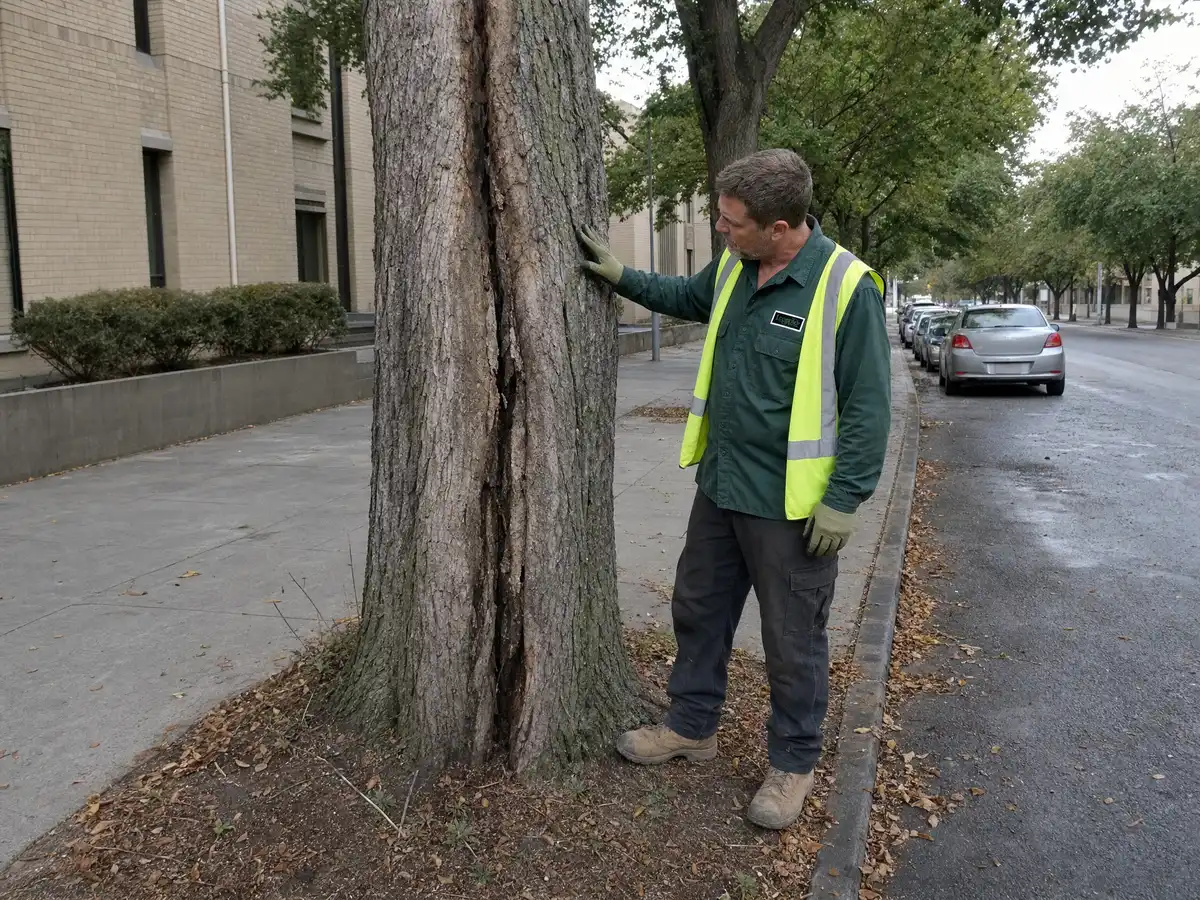
    A Legacy Tree Care arborist with a hand on the trunk of a street tree, examining a long vertical seam in the bark beside a city sidewalk

    Street trees sit between a sidewalk and moving traffic, which are the two targets hardest to move. They also get inspected least, because they belong to nobody’s building and appear on nobody’s grounds contract.

  • The Record Itself

    A Legacy Tree Care arborist photographing a large open decay cavity in a tree trunk, with a clipboard and folding ruler laid on the grass beside it

    Photographed, measured, dated, and written so a stranger can follow it. On public property the record is part of the work rather than a byproduct of it, and it’s frequently the reason the file exists at all.

Duty Of Care Is Higher Where Nobody Chose To Be There

A tenant signed a lease. An employee took a job. A child on a public playground made no such decision, and neither did the person waiting at a bus stop under a street tree.

That difference is why consequence, rather than likelihood, tends to drive municipal tree work. A defect that would be watched for another two years on a maintenance yard gets addressed this season when it sits above a pavilion that hosts events every weekend. It isn’t that the tree is more dangerous. It’s that the same failure lands differently.

It’s also why the published baseline for public land is stricter than for a back lot. Systematic, annual, documented inspection is the recommendation for high-use sites such as recreation areas and heavily traveled routes, which is most of what a parks or public works department actually manages.

Sorting an inventory by what’s underneath it, rather than by species or by district, is usually the single most useful thing a public entity can do with a limited assessment budget.

Procurement Is The Relationship

Private clients call. Public entities have a process, and pretending otherwise wastes everybody’s time. Small assessments often sit under a quote threshold, larger programs need a solicitation, and many entities prefer a term contract so individual work can be released without starting the process again each time.

Where we can genuinely help is upstream of the bidding: a scope specific enough that the bids coming back are comparable. Tree work is unusually easy to specify badly, and a vague scope produces a spread of numbers that measure different work, which is the part that makes a public solicitation painful to evaluate and easy to challenge.

We’ll write that scope and hand it over, including to competitors. On public work that isn’t generosity, it’s the only version that survives scrutiny.

After A Storm, Everybody Calls At Once.

Municipal storm response competes with every commercial property in the county for the same crews in the same hour. Nothing changes that except an arrangement made before the storm.

The practical value of a term contract or a standing arrangement isn’t preferential treatment. It’s that the first day isn’t spent negotiating rates and terms while streets are blocked, and that whoever arrives already knows the property. That first day is the one that gets written about afterwards, which brings this back to where the page started.

Who Else We Write For

The same work, answering to somebody different.

See all seven, and the two things that change between them

Frequently Asked Questions

Tell us which route applies and we'll work to it rather than around it. Small assessments often sit under a quote threshold, larger programs usually want a solicitation, and many entities prefer a term contract so individual jobs can be released without starting over each time. What we can help with either way is writing a scope specific enough to produce comparable bids, which is the part that most often makes a public solicitation painful.

They're written on the assumption that they'll be. That means no internal shorthand, no conclusions without the observation behind them, and no language that reads differently out of context than in it. A report that only makes sense to the person who commissioned it's a liability on public property, because it'll eventually be read by somebody else entirely.

Then it's in the highest consequence category on your entire inventory and worth assessing on that basis. Consequence is half of any risk assessment: the same defect in the same species matters differently over a playground than over a maintenance yard. Trees over playgrounds, benches, pavilions and event lawns are the ones worth knowing about first, and usually the ones nobody has looked at closely.

Usually the work your crews aren't set up for rather than the work they do daily: assessments requiring a certified arborist, large removals near occupied structures, aerial work beyond your equipment, and surge capacity after a storm. The most common arrangement is that your people handle routine maintenance and we take the specialist and overflow work, which is cheaper than either of us doing all of it.

Be honest with yourself about the queue. Every commercial property in the county calls at the same hour, and municipal work competes with everything else unless something exists in advance. A term contract or a standing arrangement is what changes the position, and the practical value of it isn't preferential treatment so much as not spending the first day negotiating terms while streets are blocked.

Which is worth naming rather than stepping around. A municipality removing a tree on its own property invites the obvious question, and the answer is documentation: the same assessment, the same reasoning, the same record you'd want from a private applicant. Holding your own property to the standard you set is considerably easier when the file already reads that way.

Then do it by consequence rather than by geography. A complete inventory of every tree the entity owns is a large project; an assessment of every tree with a target under it is a much smaller one and answers the question that actually matters. The rest can follow in later cycles, and the first pass tells you how big the rest of the job really is.

Ask for the certificate at the start rather than at award, and send us the exact wording your entity requires. Where bonding or specific limits apply we'll confirm in writing whether we meet them before you shortlist us, because finding out at award is a problem for your schedule rather than ours.

Where To Start

Three Ways To Take This To A Decision

Most of these decisions get made by somebody who then has to show their work to somebody else. All three produce something you can hand over.

Something Is Wrong Now

Call. You'll reach a person at any hour. We respond immediately during business hours, and first thing the next morning if you call overnight.

(214) 668-8346

You Want To Know What You Have

An arborist walks the property and you get the condition in writing, in a form that survives a board meeting or a budget review.

Request A Walkthrough

Nothing Is Wrong Yet

Get on file before the season. Properties we already hold move faster on a storm night, because the crew isn't spending the first hour learning the site.

Set Up A Vendor Agreement

Commercial property only, fully responsible for the outcome, and we call 15 to 30 minutes before we arrive. The insurance clears before a truck moves. (214) 668-8346.

Request A Walkthrough

Tell Us About The Property

We'll walk the site, put the condition of every tree in writing, and give you a scope you can take to a board or a budget meeting. No obligation, and no pressure to decide on the spot.

If a limb is down or a lane is blocked right now, calling is faster than a form.

Call (214) 668-8346

  • Insured & Bonded
  • Serving the Plano Area Since 2005
  • Emergency Dispatch
  • Commercial Property Specialists

Send Us The Details

Tell us the property type and what you're seeing. We'll come back with next steps.

Request A Property Walkthrough
A limb over the entrance, a tree that looks unwell, a permit deadline, storm cleanup, an annual contract you want quoted, or getting set up as a pre-approved vendor before storm season.
Request A Walkthrough Call Now