

The One Client Who Actually Gets The Payback
Most commercial tree work is bought by somebody who won’t be there to see the result. A manager rotates, an owner sells at year five, a developer hands over at completion. A campus owner is the rare commercial client who inherits their own decisions, which is less common than it sounds and changes the arithmetic completely.
That single fact changes what’s worth doing. Preservation is a poor argument to somebody holding an asset for three years and an obvious one to somebody holding it for thirty. Every case for keeping a tree rather than replacing it gets stronger the longer you intend to stay, and on a campus it’s usually the strongest it ever gets.
It also means the mistakes compound in your direction rather than somebody else’s, which is the less comfortable half of the same sentence.
What A Campus Canopy Is Actually Doing
Three jobs, none of which show up as a line item, and all of which get noticed the moment they stop.
Holding Old Trees Together

The specimens worth keeping are usually the oldest, and old trees develop structural weaknesses that are fixable rather than fatal. Cabling a union that has become a liability can add decades to a tree that would otherwise be a removal.
Shade Nobody Thanks You For
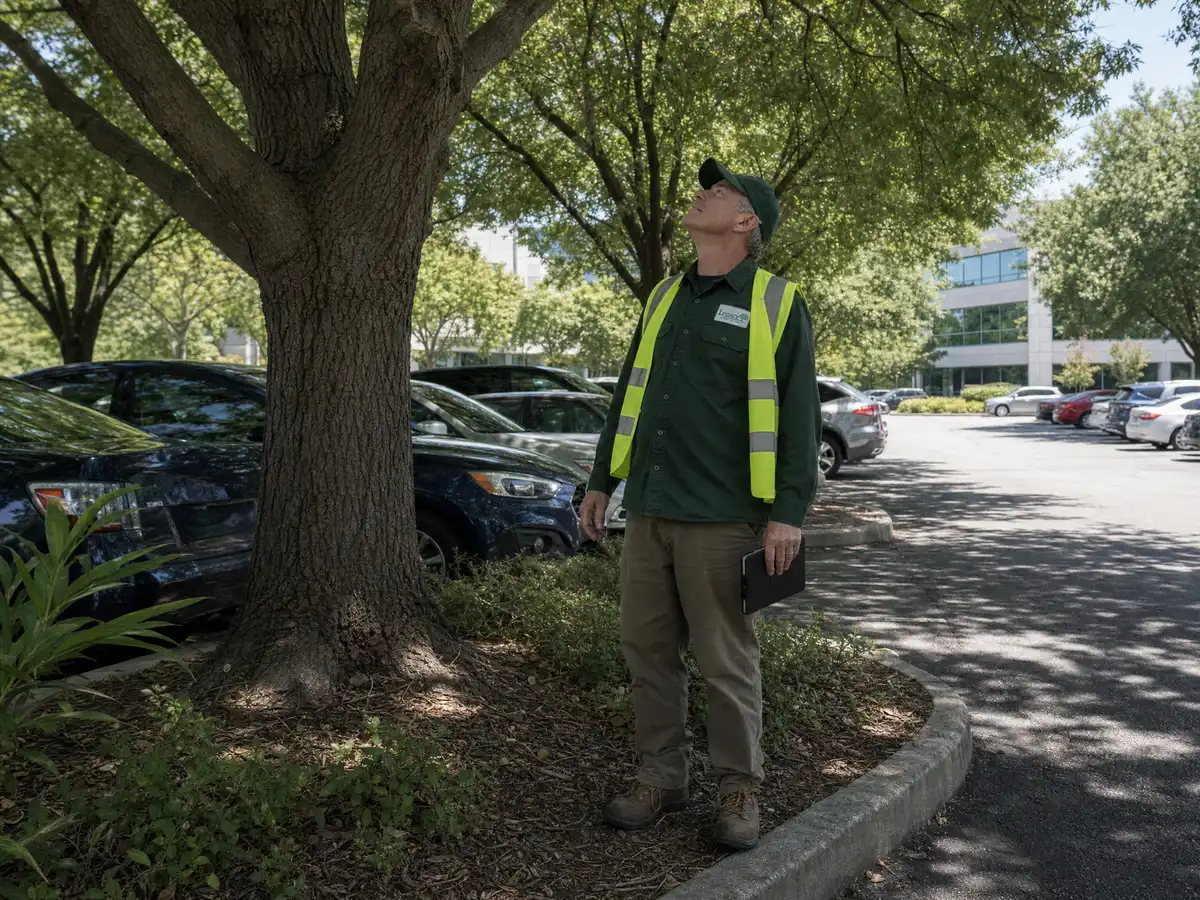
Canopy over a lot is a genuine amenity and an invisible one. Nobody mentions it until the tree comes out, and then the complaints arrive about the heat, the glare and the cars, all at once and all to facilities.
Keeping Root Flares Alive
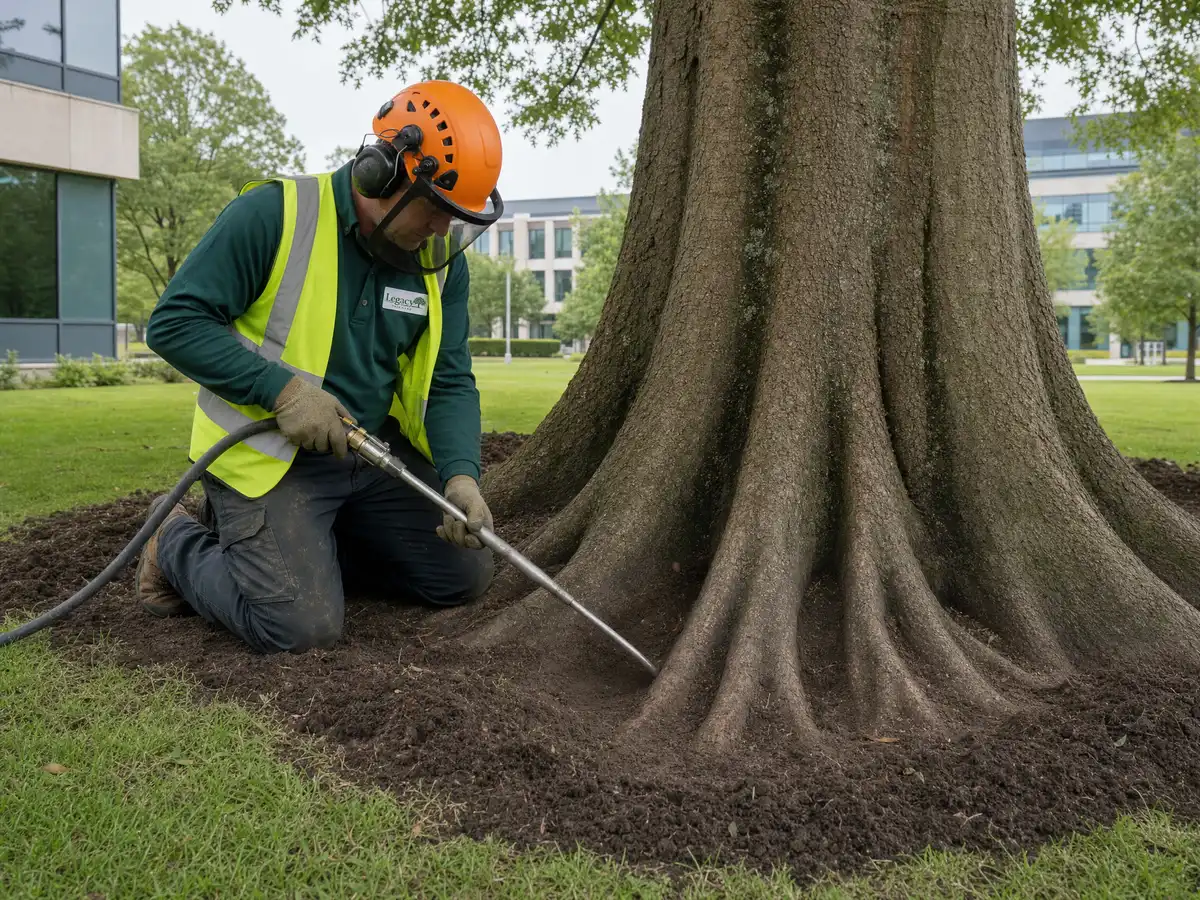
Decades of mulch and grade change bury the flare, and a buried flare rots slowly and invisibly. Excavating it with compressed air is a small job that resolves a problem most people never knew their oldest trees had.
What You Can’t Buy Back
A mature tree is the one thing on a campus that money can’t replace on any useful timescale. Everything else can be rebuilt, resurfaced or reordered, and a forty-year canopy takes forty years.
That’s the whole preservation argument, and it’s stronger here than anywhere else on this site. A replacement tree isn’t a substitute for the tree it replaces; it’s a commitment to wait. The nursery stock that goes in at three inches of caliper will shade a parking bay properly somewhere around the time the people who approved it have retired.
So the trees worth spending money on are the ones that are already big, which is the opposite of how most maintenance budgets are built. Cabling a structurally weak union on a specimen oak is expensive next to removing it and cheap next to being without it for three decades.
Your Staff Are The Inspection Regime
On a campus, several hundred people walk past the same trees twice a day. That’s a level of scrutiny no other commercial property has, and it cuts both ways.
The upside is genuine: things get noticed. A limb down after a storm, a lean that wasn’t there, water standing where it didn’t used to. The downside is that most of what reaches facilities is about sap, leaf litter, or shade falling on the wrong bays, and the temptation is to solve a complaint by removing a healthy tree, which is permanent and rarely satisfies anybody.
The useful move is to separate the two categories once, properly, so the next complaint arrives against a known baseline instead of a blank page.
The Best Work Window On Any Commercial Property
A retail center can be worked before opening. A hospital effectively can’t be worked at all. A campus empties on a schedule everybody already knows, and that’s worth more than it sounds.
Weekends, holiday closures and the predictable quiet weeks mean the disruptive work can be done with the lots empty, no traffic control, and no staff walking under an active drop zone. It’s faster, it costs less, and your people see a finished result rather than two weeks of cones.
The only requirement is booking it in advance rather than at the point something has already failed, which is the difference between using the window and missing it.
Where Campus Canopies Actually Fail
Rarely from storms, and usually from something decided years earlier. The common one is a campus planted all at once at construction, which produces a canopy of near-identical age that arrives at every stage of its life simultaneously, including the expensive ones.
The second is the slow damage nobody attributes to anything: irrigation running against trunks, mulch piled against flares year after year, mowing damage at the base, and soil compacted by decades of foot traffic on the same desire lines. None of it looks like an event and all of it shortens a tree’s life, which is why it’s almost never the thing anybody calls about.
Who Else We Write For
The same work, answering to somebody different.
Commercial Property Managers
Portfolios, budget cycles and an owner who wasn't there.
HOA Boards
Dues, meetings, and neighbors who can see the tree from the kitchen.
Developers And Contractors
Surveys and preservation plans, where the currency is weeks.
Retail Centers
Trading hours, parking bays and tenants who raise sightlines.
Industrial And Warehouse
Turning circles, dock clearance and wet ground at the ponds.
Municipal And Public Sector
Procurement, public duty of care, and a file that gets opened.