Skip To Content
  • Serving Plano and Collin, Dallas, and Denton Counties
(214) 668-8346
A Legacy Tree Care crew working on trees at a commercial office property, one arborist pruning from a bucket lift while another feeds brush into a chipper

For Property Managers, HOA Boards and Developers

Commercial Tree Health Care in Plano, TX

Most declining commercial trees aren't sick.

On property built in the last twenty years the usual cause is how the tree was planted and what has happened around it since. Those are site problems wearing the appearance of disease, and several of them are still fixable.

(214) 668-8346

Crews dispatch in business hours.

Request A Property Walkthrough

Quick Walkthrough Request

Rather talk it through? (214) 668-8346.

  • Insured & Bonded
  • Serving the Plano Area Since 2005
  • Emergency Dispatch
  • Commercial Property Specialists

Decline Is A Symptom, Not A Diagnosis.

A thinning canopy, early leaf drop, dieback in the upper crown. These are the things a property manager notices, and they’re the end of a process rather than the beginning.

By the time a tree looks poor from the parking lot, whatever caused it has usually been running for two or three years. Treating the symptom without finding the cause produces a tree that looks slightly better for one season and then continues exactly as it was.

Where The Cause Usually Is

On commercial property built within the last two decades, the cause is more often the planting than the pathogen.

Planting depth is the most common single fault we find. A tree set too deep, or with mulch piled over the root flare, is a tree slowly being girdled by its own roots, and it can take fifteen years to express. Stakes left on past their first season produce a stem that never developed taper. Irrigation tuned for turf keeps roots shallow, so the tree is fine until the first year nobody waters it.

None of those are diseases and none respond to a spray. They’re conditions, and the fixable ones stay fixable only while there’s enough tree left to recover.

What We Look At First

In this order, because the cheap findings are usually the important ones.

  • The Root Flare

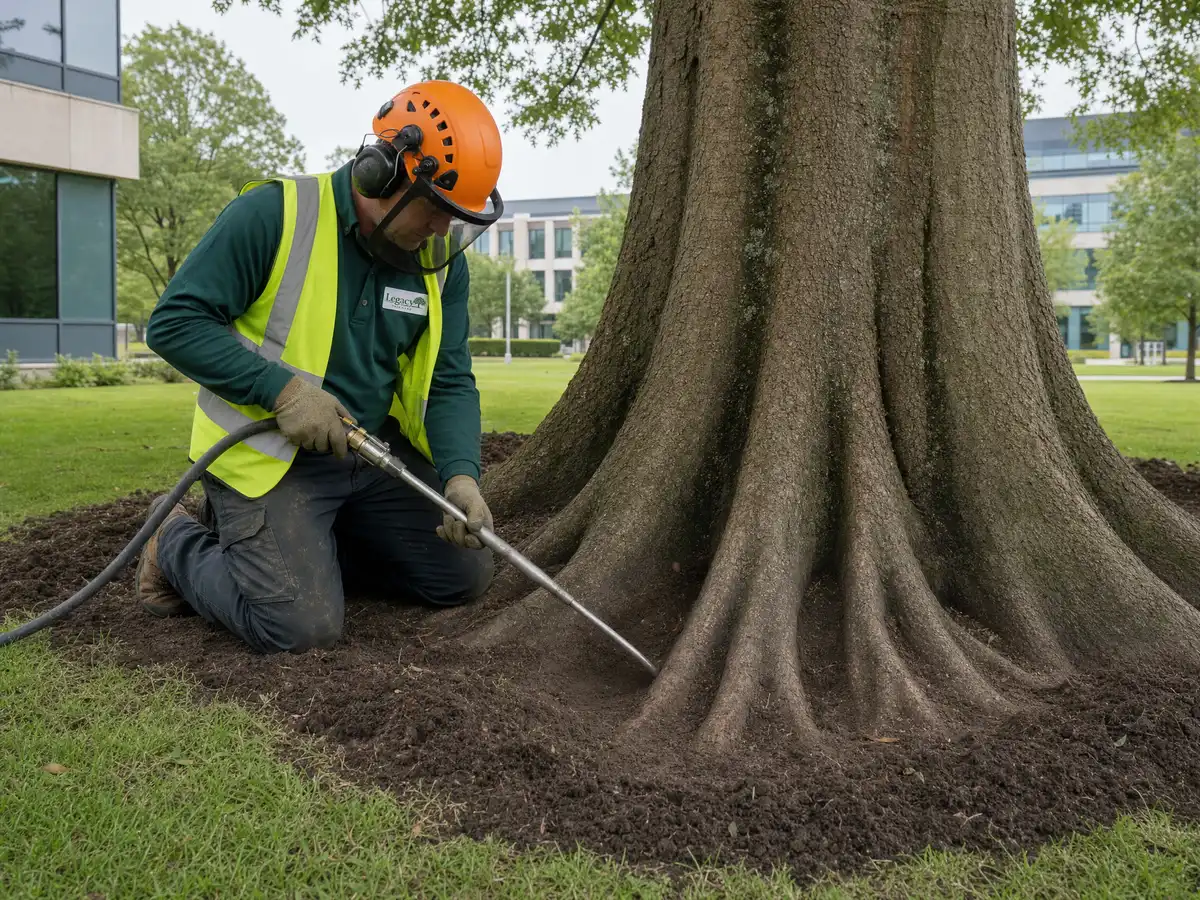
    A Legacy Tree Care arborist kneeling with a compressed air lance to clear soil from the root flare of a mature tree, at a commercial property

    Where the trunk should widen into roots. If it enters the ground like a post, the flare is buried, and that alone explains a great many declining commercial trees. Compressed air excavation exposes it without cutting roots.

  • The Soil It's Standing In

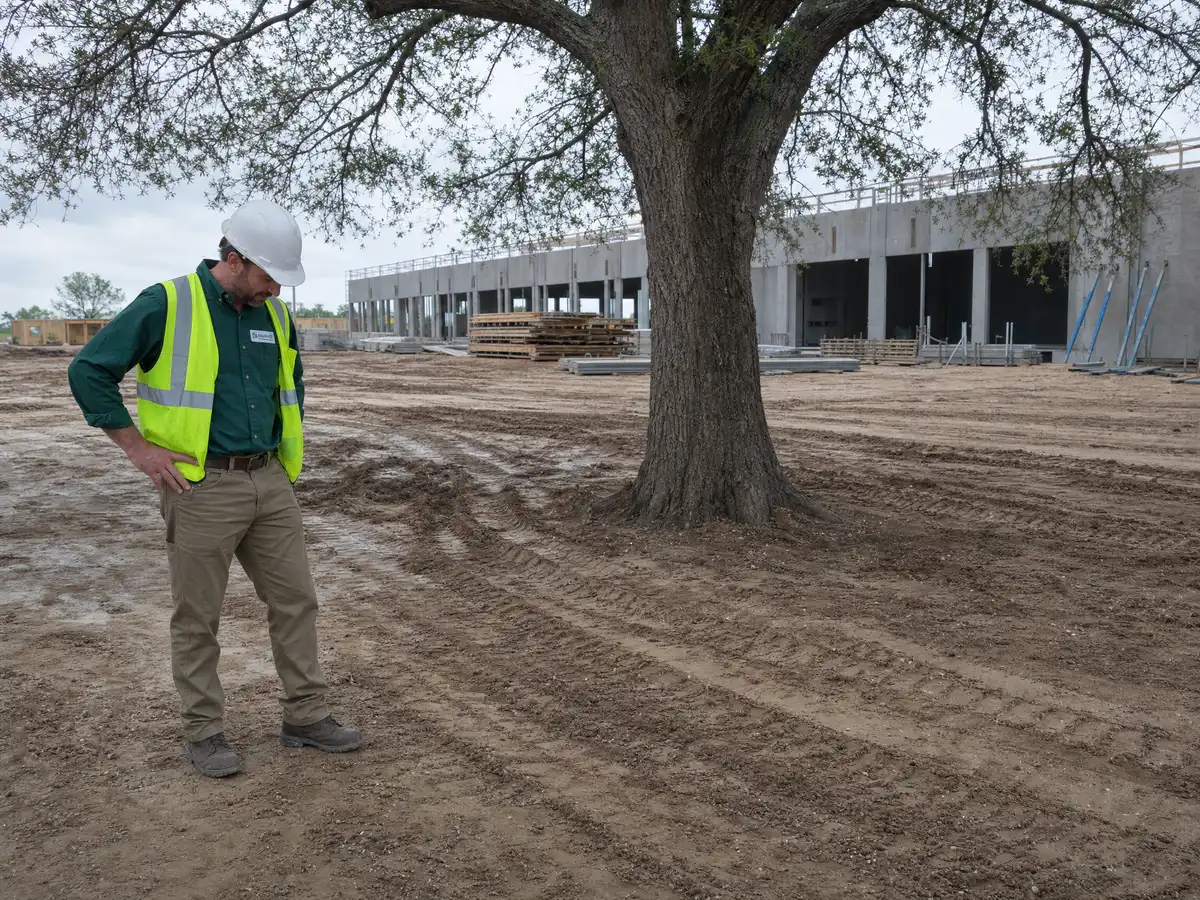
    A Legacy Tree Care arborist looking down at vehicle ruts compacted into bare soil across the root zone of a mature tree, on a construction site

    Compaction from construction, parking or foot traffic restricts the gas exchange roots depend on. It’s invisible from above and it’s frequently the difference between two identical trees on the same site.

  • What The Trunk Is Telling Us

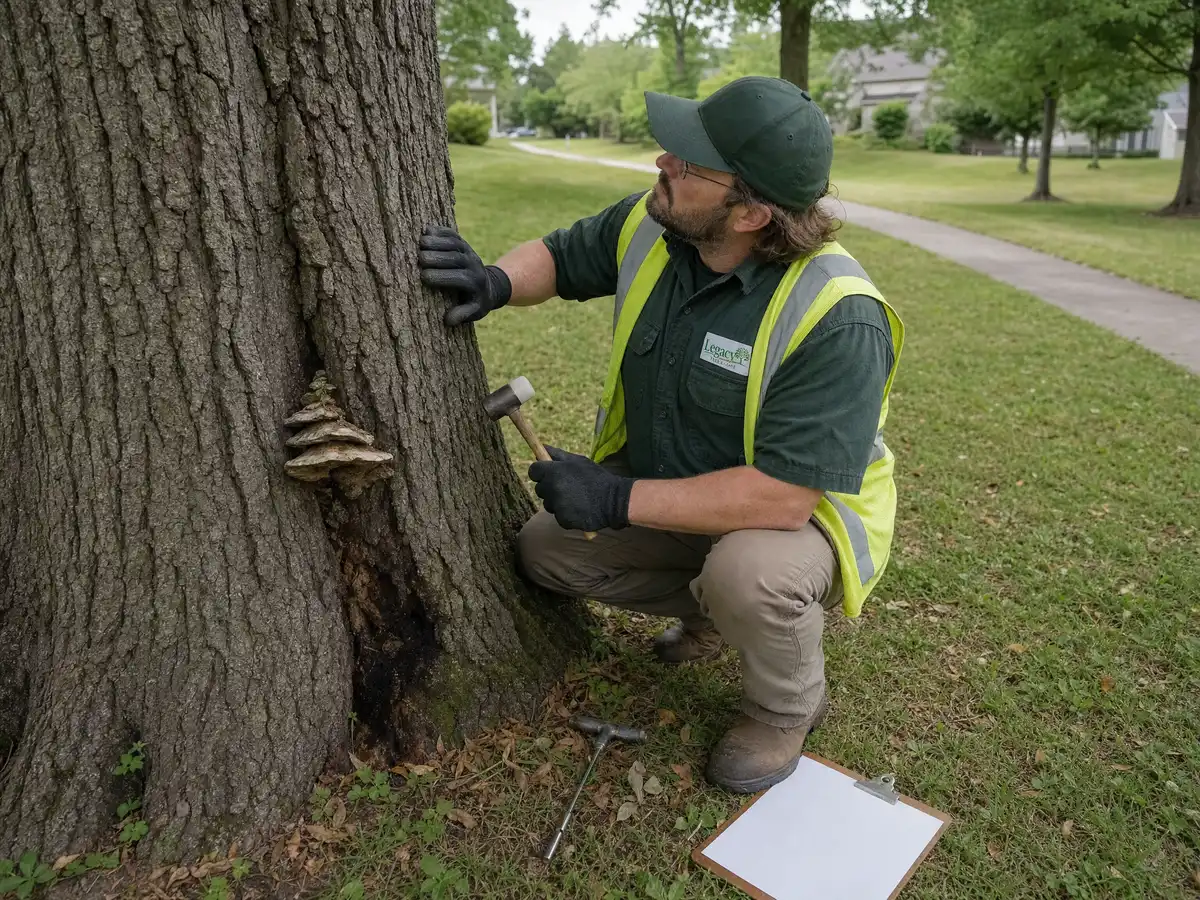
    A Legacy Tree Care arborist kneeling to sound a tree trunk with a mallet, beside a bracket fungus growing from the bark and a clipboard on the ground

    Sounding, fungal fruiting bodies, wounds and old cuts. Decay is a structural question as much as a health one, and it changes the answer from what will help this tree to what’s standing over your parking.

What We Won’t Sell You

A fertilizer program for a tree whose problem is depth. Injections for a tree whose problem is compaction. An annual treatment plan on a healthy tree that needs looking at every few years and nothing else.

Deep root feeding is the most oversold service in this trade, and on a site with adequate soil it usually buys nothing. Where a nutrient deficiency is real, a soil test says so, and then it’s worth doing for a reason rather than on a schedule.

Our assessments regularly end in less work than the property expected. That’s uncomfortable to write on a page whose purpose is to sell tree care, and it’s the honest version.

What’s Correctable And What Isn’t

Buried flares can be excavated. Girdling roots can sometimes be cut before they close. Compaction can be relieved. Irrigation can be retuned, and a tree that has been kept shallow can be gradually weaned onto a deeper root system.

Structural decay can’t be reversed, and neither can a stem union that formed badly twenty years ago. Those become questions about risk and time rather than health: how long the tree has, what’s underneath it, and whether support or removal is the right answer.

Being clear about which category a tree is in is most of the value of an assessment. The wrong answer in one direction wastes money on a tree that was always going to be removed. In the other it removes a tree that had another two decades in it.

What An Assessment Costs You In Removals

The commercially awkward part of doing this properly is that a real diagnosis frequently ends in less billable work than the property was braced for.

A tree written off as dying because the canopy thinned turns out to have a buried flare and eight more good years in it. A row of struggling trees on the same irrigation zone turns out to have one problem rather than fourteen. Neither of those outcomes produces a removal, and both are the correct answer.

The reverse also happens and matters more. A tree that looks acceptable from the parking lot, with a sound canopy and no obvious symptoms, occasionally has decay at the base that changes it from a health question into a risk one. That finding is the reason an assessment is worth commissioning before somebody parks under it for another season.

Heavy Pruning Is A Health Decision

A declining tree has less canopy than it needs, and taking more is a treatment that occasionally kills the patient.

Several cities here regulate this directly. Dallas names excessive pruning and topping in a standard covering acts likely to cause a tree to decline and die within five years, so on a protected tree it can be an ordinance matter as well as an arboricultural one. What the four pruning operations actually do covers where the line sits.

Request A Walkthrough

Frequently Asked Questions

On property of that age it's usually planting depth, stakes left on too long, or irrigation that kept the roots shallow, rather than anything happening in the canopy. Those are establishment problems surfacing years later, and several of them are still correctable. It's worth an assessment before replacing anything, because replacing into the same conditions produces the same result.

It's where the trunk widens into the roots, and on a healthy tree it should be visible at the soil line. If the trunk enters the ground like a post, the flare is buried, which encourages roots to circle and eventually girdle the stem. It's the single most common finding on declining commercial trees of planting age.

Usually not, and it's the most oversold service in this trade. On a site with adequate soil it buys very little, and it does nothing at all for a tree whose actual problem is depth or compaction. Where a deficiency is real a soil test shows it, and then the treatment has a reason behind it rather than a schedule.

Sometimes, and it depends on what's causing it and how much tree is left. Buried flares, girdling roots, compaction and irrigation faults are all addressable while there's enough canopy to recover on. Structural decay and a badly formed union aren't, and those become questions about risk rather than health.

Seasons, not weeks, and the first sign is usually that decline stops rather than that the tree visibly improves. Trees respond on their own timescale, and anyone promising a visible change by next month is selling something other than tree care.

No, and a proposal to do so is worth questioning. On most commercial sites a small number of trees carry the consequence and the rest need looking at occasionally. Spending evenly across a canopy is how budgets get consumed without changing the outcome for the trees that matter.

It depends what it is and where. Fruiting bodies on root flares, stems or branches can indicate advanced internal decay, which is a structural finding rather than a cosmetic one. Something growing on dead bark from an old wound may mean much less. It's worth identifying rather than guessing in either direction.

It usually hurts it. A declining tree already has less canopy than it needs, and removing more takes away the energy it'd recover on. On a protected tree it can also be a regulatory matter, since some cities here name excessive pruning in provisions about acts likely to kill a tree.

A written record of what we found, what we think is causing it, what we recommend and what we specifically don't, with dates and photographs. That document is useful beyond the tree work: it's the thing that answers what you knew and when, if a tree ever fails.

It's a real consideration in this region and it shapes when oaks should be pruned rather than being a routine finding. If oaks are involved in a scope, the timing belongs in the plan rather than being settled by whichever crew turns up on the day.

Where To Start

Three Ways To Start On This Work

Pick whichever one matches where the decision actually sits, including the one that costs you nothing and commits you to nothing.

Something Is Wrong Now

Call. You'll reach a person at any hour. We respond immediately during business hours, and first thing the next morning if you call overnight.

(214) 668-8346

You Want To Know What You Have

An arborist walks the property, you get the condition and the scope in writing, and the estimate costs you nothing.

Request A Walkthrough

Nothing Is Wrong Yet

Get on file before the season. Properties we already hold move faster on a storm night, because the crew isn't spending the first hour learning the site.

Set Up A Vendor Agreement

Commercial property only, fully responsible for the outcome, and we call 15 to 30 minutes before we arrive. The insurance clears before a truck moves. (214) 668-8346.

Request A Walkthrough

Tell Us About The Property

We'll walk the site, put the condition of every tree in writing, and give you a scope you can take to a board or a budget meeting. No obligation, and no pressure to decide on the spot.

If a limb is down or a lane is blocked right now, calling is faster than a form.

Call (214) 668-8346

  • Insured & Bonded
  • Serving the Plano Area Since 2005
  • Emergency Dispatch
  • Commercial Property Specialists

Send Us The Details

Tell us the property type and what you're seeing. We'll come back with next steps.

Request A Property Walkthrough
A limb over the entrance, a tree that looks unwell, a permit deadline, storm cleanup, an annual contract you want quoted, or getting set up as a pre-approved vendor before storm season.
Request A Walkthrough Call Now