Skip To Content
  • Serving Plano and Collin, Dallas, and Denton Counties
(214) 668-8346
A Legacy Tree Care crew working on trees at a commercial office property, one arborist pruning from a bucket lift while another feeds brush into a chipper

For Property Managers, HOA Boards and Developers

Commercial Tree Cabling and Bracing in Plano, TX

Hardware buys time on a defect. It doesn't remove one.

Cabling is worth doing when a mature tree is worth keeping and the defect is one that support can carry. It's worth refusing when the honest answer is removal, and it's never a decision you make once and forget.

(214) 668-8346

Crews dispatch in business hours.

Request A Property Walkthrough

Quick Walkthrough Request

Rather talk it through? (214) 668-8346.

  • Insured & Bonded
  • Serving the Plano Area Since 2005
  • Emergency Dispatch
  • Commercial Property Specialists

What It’s Actually For

A mature tree with a structural defect over a parking row presents a narrow problem: the tree is worth far more than anything you could plant to replace it, and the defect isn’t going to improve on its own.

Support hardware is a way of buying time on that trade. It reduces the load a weak union carries and limits how far things move in wind. What it doesn’t do is repair the defect, and any description that suggests otherwise is selling the wrong idea.

Cabling And Bracing Are Different Jobs

System What It Does
Cabling Flexible support installed high in the canopy, limiting how far two leaders can move apart under load while allowing normal movement
Bracing Rigid rods through the union itself, resisting the stems pulling apart. Used where a split has already begun or where movement must be prevented rather than limited
Both together Common on a union that has already cracked, where the rod holds the split and the cable takes load off it

Placement is most of the work. A cable installed too low does very little, and one installed carelessly becomes a defect of its own as the tree grows around it.

The Defect That Usually Prompts The Call

Codominant stems: two leaders of similar size competing from the same point, rather than one trunk with branches off it.

Where the bark of both stems grows inward into the union rather than knitting together, the join has no real wood connecting it. That’s included bark, and it’s the classic failure that takes half a tree onto whatever is beneath it, usually in the first serious wind after a wet period.

It’s also the defect a competent pruning cycle prevents. A competing stem removed on a young tree is one small cut, and that same defect at forty years is this page.

When The Honest Answer Is No

Three situations where hardware is the wrong purchase, and saying so is the service.

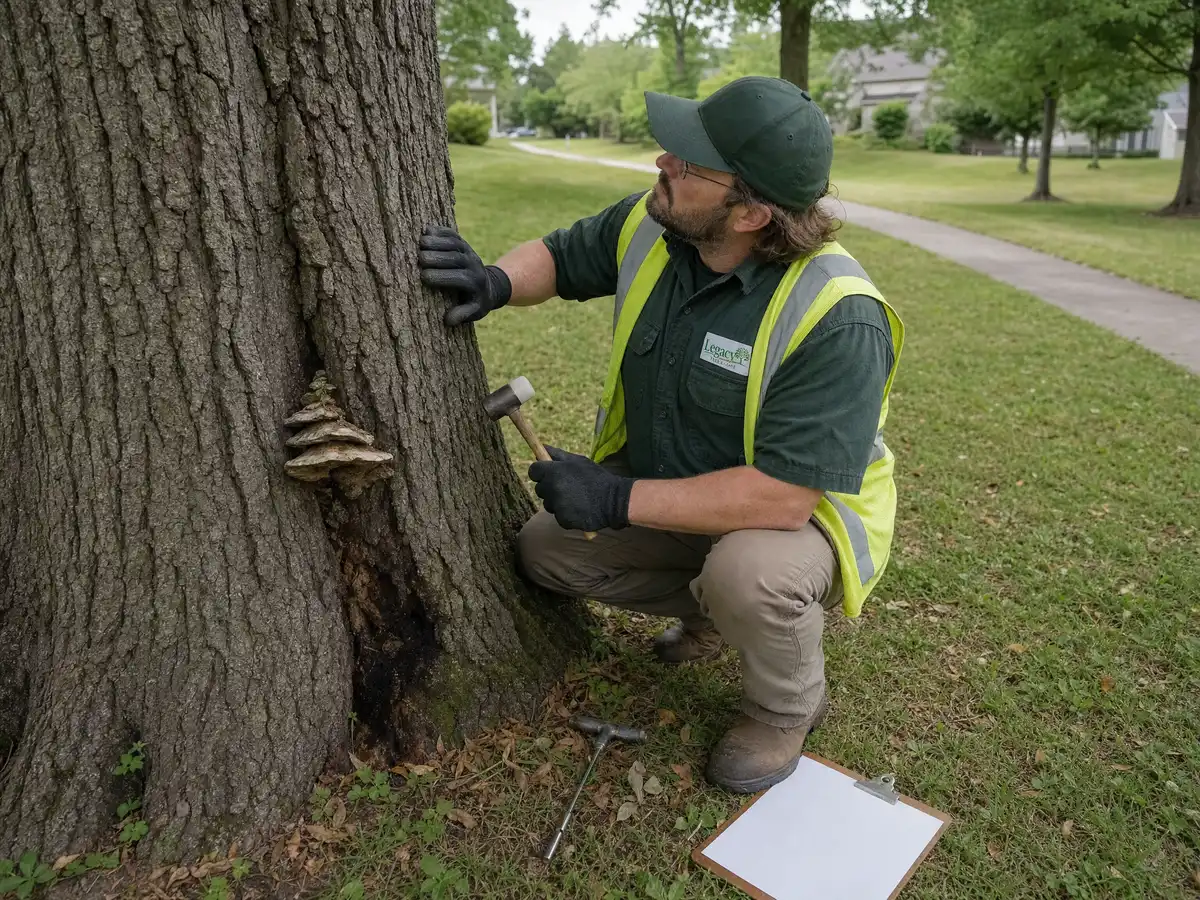
  • The Wood Is Already Gone

    A Legacy Tree Care arborist kneeling to sound a tree trunk with a mallet, beside a bracket fungus growing from the bark and a clipboard on the ground

    Support transfers load into sound wood. Where decay has taken the anchor points, there’s nothing to fasten to, and hardware becomes a false reassurance that delays a removal that was already necessary.

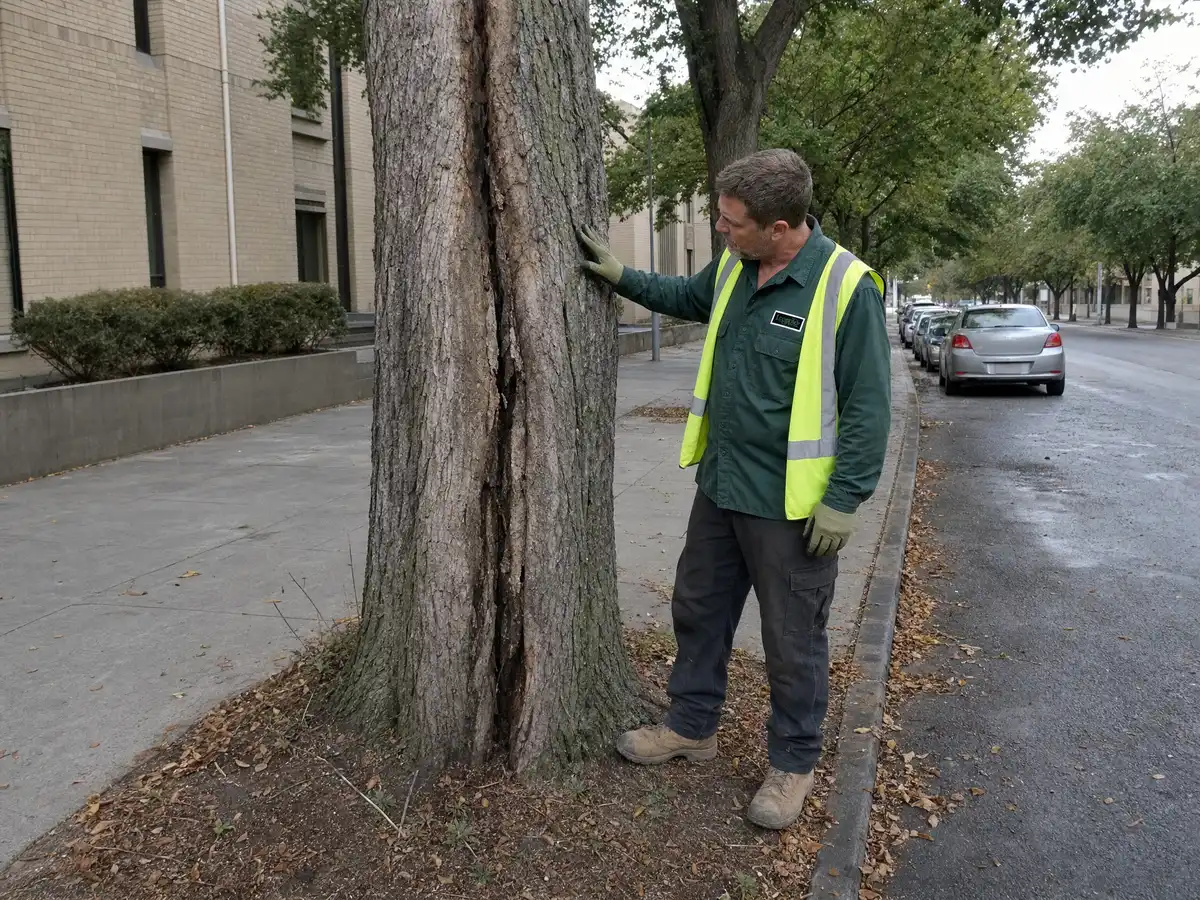
  • The Tree Isn't Worth It

    A Legacy Tree Care arborist with a hand on the trunk of a street tree, examining a long vertical seam in the bark beside a city sidewalk

    A young or common tree with a bad union is usually cheaper to replace than to support and inspect for thirty years. Cabling earns its place on trees that genuinely can’t be replaced inside a working lifetime.

  • Nobody Will Inspect It

    A Legacy Tree Care arborist photographing a large open decay cavity in a tree trunk, with a clipboard and folding ruler laid on the grass beside it

    Hardware is a commitment to a recurring inspection. Installed on a property with no plan to look at it again, it quietly becomes an unmonitored load path with a date on it.

It’s A Commitment, Not An Installation.

This is the part most quotes leave out, so it goes here.

Installed hardware needs inspecting on a regular interval, because the tree keeps growing around it and the loads keep changing. Attachment points need checking. On older installations we frequently find hardware the tree has partly absorbed, or a cable installed decades ago that’s now doing nothing at all.

A support system nobody inspects is worse than no system, because the property believes the risk was dealt with. If a site can’t commit to the inspection, that belongs in the decision before anything is installed.

What Installation Involves

The hardware itself is unremarkable. The judgment is in where it goes and how much of the tree it’s asked to hold.

Cables are installed high, typically well up the leaders rather than close to the union, because leverage is the whole point: the further out the attachment, the less force it takes to limit movement. Attachment hardware goes through the stem rather than around it, since anything wrapped around a growing tree eventually strangles what it was installed to protect.

Placement is decided from the defect rather than from a standard drawing. Two trees with the same species and the same diameter can need different systems, because the union sits at a different height and the load arrives from a different direction.

Work happens from the canopy, not from a bucket parked in a fire lane, which on an occupied commercial property usually means less disruption than the pruning visit that preceded it.

Where It Genuinely Earns Its Place

A large specimen shading twenty parking spaces or the front of a building, structurally sound apart from one union, on a site that will still be there in twenty years.

Nothing you plant will do that job again within twenty-five years, and the shade over that parking is an operating cost item rather than decoration. Against that, hardware and a recurring inspection is a small number.

The same defect on a middling tree in a back corner isn’t the same proposition, and we’ll say so.

Request A Walkthrough

Frequently Asked Questions

Cabling is flexible support installed high in the canopy, limiting how far two leaders move apart while allowing normal movement. Bracing is rigid rods through the union itself, resisting the stems pulling apart. A union that has already begun to split often gets both, with the rod holding the split and the cable reducing the load reaching it.

No, and that matters. It buys time on a defect by reducing what the weak point carries. The union doesn't heal and the tree doesn't become sound. Anyone describing it as a repair is describing something other than what the hardware does.

Codominant stems are two leaders of similar size competing from the same point rather than one trunk with branches. Where the bark of both grows inward into the union instead of knitting together, there's no real wood joining them. That's included bark, and it's the classic failure that drops half a tree.

On a regular interval for as long as the hardware is in the tree, because the tree keeps growing around it and the loads keep changing. The standard doesn't set a number: ANSI A300 Part 3 says systems should be inspected periodically for wear, corrosion, hardware degradation and damage to the tree, and leaves the interval to the site. The standard is specific about one thing, and it's the part worth knowing before you agree to any of it. Scheduling those inspections is the tree owner's responsibility, and we're required to tell you so before the hardware goes in. Annual is the usual answer where what's underneath is parking or an entrance.

There isn't a service life, which is the honest answer and also the problem. ANSI A300 Part 3 sets no lifespan for a support system. It requires that one is maintained and removed once it's no longer needed, which makes it a standing obligation rather than a fitting with a replacement date. On older installations we regularly find hardware the tree has partly grown around, or cables gone slack and contributing nothing. Both look like a tree that's been dealt with, from the ground.

When the anchor points are decayed, so there's no sound wood to fasten to. When the tree is common or young enough that replacement is cheaper than support plus decades of inspection. And when the site has no realistic intention of inspecting it, since unmonitored hardware is a false reassurance rather than a control.

Often, yes, and on a young tree it's a single small cut. A competing stem removed early never becomes a codominant union, which is the strongest argument for a structural pruning cycle on young commercial trees rather than waiting until the canopy is worth protecting.

Barely. Cables sit high in the canopy and are thin against the branches, and bracing rods are in the union rather than on the outside of the tree. On most commercial properties nobody notices them until they're pointed out.

Not usually for the hardware itself, though some cities restrict attachments to trees, particularly public ones. Where a tree is protected it's worth confirming, because the relevant question is often whether the work risks harming the tree rather than whether the fixing is allowed.

What was found, why support was recommended over the alternatives, what was installed and where, and when it should next be inspected. On a tree over parking or an entrance that record is the thing that answers what you knew and when, which is the question that actually gets asked after a failure.

Where To Start

Three Ways To Start On This Work

Pick whichever one matches where the decision actually sits, including the one that costs you nothing and commits you to nothing.

Something Is Wrong Now

Call. You'll reach a person at any hour. We respond immediately during business hours, and first thing the next morning if you call overnight.

(214) 668-8346

You Want To Know What You Have

An arborist walks the property, you get the condition and the scope in writing, and the estimate costs you nothing.

Request A Walkthrough

Nothing Is Wrong Yet

Get on file before the season. Properties we already hold move faster on a storm night, because the crew isn't spending the first hour learning the site.

Set Up A Vendor Agreement

Commercial property only, fully responsible for the outcome, and we call 15 to 30 minutes before we arrive. The insurance clears before a truck moves. (214) 668-8346.

Request A Walkthrough

Tell Us About The Property

We'll walk the site, put the condition of every tree in writing, and give you a scope you can take to a board or a budget meeting. No obligation, and no pressure to decide on the spot.

If a limb is down or a lane is blocked right now, calling is faster than a form.

Call (214) 668-8346

  • Insured & Bonded
  • Serving the Plano Area Since 2005
  • Emergency Dispatch
  • Commercial Property Specialists

Send Us The Details

Tell us the property type and what you're seeing. We'll come back with next steps.

Request A Property Walkthrough
A limb over the entrance, a tree that looks unwell, a permit deadline, storm cleanup, an annual contract you want quoted, or getting set up as a pre-approved vendor before storm season.
Request A Walkthrough Call Now