

The Work Is The Same Everywhere. The Rules Aren’t.
Pruning a live oak is pruning a live oak whether it stands in Plano or Wylie. What changes at the city line is what you’re allowed to do to it, what it costs you if you do, and what paperwork has to exist first.
That surprises people, and it surprises them expensively. Tree ordinances are municipal, not county and not state, so a process that worked on a property twenty minutes away may not transfer at all. One city here requires a separate removal permit; another has no private-property tree ordinance whatsoever. One calculates mitigation as a percentage of caliper inches, another as a ratio by species class, another as a running credit ledger. One enforces with a civil penalty per inch, another with a misdemeanor.
None of that is discoverable from a quote. It’s discoverable from the ordinance, which is why we read all eight of them rather than asking the city over the phone and hoping.
When The City Actually Matters
Most of our tree services in Plano aren’t touched by any of this. Scheduled pruning, cabling, health care and storm cleanup are governed by the same arboriculture wherever the property sits. The ordinance bites in three situations, and it bites hard in all three.
Taking A Tree Out

Whether you need a permit, what counts as protected, and what you owe in replacement are all municipal. A tape around the trunk answers all three, and the difference between two neighboring cities can be thousands of dollars on the same tree.
Developing Or Redeveloping A Site
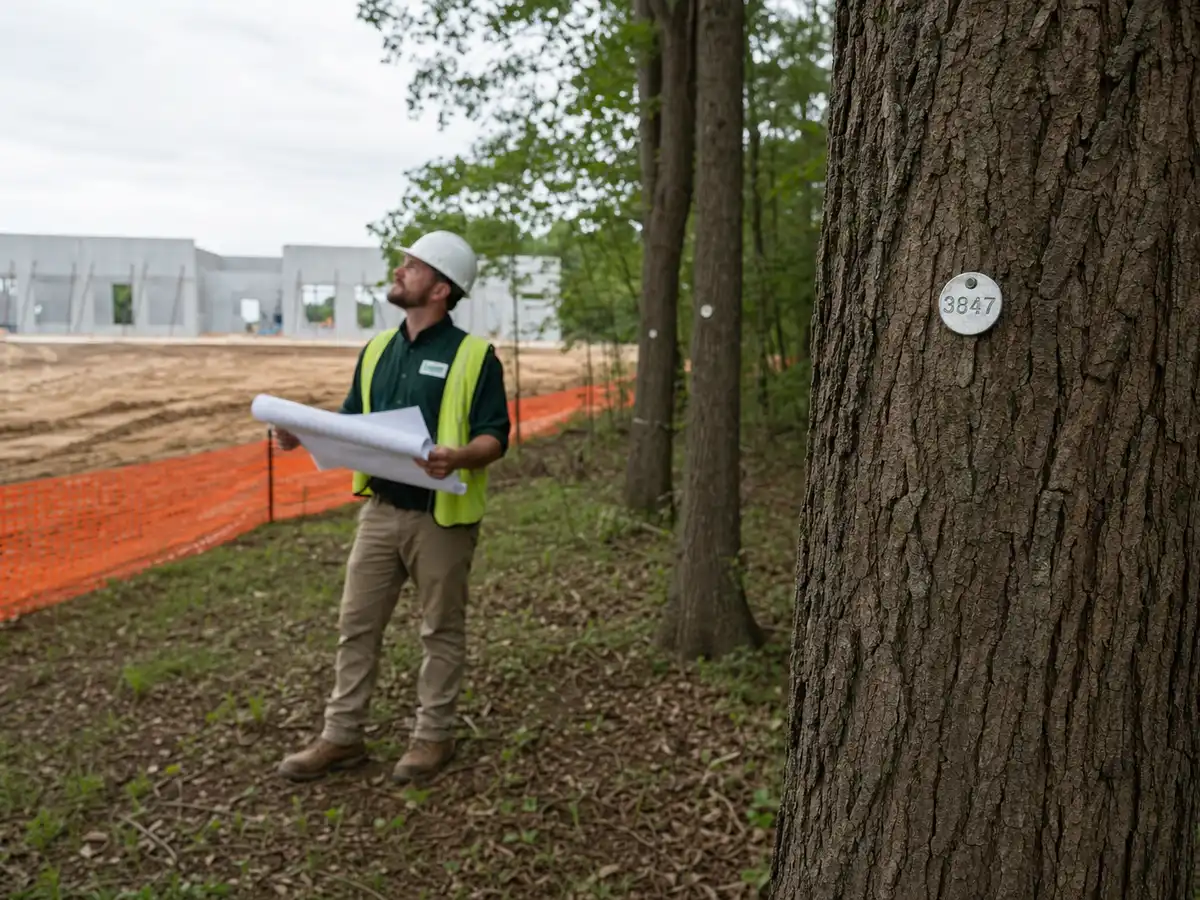
This is where it gets expensive, because the survey and the preservation plan shape what the site plan can do. Produced late, they mean redoing one or the other, and a rejected plan review costs more in schedule than the survey ever cost in fees.
What Doesn’t Change
Every property we work on gets the same three things regardless of which city it sits in.
An assessment before a quote. We look at the whole property rather than the one tree somebody called about, because the tree somebody called about is frequently fine and something behind it isn’t.
The condition of the trees in writing. What we found, what we recommend, why, and what happens if nothing is done. That document is what turns a decision into one you can defend to a board or an insurer.
Work planned around your operation. Lane closures, parking impact and trading hours agreed before crews arrive rather than negotiated in front of your tenants.
If Your City Isn’t Listed
We’re based in Plano and work across Collin, Dallas and Denton Counties, which covers considerably more ground than the cities below. The list is where we’ve done the ordinance research and written it up, not the limit of where we work.
If your property sits somewhere else in those three counties, ask. The honest answer will either be yes with the ordinance work still to do, or a straight no, and a straight no is cheaper for both of us than a crew that turns up unfamiliar with the site.
Cities We Work In, And What Changes Between Them.
One line each, taken from that city's own ordinance. If you manage property in more than one of them, these are the differences that cost money.
Richardson
No tree preservation ordinance for private commercial property at all. Its tree chapter covers public trees only, so on a Richardson site the documentation you keep is the only thing protecting you.
Frisco
Requires a separate Tree Removal Permit, and mitigates as a percentage of the diameter removed, climbing to 300 percent above 20 inches. The survey needs two seals, not one.
Garland
Class-based replacement ratios, and a civil penalty of $250 per diameter inch that applies to INJURING a tree, not only removing one.
Allen
Runs a credit ledger rather than a ratio. Removing costs exactly double what preserving earns, and the removal permit carries a 90 day clock.
McKinney
Three protected tiers, and a perimeter zone beside existing housing where protected trees may not be touched at all. Mitigation doubles above 17 inches.
Carrollton
Replacement runs to 100 percent of the diameter removed, clear-cutting is flatly prohibited, and a tree that dies within two years of the project still has to be replaced.
Wylie
The only one here that enforces criminally: removing or injuring a protected tree is a misdemeanor. Protection is also defined to exclude anything standing in the buildable area.
Dallas
Article X waives mitigation across the development footprint, but only to 70 percent of the site, never for excess parking, and never for a significant tree.