

Nobody Arrives Knowing Which Of These They Need
The list below is eleven commercial tree services. Most commercial properties need two or three of them, and which two or three isn’t obvious from the ground. A tree that has dropped a limb might need pruning, might need cabling, might need removing, and might need nothing at all. Those four answers have wildly different costs and the difference between them isn’t visible from a truck window.
Emergencies aside, that’s why assessment comes before the rest rather than being a service you can buy by the hour. An arborist’s job is to tell you which of the other ten you actually need, and to put the reasoning somewhere you can show a board six months later.
It’s also why we’d rather quote after walking a property than before. A number produced from a photo and a phone call is a guess wearing a decimal point.
When It Can't Wait
The first job is making the property safe and usable, not selling the cleanup.
Emergency Tree Service
Storm damage, a blocked lane or fire access, a tree on a structure. Lanes, entrances and fire access get cleared first, and the rest is scheduled once nobody is being routed around a hazard.
The Ones You’ll Probably Use More Than Once
Commercial property doesn’t consume tree work evenly. Most of it clusters in three places.
Scheduled Trimming And Pruning
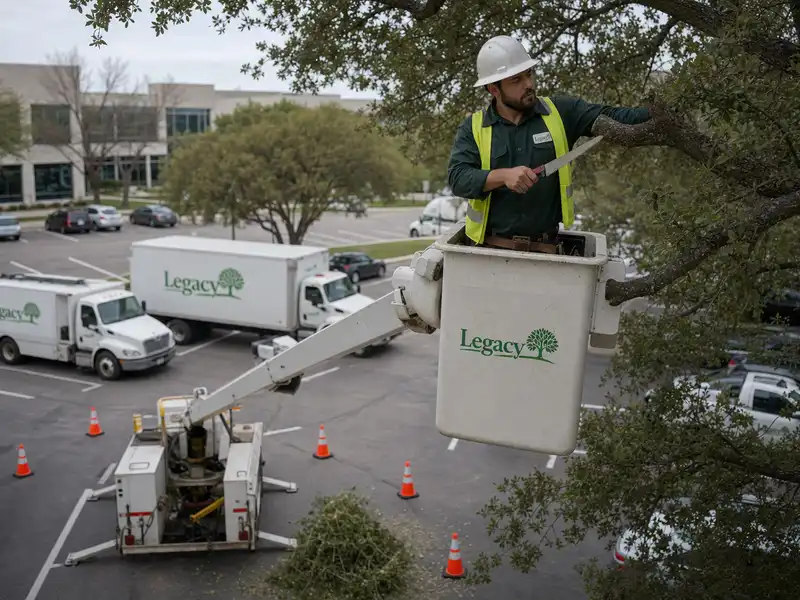
The largest by volume and the least urgent, which is exactly why it slips. Deferring it doesn’t save money, it converts a pruning line into a removal line several years out, and on a young canopy it decides what the property will be paying for in twenty years.
Storm And Emergency Response

The least predictable and the most expensive to arrange badly. The difference between a property that gets cleared the same morning and one that waits three days is almost always whether the relationship existed before the storm.
Documentation

The one nobody budgets for and everybody eventually needs, usually the week a claim, a permit application or a board question lands. It’s the cheapest of the three to produce in advance and the most expensive to produce under pressure.
What Getting Started Actually Looks Like
A walkthrough. We look at the whole property rather than the one tree somebody called about, because the tree somebody called about is frequently fine and something behind it isn’t.
What comes back is a written condition assessment, a recommendation with reasoning attached, and a scope you can take to a budget meeting. Where work is genuinely urgent we’ll say so plainly. Where it can wait a year, we’ll say that too, and we’ll tell you what changes if you wait longer than that.
There’s no obligation attached and no pressure to decide on the spot. If the answer is that the trees are in good condition and nothing needs doing this year, that’s a perfectly good outcome and you’ll get it in writing.
Knowing What You Have
Start here if nobody has assessed the property, or if a decision has to be defended later.
ISA Certified Arborist Consulting
When you need somebody to tell you what the trees are actually doing, and to sign their name to it. Usually before a budget cycle, a purchase, or a conversation with a board.
Tree Survey and Preservation Plans
When a site is being developed or redeveloped. Nearly every city here requires a sealed survey before a plan review, and producing one after the layout is fixed usually means redoing one or the other.
Keeping What's Worth Keeping
Most trees on most commercial property belong in this group, including a good many that somebody has already been quoted to remove.
Commercial Tree Trimming and Pruning
The one that gets deferred because nothing is visibly wrong. Deferring it doesn't save money, it moves the cost from a pruning line to a removal line a few years out.
Commercial Tree Cabling and Bracing
When a tree is worth keeping but has a defect that won't fix itself, usually a bad union carrying more weight every year. Frequently the alternative to a removal somebody has already quoted.
Commercial Tree Health Care
When trees are declining and nobody knows why. On newer property it's often planting depth or irrigation rather than anything in the canopy, and several of those causes are still correctable.
Taking Out What Isn't
When removal is genuinely the answer, the question becomes access: what's underneath, and what has to stay open while the work happens.
Commercial Tree Removal
When the tree is dead, the root plate has lifted, decay has reached a main union, or it sits somewhere it can't stay. You'll get the reasoning in writing rather than being asked to take our word for it.
Crane Assisted Tree Removal
When there's no straight drag path out, or what's underneath can't take the load: parking structures, courtyards, occupied buildings. Often cheaper than the ground protection the alternative would need.
Commercial Stump Grinding and Removal
After a removal, and it's usually the part that matters most on commercial property, because a stump left in place is a trip hazard, a mower obstacle and a replanting problem at once.
Commercial Land Clearing
When a site is being prepared rather than maintained. The constraint is almost always which trees have to survive the process, which is a survey question before it's a machinery question.