

Most Trees Lost To Construction Were Never Cut
They were compacted under repeated equipment tracking, trenched through on one side, or buried under a grade change nobody thought twice about. Then they declined slowly and died two or three years later, long after anyone would connect it back to the work.
That delay is the whole problem. The damage is invisible on the day it happens and undeniable when it finally shows, by which point the contractor has gone, the landscape maintenance period has closed, and the tree is still a mitigation obligation.
The Root Zone Is A Measurable Circle, And The Cities Disagree About Its Size.
Two of them define it numerically, and the two numbers aren’t close.
Garland uses a circle one foot in diameter for every one inch of trunk caliper, or the drip line, whichever is greater. Plano’s Root Protection Zone is one foot of radius per one inch of DBH.
On a twenty-inch tree that’s a twenty-foot circle in Garland and a forty-foot circle in Plano. Same tree, four times the protected area, because one ordinance says radius and the other says diameter. Reading one city’s rule and applying it eight miles away is how a site ends up with fencing in good faith and in the wrong place.
In both cases the drip line can be the larger figure on a mature spreading specimen. And in both cases it’s frequently more ground than a commercial site plan has left unallocated, which is why the conflict surfaces during grading rather than during design.
What Goes Up, And When.
The fence is the physical form of the root zone. Its position is the decision; its specification is just how the decision gets enforced.
At The Drip Line And Before Grading
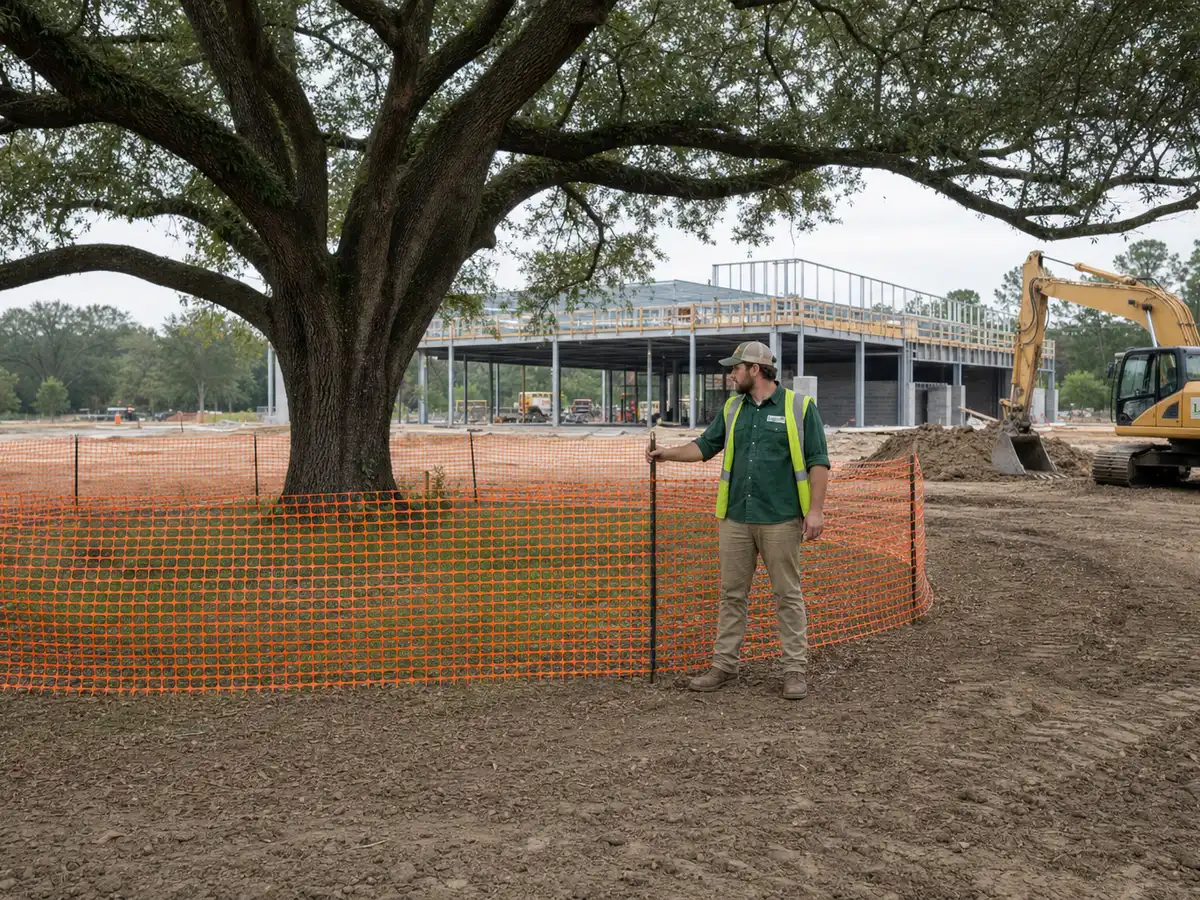
Frisco wants four-foot plastic or silt fencing in high visibility at the drip line, installed by the owner and inspected before the pre-construction meeting or the grading permit. Plano wants plastic mesh at four feet minimum, in place before grading.
Nothing Stored And Nothing Parked
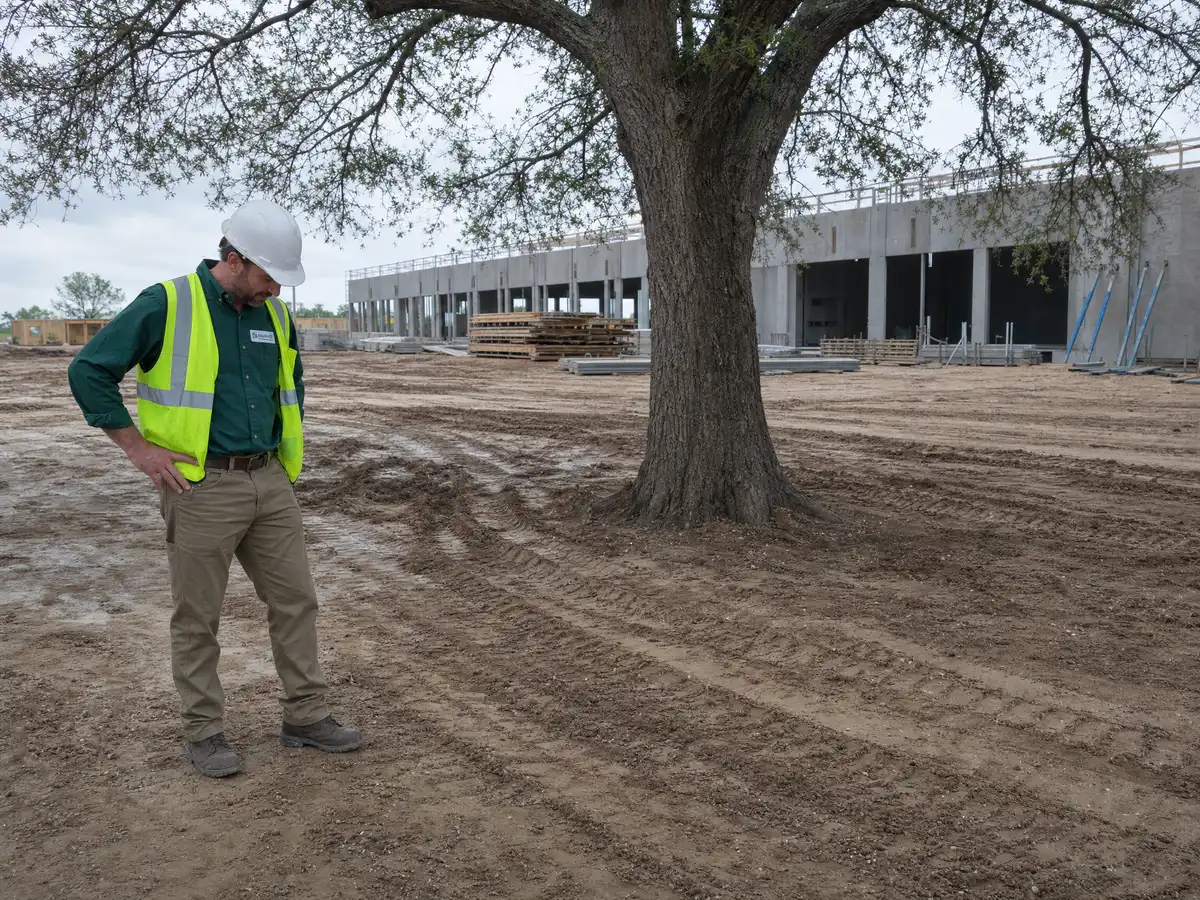
Garland bars disturbing natural grade inside the zone and bars using it for parking, equipment, material storage or chemical wash-out. Wash-out is the one that catches sites, because the spot gets chosen on the day rather than drawn on a plan.
Bored Rather Than Trenched

Carrollton can require a utility provider to bore under a drip line rather than trench through it. A trench that takes one side of a root plate can destabilize a tree that shows no symptoms for two more seasons.
Six Inches Of Fill Isn’t A Small Change
Wylie requires a retaining wall or a tree well at the drip line for any grade change of six inches or more, and the figure sounds far more trivial than it’s.
Roots sit much shallower than people expect, and the fine absorbing roots that do most of the work are in the top layer of soil. Fill over them restricts gas exchange to a system that needs it, and the tree responds over seasons rather than days. By the time the canopy thins, the fill has been in place long enough to look like part of the site.
Plano lands in the same place by a different route: no fill or excavation within the drip line of a tree to be preserved unless there’s a specific approved plan for tree wells or retaining walls, and major changes of grade of six inches or greater requiring additional measures to maintain oxygen and water exchange with the roots.
Wylie also bars wires and attachments other than protective ones, and restricts clearing brush under drip lines to hand or mower work, never a dozer or a loader. That rule is about the machine, not the brush. A loader clearing undergrowth compacts the root zone while it does it.
Dallas Writes The Delay Into The Ordinance
Most codes prohibit removal and leave damage to be argued about. Dallas defines it instead, with a causation standard covering an act that will more likely than not cause a tree to decline and die within five years, and it names excessive pruning, topping and soil compaction expressly.
Five years is a long horizon written into a municipal code, and it exists because that’s genuinely how long construction damage can take to resolve into a dead tree. It’s also the clearest official acknowledgment in this market that the day the damage happens and the day it becomes visible are different days.
The Obligation Outlives The Contractor
Carrollton carries a survival obligation two years past project completion. Allen carries three, written into a tree mitigation agreement.
So a tree that was preserved on the approved plan, and then died from what happened around it, can arrive as a replacement obligation after the contractor has demobilized and the retention has been released. The owner is holding it either way.
Which makes dated photographs of the protection measures worth more than they look: fencing in position before grading, the root zone intact during the work, and the condition of each preserved tree at handover. That file is the difference between a conversation about who caused it and an assumption about who pays.
The Rest Of What The Rules Ask For
The provisions themselves, explained once rather than nine times: what counts as protected, what a permit is called here, and what has to exist before a tree comes out.
- Tree Ordinance Compliance Across Collin, Dallas And Denton Counties
- Tree Mitigation Plans And What A Removal Really Costs
- Tree Removal Permits And What Each City Actually Calls It
- What Counts As A Protected Tree And Where The Line Sits
- Tree Preservation Plans: What Goes In One And Who Signs It
- Tree Protection During Construction On Commercial Sites
- Paying A Fee Instead Of Planting Replacement Trees
- Who Approves A Tree Removal, And How A Refusal Is Appealed
- Perimeter Zones, Floodplain Limits And Protected Natural Areas
- Street Trees, Rights-Of-Way And Trees On Public Property
- Tree Due Diligence Before You Buy Or Lease A Site
- When Tree Work Belongs In A Construction Schedule
- Tree Rules On An Operating Property, With No Construction
- Ordinances Get Amended, And The Version Matters
- Tree Ordinance Rules In HOA Common Areas
- Screening, Buffers And The Trees That Have To Stay
- Putting Tree Protection In A Contractor Scope Of Work
- Parking Lots, Paving And The Trees Underneath Them
- Storm Removals And What The Ordinance Still Wants After
- Trees In Easements And Who Actually Controls Them
- Choosing Replacement Trees, And Why Species Caps Exist
- Tree Ordinance Terms, Translated Into Plain Language
- How To Find Out Which Tree Rules Apply To Your Site
- See All City Tree Ordinances