

The Code Looks At The Property
Municipal tree provisions are written against land. They attach to a site, they’re enforced against whoever owns it, and they take limited interest in the commercial arrangements behind the work.
Garland’s penalty provision reaches the property owner as well as the person doing the work, and extends to anyone who allows or suffers the activity. Frisco goes further in a quieter way: its protective fencing is to be installed by the owner, in terms, and inspected before the pre-construction meeting or the grading permit.
Which sets up the practical point of this page. The code won’t move a penny of that exposure onto the party who caused it. Only the contract can do that, and only if it says so.
What Belongs In The Scope
Six items, all of which get assumed on projects where they later go wrong.
Extent And Standard
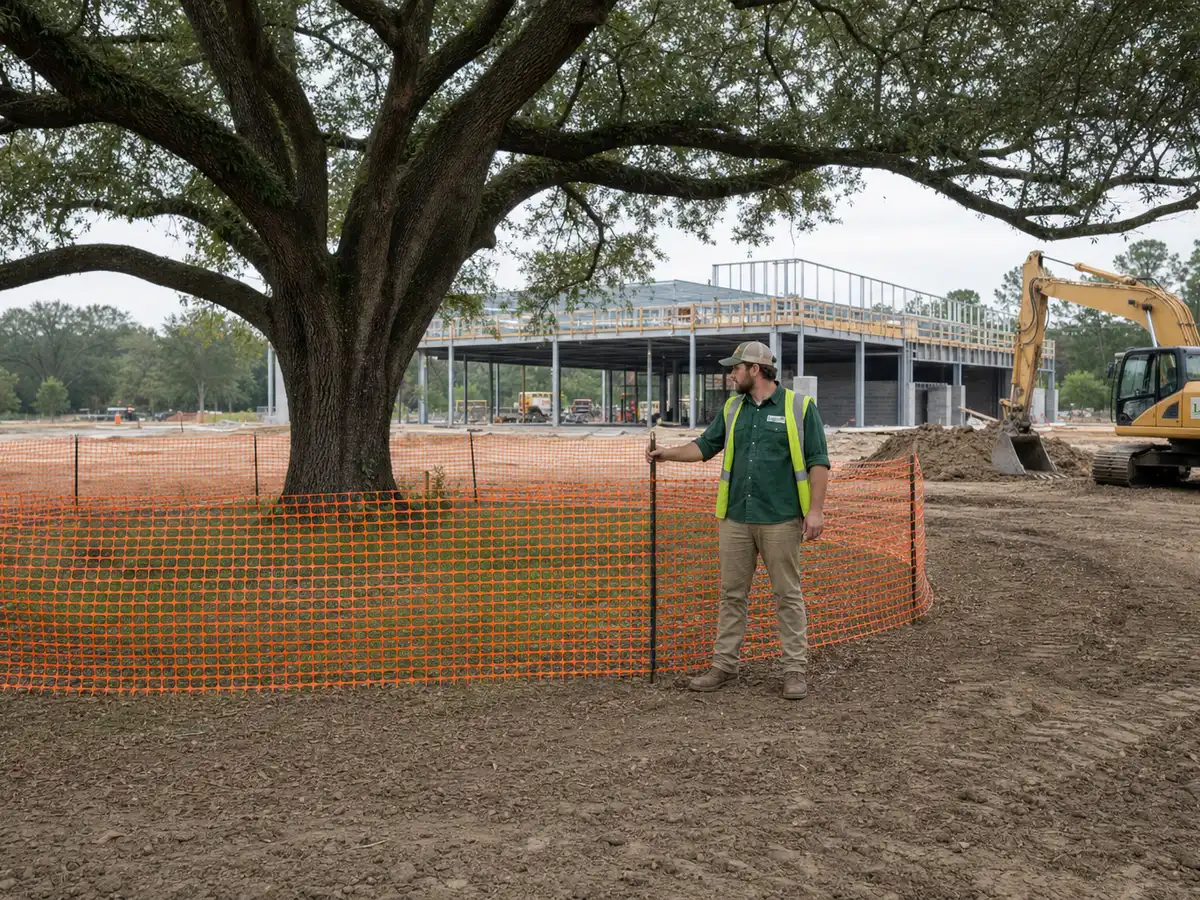
Where the protection sits and what it’s made of, both calculable in advance. The protected area follows from trunk measurements and the fencing carries a specification, so neither needs to be settled on site.
Who Books The Inspection

Where an inspection precedes the grading permit, somebody has to arrange it. Unassigned, it becomes the reason a permit sits waiting, and it’s the cheapest delay on any project to avoid.
What's Prohibited Inside
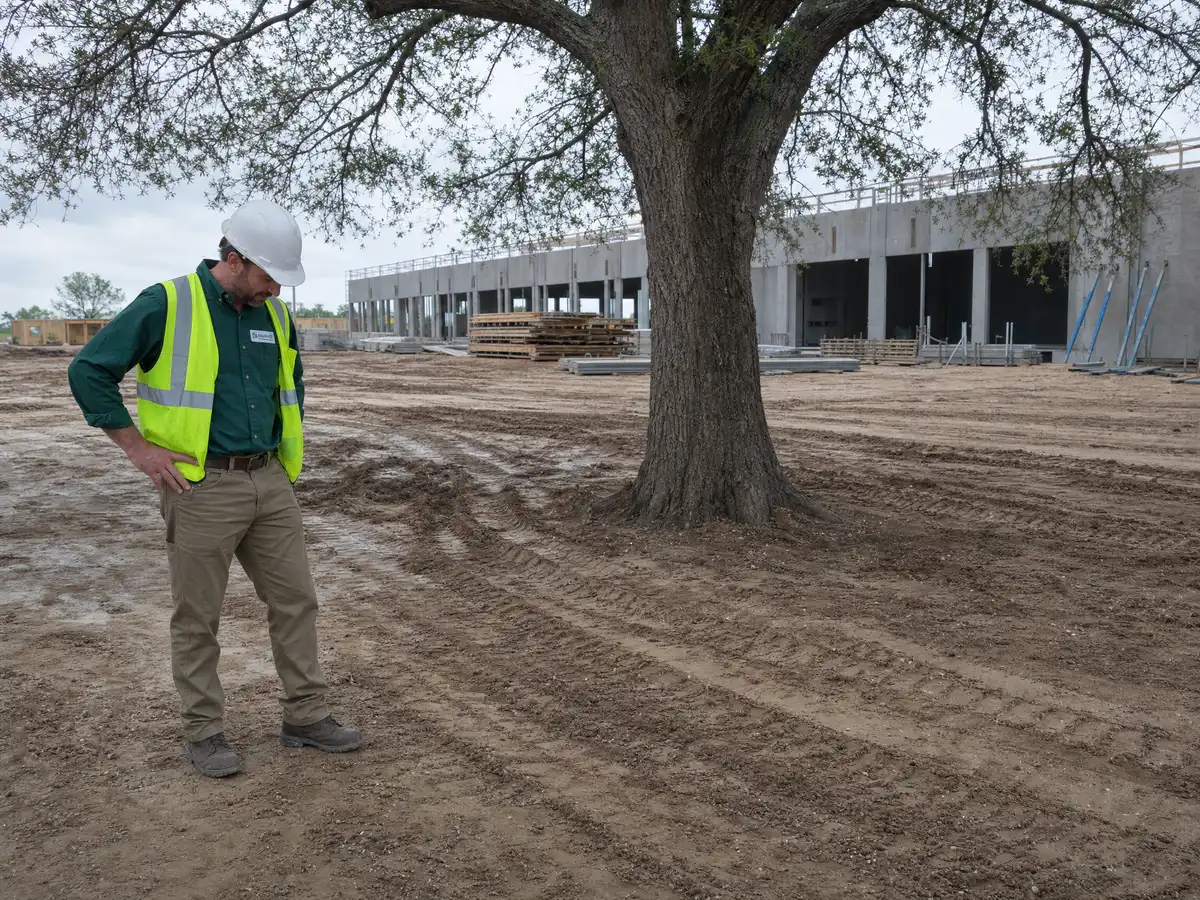
Parking, equipment, material storage and chemical wash-out are four distinct site habits. Naming them individually works; a general instruction to respect the fencing doesn’t, because the wash-out spot gets chosen by whoever needs one.
Price It As A Line, Not As Preliminaries.
Tree protection has a measurable extent, a specification and a date, which makes it a straightforward line item.
Folded into general preliminaries it becomes something else: an unpriced expectation, first to be squeezed when the number needs to come down, and last to be checked when the program tightens. Nobody defends a cost they can’t see.
Priced separately it also becomes verifiable. There’s an amount attached to something that either happened or didn’t, and a photograph settles which.
The Contract Usually Ends Before The Damage Appears
This is the structural problem, and no amount of care on site resolves it entirely.
Compaction and root loss take seasons to express, and Dallas puts a five-year horizon into its ordinance in recognition of exactly that. Practical completion, the defects period and the retention release all happen well inside that window.
So a project that ends with no record of tree condition has quietly decided the question in advance: when a preserved tree fails two summers later, there’s nothing to argue from, and the owner holds it.
Handover Is Where This Gets Cheap
The remedy is a small file, assembled while everyone is still on site.
Dated photographs of the protection in position during the works. The condition of each preserved tree at completion, recorded rather than assumed. A note of what was planted, under what obligation, and when any survival period ends.
It takes an hour. It’s also the only account of what happened that will still exist in three years, by which point it’s either the reason a claim resolves quickly or the thing nobody made.
The Rest Of What The Rules Ask For
The provisions themselves, explained once rather than nine times: what counts as protected, what a permit is called here, and what has to exist before a tree comes out.
- Tree Ordinance Compliance Across Collin, Dallas And Denton Counties
- Tree Mitigation Plans And What A Removal Really Costs
- Tree Removal Permits And What Each City Actually Calls It
- What Counts As A Protected Tree And Where The Line Sits
- Tree Preservation Plans: What Goes In One And Who Signs It
- Tree Protection During Construction On Commercial Sites
- Paying A Fee Instead Of Planting Replacement Trees
- Who Approves A Tree Removal, And How A Refusal Is Appealed
- Perimeter Zones, Floodplain Limits And Protected Natural Areas
- Street Trees, Rights-Of-Way And Trees On Public Property
- Tree Due Diligence Before You Buy Or Lease A Site
- When Tree Work Belongs In A Construction Schedule
- Tree Rules On An Operating Property, With No Construction
- Ordinances Get Amended, And The Version Matters
- Tree Ordinance Rules In HOA Common Areas
- Screening, Buffers And The Trees That Have To Stay
- Putting Tree Protection In A Contractor Scope Of Work
- Parking Lots, Paving And The Trees Underneath Them
- Storm Removals And What The Ordinance Still Wants After
- Trees In Easements And Who Actually Controls Them
- Choosing Replacement Trees, And Why Species Caps Exist
- Tree Ordinance Terms, Translated Into Plain Language
- How To Find Out Which Tree Rules Apply To Your Site
- See All City Tree Ordinances