

Most Of These Trees Were A Condition Of Approval
On an industrial site nobody planted trees for the view. They’re there because a landscape ordinance required them before the certificate of occupancy issued, and they were drawn on a plan somebody approved.
That changes what removing one means. On a campus a tree comes out because it’s dangerous or in the way; here it can also put the site out of compliance with its own approved plan, with replacement owed at a ratio the city sets rather than one you negotiate.
So the first question about any industrial tree isn’t its condition. It’s what it’s doing on the plan, and that’s answerable before anything is cut rather than afterwards.
Where Trees And Operations Actually Collide
Three places, and none of them is about how the trees look.
Clearance Over The Apron
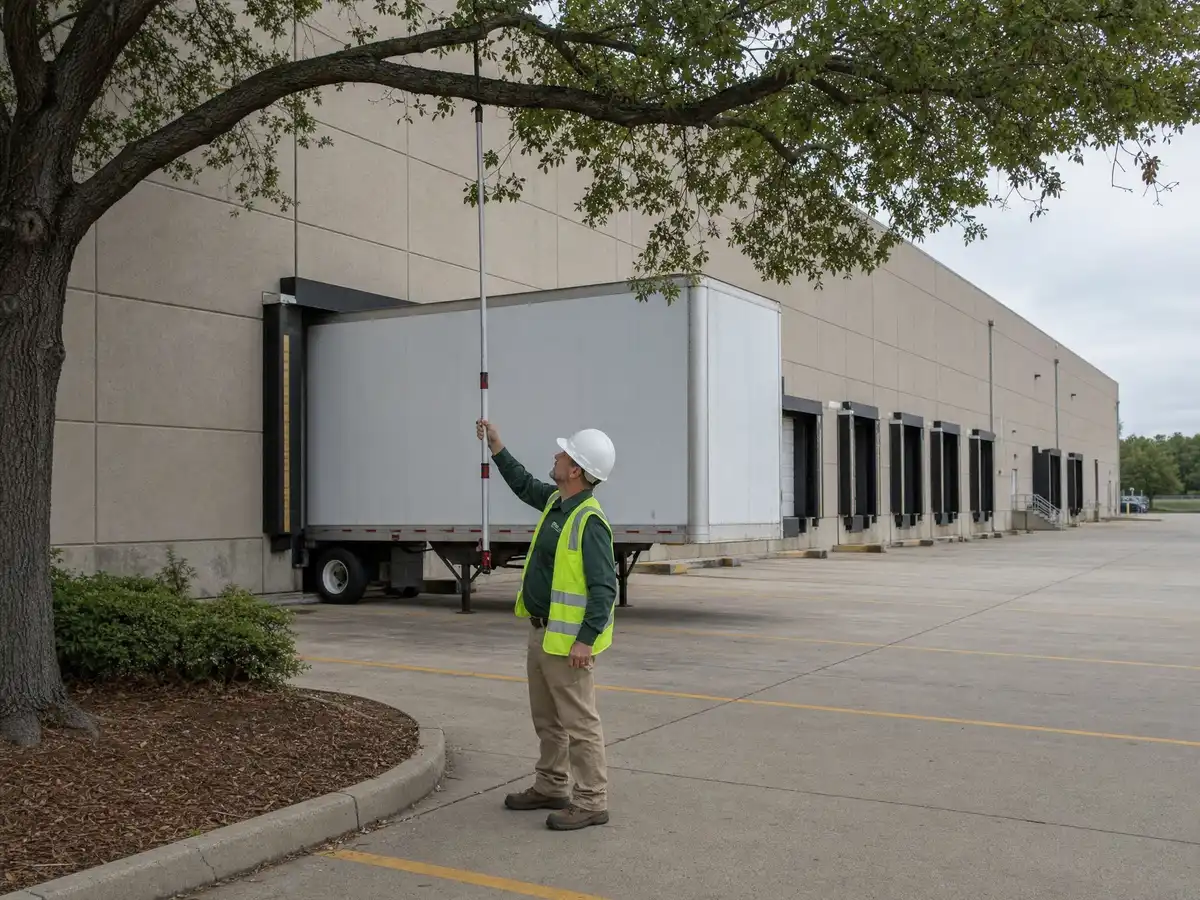
A limb lower than a trailer is a strike waiting to happen, and the strike damages the tree as well as the equipment. Pruned to a measured height it holds for a season; pruned to wherever the last impact happened, it doesn’t.
The Residential Buffer

The one your neighbors look at every day, and the one most likely to generate a complaint to the city. Thin screening is usually spacing and species rather than neglect, which is why replanting the same way fails the same way.
Trees On The Basin Bank

Saturated ground holds a root plate far less firmly than dry ground. Basin banks produce leaning trees and windthrow out of all proportion to how few trees are on them.
Clearance Is A Number, Not An Opinion.
Everywhere else on this site, pruning decisions involve judgment about the tree. Clearance is the one place where the answer is arithmetic: a trailer is a known height, a fire lane has a required width and clear height, and a limb is either above that or it isn’t.
Which makes it the easiest thing on an industrial site to get right and the most common thing to get wrong, because it’s usually done reactively. A limb gets clipped, that limb gets cut, and the next one down the row gets clipped a month later. Limbs along a lane grow at the same rate, so the one that caused the damage is rarely the only one at that height.
Doing the lane to a measured clearance in one visit costs less than three reactive calls and buys a season rather than a week.
The Buffer Is What The Neighbors See
The screening strip between an industrial property and the housing behind it is the only part of your landscape somebody looks at from their kitchen window. It’s also the part most likely to turn into a call to the city rather than a call to you.
When it goes thin, the instinct is to replant into the gaps. That usually fails, because the reason it went thin is rarely neglect: evergreens planted too tightly in a narrow strip shade each other out from the inside and go bare at the bottom first, which is exactly the height the screen is needed at. Replanting the same species at the same spacing reproduces the same failure on a delay.
What works is changing the spacing, the species, or both, and accepting that a screen takes a few seasons to close. What doesn’t work is arguing that it’s adequate when the person behind the fence can see your wall through it.
Pavement Is The Expensive Part
Root damage costs more here than anywhere else on this site, and not because the roots behave differently. Pavement built for loaded trucks is far more expensive per square foot than a parking bay or a walkway, so the same lifted slab carries a much larger repair bill.
It’s also more predictable. The damage concentrates where vehicles turn, because that’s where the load is highest and where landscape islands sit closest to the traffic. Those are the locations worth inspecting on a schedule rather than waiting for the surface to tell you.
Who Else We Write For
The same work, answering to somebody different.
Commercial Property Managers
Portfolios, budget cycles and an owner who wasn't there.
HOA Boards
Dues, meetings, and neighbors who can see the tree from the kitchen.
Developers And Contractors
Surveys and preservation plans, where the currency is weeks.
Corporate Campuses
Old canopy, one long-term owner, and staff who notice everything.
Retail Centers
Trading hours, parking bays and tenants who raise sightlines.
Municipal And Public Sector
Procurement, public duty of care, and a file that gets opened.