

When Removal Is The Right Call, And When It Isn’t.
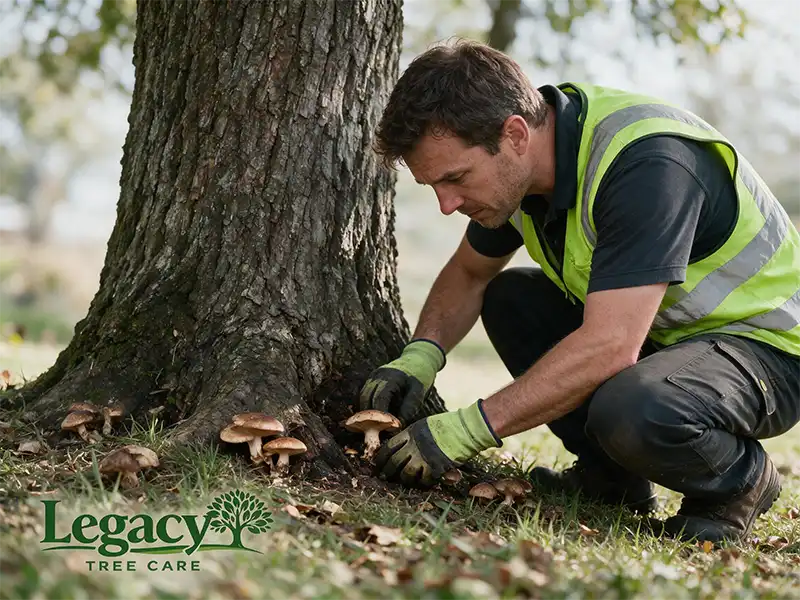
Most of the trees we’re asked to remove don’t need to come out. That’s a strange thing for a removal page to admit, but it’s the difference between a contractor and an arborist, and it’s the reason property managers keep our number. A tree that’s dropped a large limb isn’t automatically a hazard. A tree that leans isn’t automatically failing.
So the first thing that happens is an assessment, not a quote. We look at the root plate, the trunk, the unions where the major limbs meet, and the target underneath. That order isn’t arbitrary: research reviewed in Arboriculture and Urban Forestry found that when failure points were traced in park trees that had already been removed, between 50 and 70 percent of them sat in the lower portion of the tree, the roots, root flare and trunk.
The part of a tree most likely to fail is the part you can’t see from a truck window. Sometimes the answer is a crown reduction that takes weight off a bad union and buys the tree another fifteen years. Sometimes it’s cabling. Sometimes it’s removal, and when it is, you’ll get the reasoning in writing rather than being asked to take our word for it.
When removal genuinely is the answer, it’s usually one of these:
- The tree is dead, or declining past the point where treatment changes the outcome
- The root plate has lifted, which is the failure that gives you the least warning
- There’s significant decay at the base or through a main union
- The tree is structurally sound but sits where it can’t stay, like a foundation, a fire lane, or the footprint of a planned build

Removal On An Occupied Property Is A Different Job
Taking a tree down in an empty lot is tree work. Taking the same tree down beside a leased office building on a Tuesday morning is logistics with tree work in the middle of it.
The tree is often the easy part. The hard part is the hundred feet around it: which lanes close and for how long, where the chipper stages without blocking a loading dock, how tenants reach the entrance while the drop zone is live, and what happens if the work runs past the window you agreed with them. A crew that shows up without answers to those questions costs you more in tenant complaints than the removal saved.
We plan that before we mobilize and we put it in the scope: the staging plan, the lane closures, the hours, and the name of the person on site who owns the job. On most properties we can work early mornings, weekends, or overnight where that’s what keeps the disruption off your tenants’ day.
The Paperwork Is Half The Job
Ask anyone who manages commercial property what actually goes wrong with tree vendors and you’ll rarely hear about the tree. You’ll hear about the certificate of insurance that arrived three days after the crew did, the invoice that didn’t match the scope, or the removal nobody can document once an adjuster starts asking.
Insurance clears before anyone mobilizes. Your certificate holder language, your additional insured requirements, and your limits get sorted before a truck is loaded, not chased afterward. This is the single most common reason a commercial job goes wrong, and it’s entirely preventable.
This isn’t a rare problem. The same review of tree risk research reports a survey in which 52 percent of responding communities acknowledged that claims had already been filed against them over trees, and, more tellingly, that communities which had been through a claim were twice as likely to be running an active risk assessment program. Documentation is what organizations adopt after they get sued. The argument for doing it first is that it costs the same either way.
Everything else gets written down too: what condition the tree was in, why it came out, what we did, and how the site looked when we left. That record is the part you keep. It’s what you hand a risk manager, what an adjuster asks for, and what answers a board that wants to know why the budget line moved. Nobody thinks about the documentation until the moment they need it, and by then it either exists or it doesn’t.
Plano’s Tree Ordinance, Before You Schedule.
Plano regulates tree preservation, and non-residential property sits under requirements that don’t apply to a homeowner’s back yard. Getting that wrong is expensive in a way that has nothing to do with the cost of the removal itself, so here are the numbers rather than a warning about them.
Under Article 17 of the Plano Zoning Ordinance, trees 8 inches or larger in caliper have to be shown individually by location and species. Removal triggers replacement, and the rate isn’t flat: trees from 8 to 30 inches are replaced inch for inch, and trees over 30 inches at 1.5 inches for every inch removed. The minimum replacement tree is 4-inch caliper. That last threshold is the one that surprises people, because a mature 36-inch oak carries half again its own caliper in replacement obligation, and most summaries of this ordinance say a flat one-to-one.
The preservation rules bite before anything is cut, too. Protected trees need a mesh fence at least 4 feet high standing before grading or brush removal begins, no fill or excavation inside the drip line without an approved plan, and a root protection zone measured at one foot of radius for every inch of trunk diameter. Grade changes of 6 inches or more need extra measures to keep air and water reaching the roots.
We treat all of that as part of the scope rather than leaving it with you, and where the arithmetic favors it we’ll tell you that the ordinance also allows a fee paid to the city in lieu of replacement, subject to approval. Where a removal needs city involvement, you’ll know before it’s scheduled, not after a crew is standing in your parking lot. The City of Plano's Urban Forestry department publishes the current requirements, and where a situation is genuinely unusual we’ll tell you that and go find out rather than guess.
This matters most on redevelopment sites, where the trees that stay and the trees that go are decided long before anyone brings a saw, and where a survey done late can hold up a schedule that has nothing to do with landscaping.
What Actually Drives The Cost
You won’t find a price range on this page, because a number that isn’t attached to your tree is marketing rather than information. What we can tell you is what moves the figure, and it’s rarely the thing people expect. Size matters less than what surrounds the tree.
| What Changes The Price | Why It Moves |
|---|---|
| Access | A large oak with a clear drop zone and room for a chipper is often cheaper than a smaller tree over a roof, because the second one has to come apart in controlled pieces |
| Rigging Or Crane | Anything over a structure, a parking deck, or something slow to repair needs controlled lowering. This is the biggest single driver on most commercial jobs |
| Timing | Work outside business hours costs more than work during them, and is often still the cheaper choice once you price a closed lane |
| Cleanup | Full stump grinding, chasing surface roots, and restoring a bed or lawn area all cost more than leaving a flush cut |
We’d rather show you those choices and let you decide than bury them in one number. It also means a quote from us can be compared line by line against a quote from anyone else, which is harder than it sounds in this trade.
Credentials Are Worth Checking, Including Ours.
The International Society of Arboriculture holds credentialed arborists to a code of ethics and to industry standards. On what a credential actually establishes, it says:
Certification demonstrates the individual has the minimum knowledge and skill requirements to perform work according to the scope of the program they hold a credential in.
International Society of Arboriculture
That’s worth verifying on any vendor you let onto your property, and it’s worth verifying on us. Ask for the credential, ask for the insurance, and ask for the scope in writing. A company that hesitates on any of the three has told you something useful, and it costs you nothing but the asking.
The Rest Of What We Do
Eleven services for commercial property. Most sites need two or three.
- Commercial Tree Trimming and Pruning
- Emergency Tree Service
- Crane Assisted Tree Removal
- Commercial Stump Grinding and Removal
- Commercial Tree Cabling and Bracing
- ISA Certified Arborist Consulting
- Commercial Tree Health Care
- Commercial Land Clearing
- Tree Survey and Preservation Plans
- See All Commercial Tree Services