

The One City Here Without A Permit Regime
Every other page in this block is organized around an obligation: what’s protected, what you must submit, what you owe if you remove it. Richardson has to be written the other way around, because on private commercial property that obligation largely doesn’t exist.
The city does have a tree chapter. Chapter 22.5, Tree Preservation and Conservation, is about public property: planting and removal on public land, injuring public trees, attaching things to them, and the Tree Board. It’s a real chapter doing a real job, and it isn’t a private-property preservation regime.
The zoning side has landscape requirements rather than tree ones. Site development requires an approved landscape plan for nonresidential uses, and those standards cover irrigation, screening, planters and replacing dying plant material. They govern what you plant and maintain, not what you may remove.
What Fills The Gap Instead
Removing the permit doesn’t remove the risk. It removes the paperwork that would otherwise have documented it for you.
The Condition Nobody Recorded
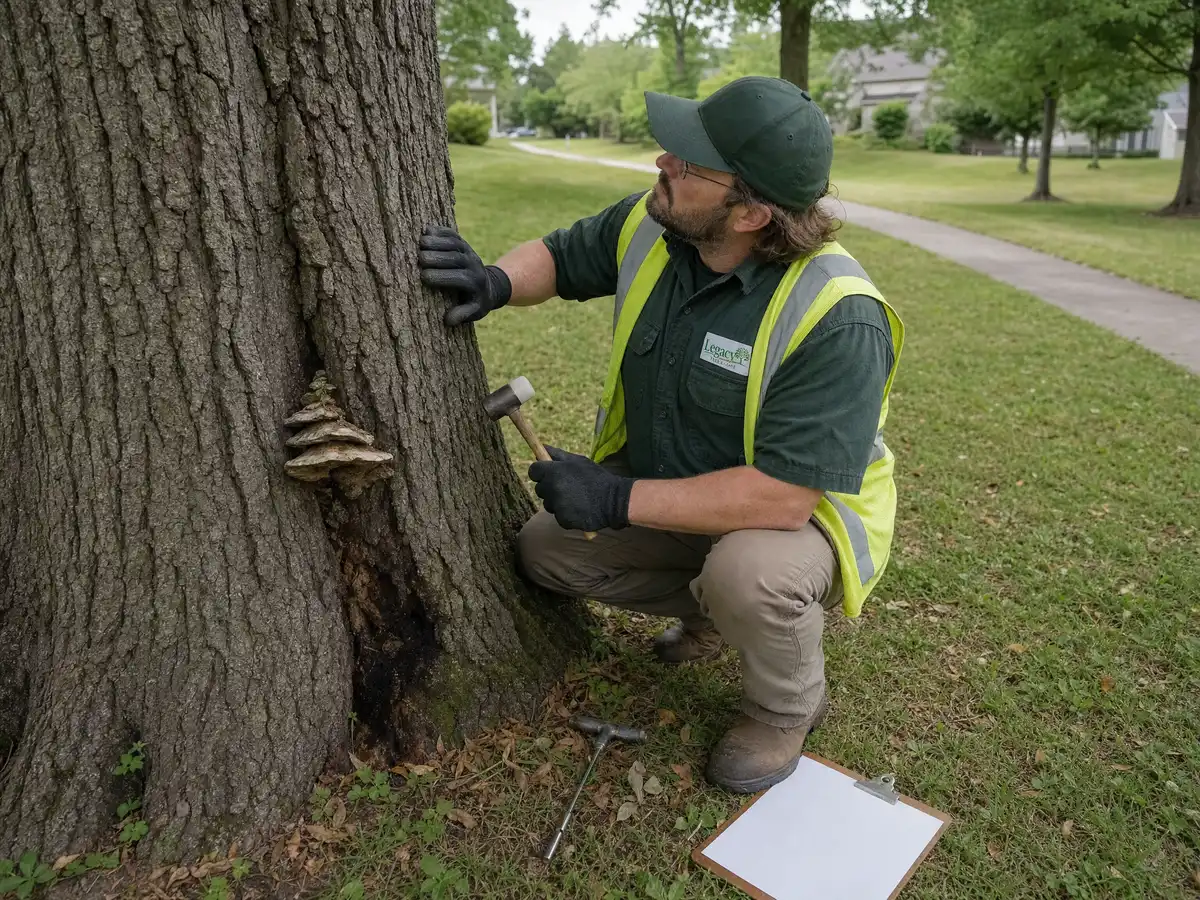
In a permit city the survey exists because the city demanded it. Here nothing demands it, so the question of what condition a tree was in before it failed has whatever answer you can produce, and often none at all.
The Record You Chose To Make

Dated, photographed, measured, with the reasoning attached. It’s the same file a permit regime would have forced into existence, produced voluntarily, and it’s worth more here than anywhere else in this market.
A Canopy Old Enough To Fail

Richardson’s commercial corridors were built in the sixties and seventies, so the trees on them are mature. That’s the age at which codominant stems fail and root plates shift, rather than the age at which trees merely disappoint.
No Permit Isn’t The Same As No Liability
The absence of a municipal process is genuinely convenient. It’s also the whole reason this page is worth reading, because the exposure that survives is the one that actually costs money.
A tree that fails onto a car, a walkway or a person produces one question: what did the owner know, and when. In Frisco or Garland there’s a paper trail whether you wanted one or not, because the city required a survey, a plan and an inspection. In Richardson there’s exactly as much record as you decided to create, and “nobody made us” isn’t an answer to that question.
That cuts both ways, which is the honest part. An owner who documented condition, acted on what the document said, and kept the file is in a better position than an equivalent owner in a permit city, because the record was built around the actual trees rather than around a submission deadline.
What We’d Actually Do Here
Not a permit application, because there’s nothing to apply for. An assessment and a record, which is the part a permit regime would have compelled elsewhere.
That means condition established and dated before anything is touched, defects photographed with scale in frame, the reasoning written down in language somebody outside the company can follow, and a note of what was done and when. On a mature canopy it also means knowing which handful of trees carry consequence, because a 1970s corridor usually has a small number of trees over walkways and parking doing most of the risk.
That’s a smaller job than a compliance submission and a more useful one, and it’s the honest answer to what a commercial owner in Richardson should buy.
One Caveat Worth Taking Seriously
Everything above describes the general position, established by reading Chapter 22.5 and Article XXII-C of the Comprehensive Zoning Ordinance in full and confirming the zoning article list carries no tree article.
It isn’t the same as having read all thirty-two zoning articles, and it says nothing about conditions attached to a specific property. A planned development ordinance or a site-specific zoning condition can carry tree and landscape provisions the general code doesn’t, and those attach to your parcel rather than to the city.
So for a specific site, check the zoning case rather than relying on a general answer, including this one. The value of knowing the general position is knowing what to look for, not knowing you can skip looking.
The Instrument, City By City.
What each city actually uses to regulate a tree, taken from its own code. No two of these are the same document.
Plano
Article 17 of the Zoning Ordinance. The preservation plan IS the permit, replacement runs inch for inch from 8 to 30 inches and 1.5:1 above that, and a fee in lieu is available with the Director's approval.
Frisco
Subsection 4.01 of the Zoning Ordinance. A separate Tree Removal Permit, mitigation banded as a percentage of diameter removed from 0 to 300 percent, and a survey needing two seals rather than one.
Dallas
Article X, Landscape and Tree Conservation. Protected at 8 inches, mitigation waived across the development footprint up to 70 percent of the site, and topping defined and regulated by name.
Garland
A Tree Management Plan plus Removal Authorization, class-based replacement ratios from 2:1 down to 0.25:1, and a civil penalty of $250 per diameter inch.
Allen
Land Development Code Article VII. A credit ledger rather than a ratio, where removal costs exactly double what preservation earns, and a 90 day clock on the permit.
McKinney
Unified Development Code Article 4. Three protected tiers, mitigation doubling above 17 inches, and a perimeter zone beside existing housing where protected trees may not be altered at all.
Carrollton
Chapter 155. Replacement at 100 percent of the diameter removed, clear-cutting prohibited outright, and a survival obligation running two years past the end of the project.
Wylie
Zoning Ordinance Article 7. Enforced criminally as a misdemeanor at $100 per caliper inch, and protection is defined to exclude trees standing in easements, rights-of-way or the buildable area.
- See All City Tree Ordinances