

Trees Are A Schedule Item Wearing A Landscape Costume
On a development, tree work gets budgeted with the landscaping and it belongs with the entitlements. Nothing about a tree costs you money as reliably as a tree that stops a plan review.
The pattern is always the same. The survey and the preservation plan are needed before the site plan can be finalized, because they define what the layout has to work around. Produced afterwards, one of the two has to be redone. A resubmittal is measured in weeks, and weeks on a development are the expensive unit.
None of that is a tree problem. It’s a sequencing problem, and it’s the one thing on this page worth remembering.
What Goes Wrong, In Order Of Cost.
Three failures account for nearly all of it, and the first one is the cheapest to avoid and the most commonly skipped.
Surveying After The Layout Is Fixed
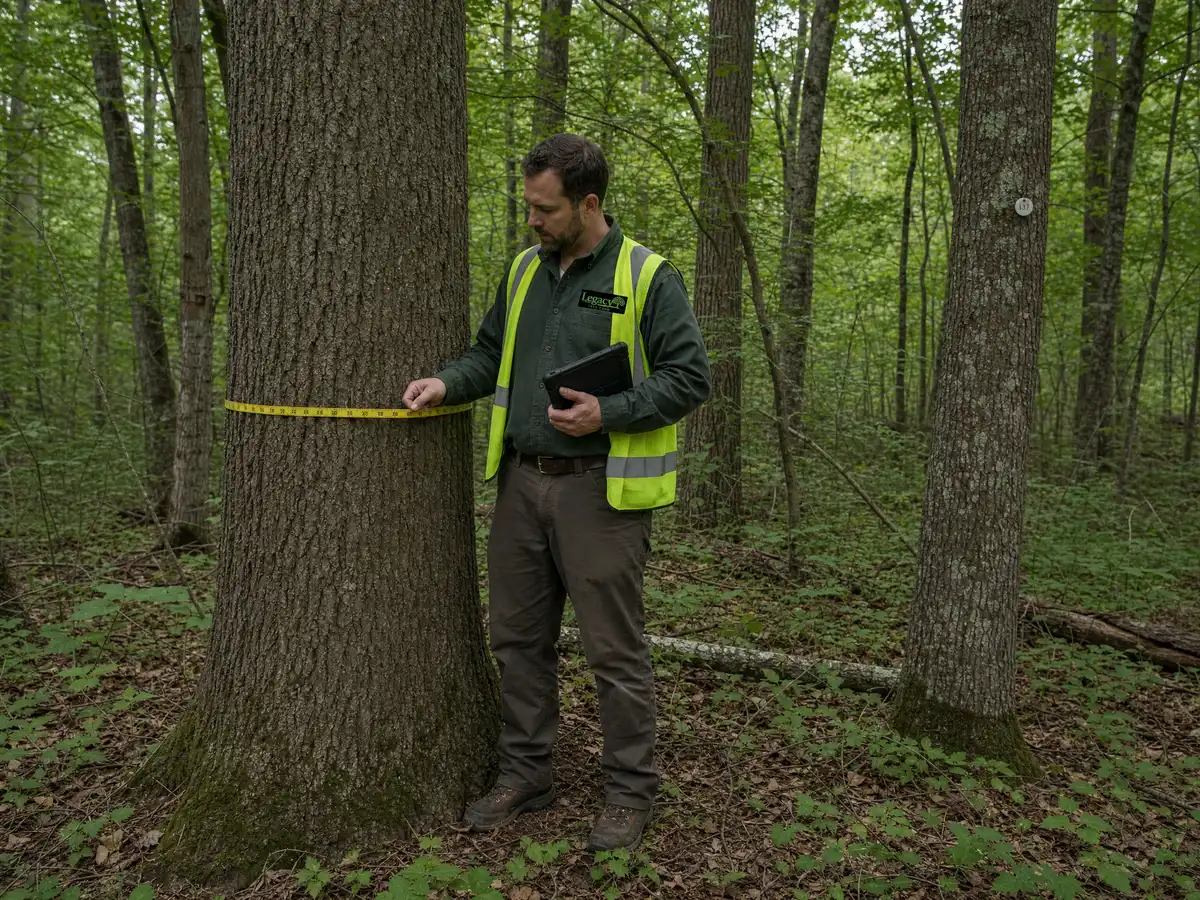
The survey defines what the site plan works around, so producing it afterwards means redesigning or mitigating. Done on raw land before design, it costs a day and changes where the fire lane goes. Done late, it changes the schedule.
Trenching Through A Root Zone

Utilities take the straight line unless somebody routes them otherwise. Roots cut on one side of a trunk destabilize the tree in a way nobody sees until it fails, and the tree stays standing long enough for everyone to assume it was fine.
Letting The Site Drive Over It
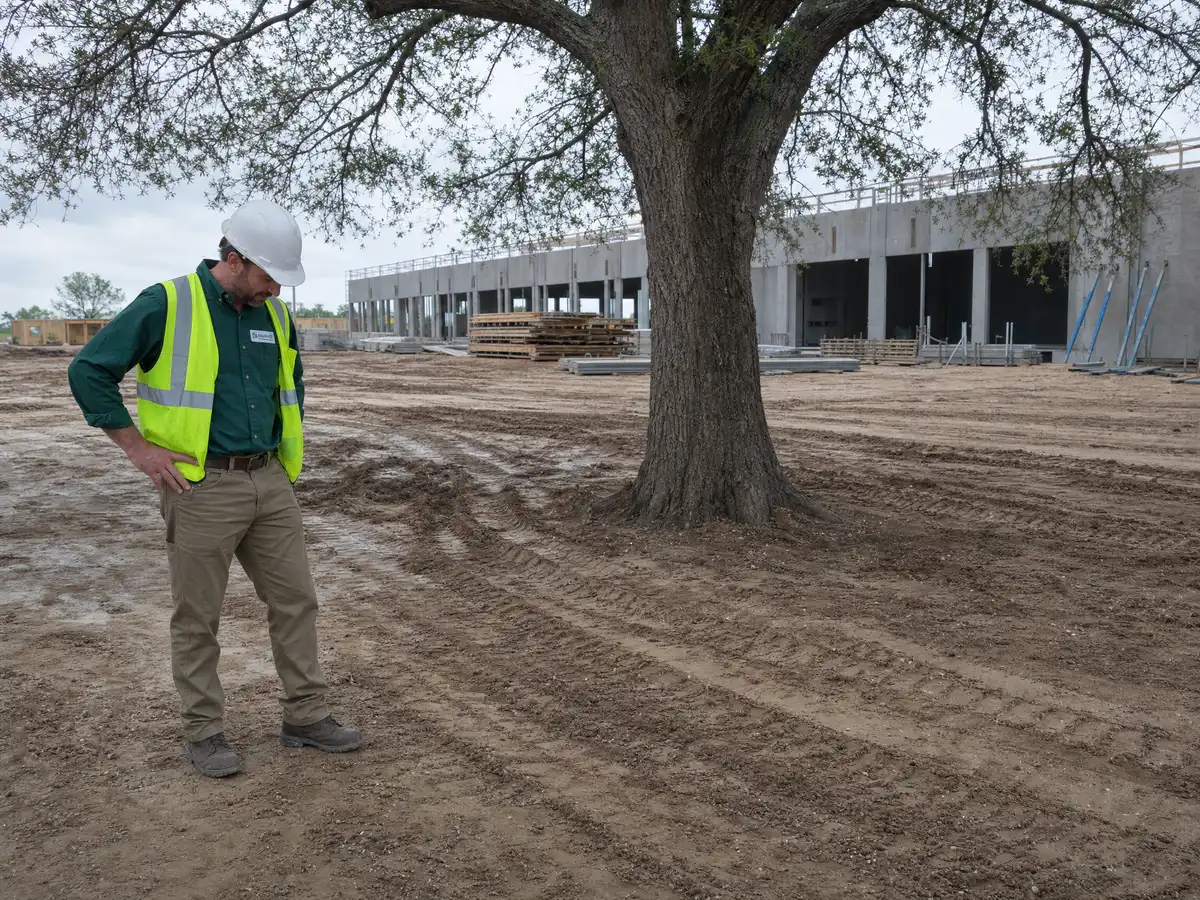
Compaction is the quietest killer on any site. It happens in the first week, it leaves no visible wound, and the tree declines two years later once the machine that did it is long gone.
The Roots Aren’t Where People Think
The mental model most sites work to is a taproot going straight down, with the important part of the tree above ground. Neither half is right, and every expensive mistake on this page follows from it.
The roots that hold a mature tree up and keep it alive are mostly in the top two or three feet of soil, spreading out to and past the edge of the canopy. That means the ground you’d naturally use for laydown, haul routes and parking is the same ground the tree depends on. It also means a trench six feet from the trunk can take a third of a root plate without touching anything anybody would describe as damage.
So the protected area isn’t the trunk. It’s the drip line and beyond, it has to be fenced before grading rather than after, and what happens inside it is the whole specification: no traffic, no storage, no spoil, no washout, and no grade change.
The Order That Saves The Weeks
Every item below is cheap in its own right. What costs money is doing them out of order.
Survey before the layout. On raw land, before anyone has drawn a fire lane. It takes a day and it tells the civil engineer which trees constrain the layout and which don’t, while moving something six feet is still a drawing change.
Mitigation math before the pro forma closes. The number is knowable from the survey and the city’s own ordinance, and it’s a great deal easier to carry as a line item than to absorb as a surprise at plan review.
Protection up before grading. Not before landscaping, before grading. The damage that kills retained trees is done in the first week by equipment taking the shortest route across ground nobody fenced.
Inspections while the site is live. Because the specification only works if somebody checks it, and because several cities want certification that protection was maintained rather than merely specified.
What We Produce, And Who It’s For.
A tree survey with location, species, size and condition, in a form that drops into the civil set rather than arriving as a separate PDF nobody reconciles. A preservation plan specifying what’s retained, where protection goes, and what the contractor may and may not do inside it. Mitigation arithmetic for the city the site actually sits in, so the number reaches the pro forma before it reaches the plan reviewer.
Then inspections during construction, because a preservation plan nobody enforces is a document that proves you knew. Where a city requires certification that protection was maintained, that record is what supports it.
If You’ve Already Started
Most of the calls we take from contractors come after something has happened: a trench went in, a tree came out, or a reviewer asked a question nobody has an answer to. That’s a worse position than starting early and a much better one than waiting.
What helps is establishing the facts quickly, before they’re contested: what was there, what condition the remainder is in, and what the city will require now. A documented position produced this week is a far better place to negotiate from than one assembled after a stop-work notice.
Who Else We Write For
The same work, answering to somebody different.
Commercial Property Managers
Portfolios, budget cycles and an owner who wasn't there.
HOA Boards
Dues, meetings, and neighbors who can see the tree from the kitchen.
Corporate Campuses
Old canopy, one long-term owner, and staff who notice everything.
Retail Centers
Trading hours, parking bays and tenants who raise sightlines.
Industrial And Warehouse
Turning circles, dock clearance and wet ground at the ponds.
Municipal And Public Sector
Procurement, public duty of care, and a file that gets opened.