

The Problem With A Free Estimate
A free estimate is a sales visit. That isn’t a criticism, it’s what the word estimate means, and most of the time it’s exactly what a property needs.
It becomes a problem in one specific situation: when the question is whether work is needed at all. Asking a company that bills per removal whether a tree should be removed is asking someone to talk themselves out of a job, and doing it well is genuinely hard even for people trying.
A consulting engagement changes the shape of it. You buy an assessment and a written opinion, the fee is the same whichever way the answer goes, and no work is attached to it.
When A Second Opinion Pays For Itself
The clearest case is a removal recommendation on a mature tree. A large tree on commercial property is worth more than almost anything you could plant to replace it, and no amount of budget brings back forty years of canopy.
If a vendor has recommended removal and the reasoning hasn’t been explained in terms of the root plate, the unions and what’s beneath the tree, that’s worth a second look. Our own assessments regularly end in pruning, support, or leaving the tree alone and reassessing next year, which is easier to write when the fee doesn’t depend on the answer.
Three Moments Worth Buying An Opinion
All three have a decision attached that costs more than the assessment does.
No Job Attached To The Answer
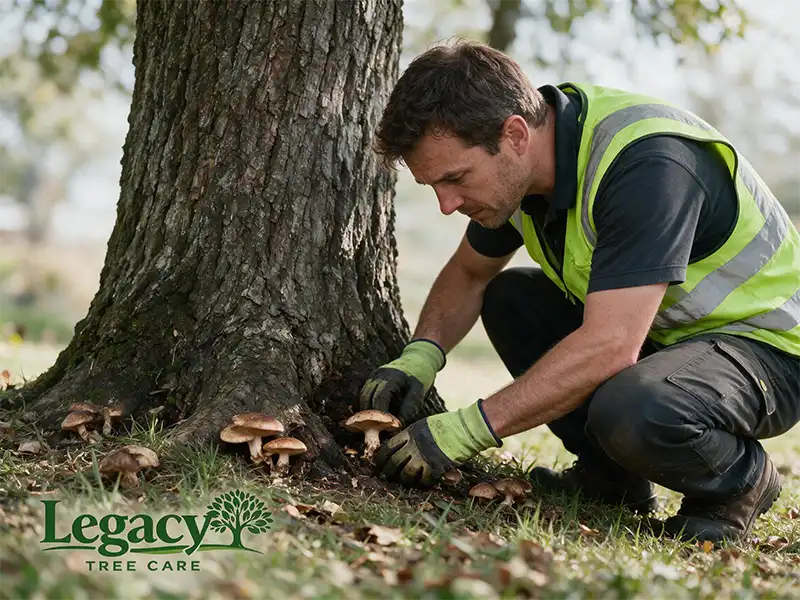
An assessment bought on its own can conclude that nothing needs doing. That’s a genuinely available outcome here, and it’s the one a quote-shaped visit finds hardest to reach.
Before The Board Votes

Boards and owners approve money against documents. A written opinion that explains the reasoning, rather than a number on a proposal, is what survives a meeting where the person who saw the tree isn’t in the room.
Before The Money Moves

Acquisitions, lease negotiations and budget cycles all commit money against assumptions about the canopy. Testing those assumptions costs a fraction of what acting on a wrong one does.
What A Written Opinion Contains
What was inspected and when. What was found, described so that somebody who wasn’t standing there can follow it. What we conclude, what we recommend, and what we specifically ruled out and why.
They’re written on the assumption that they’ll be forwarded, because they always are. An owner sends it to a board, a manager sends it to an insurer, a developer sends it to a reviewer. A report that only makes sense to the person who commissioned it fails at the first hop.
Where a claim rests on a city’s ordinance, the report says which city and which provision, because those rules change at the city line and an unattributed assertion isn’t much use to anyone.
Plan Review Before Submission
The cheapest consulting work we do is reading a preservation plan before it goes in, rather than after a reviewer has commented on it.
The things that come back are consistent: a survey missing a required seal, species identified too loosely for a class-based ratio, diameters taken at the wrong point on the trunk, or protection details that contradict the grading drawing. All four are cheap to fix in advance and slow to fix once they sit on top of a plat.
When A Consultation Is The Wrong Purchase
Frequently, and it’s worth being direct about it rather than selling one anyway.
If a limb is over an entrance and clearly has to come off, you need a crew rather than a report. If a tree has already failed, the useful call is emergency response. If the work is routine and the scope is obvious, an estimate is the correct purchase and a consulting fee adds a document nobody will read.
The engagement earns its fee when a decision is genuinely open, when the amount at stake is larger than the assessment, or when somebody who will never see the tree has to approve the outcome. Outside those, we’d rather say so and quote the work.
Disputes, And What Actually Helps.
Contractor damage, an adjoining property’s tree, an insurance question after a failure. These arrive as arguments about what happened and resolve on what was recorded.
The uncomfortable truth is that most of the value is created before the dispute exists. A dated condition assessment from two years ago settles questions that no amount of expert opinion afterwards can. Where that record doesn’t exist, a competent assessment now is still worth having, and it’s worth being honest that it’s a weaker position than it would have been.
The Rest Of What We Do
Eleven services for commercial property. Most sites need two or three.