

What A Barrier Actually Does
A root barrier is a physical panel set vertically in the soil between a tree and something it shouldn’t reach. It doesn’t stop roots growing; it changes where they grow.
Most are ribbed so roots meeting them are deflected downward rather than following the panel sideways. The intent is to send roots under a structure at a depth where they don’t lift it, rather than to prevent root growth in that direction at all.
Where They Work And Where They Don’t
| Situation | Outcome |
|---|---|
| Installed at planting, alongside a walkway | The best case. Roots develop with the barrier in place and never form the shallow structure that lifts paving |
| Installed during a rebuild, on one side only | Workable, provided the tree has adequate rooting volume in the other directions |
| Retrofitted around a mature tree | The risky case. Installing it means cutting existing roots, which is the damage the barrier was meant to avoid |
| Wrapped fully around a root zone | Don’t. A tree enclosed by a barrier is a tree in a container, and it declines on schedule |
The Trade Nobody Names
A barrier protects a surface by reducing the ground a tree can use. That’s the whole mechanism, and it’s a real cost paid by the tree.
On a site where rooting volume is already tight, which describes most commercial paving, the barrier can be the difference between a tree that struggles and one that fails. The calculation isn’t whether the barrier works. It’s whether what remains is enough.
Three Ways They Go Wrong
Retrofitted Through Live Roots

Installing a barrier beside a mature tree means trenching, and trenching severs the structural roots on that side. The tree can lose stability and vigor to a measure installed to protect a footpath.
Too Shallow To Deflect

A barrier that doesn’t reach deep enough is simply an obstacle roots grow under and back up behind, which produces heave slightly further from the tree and a bill nobody expected.
Installed Instead Of Space
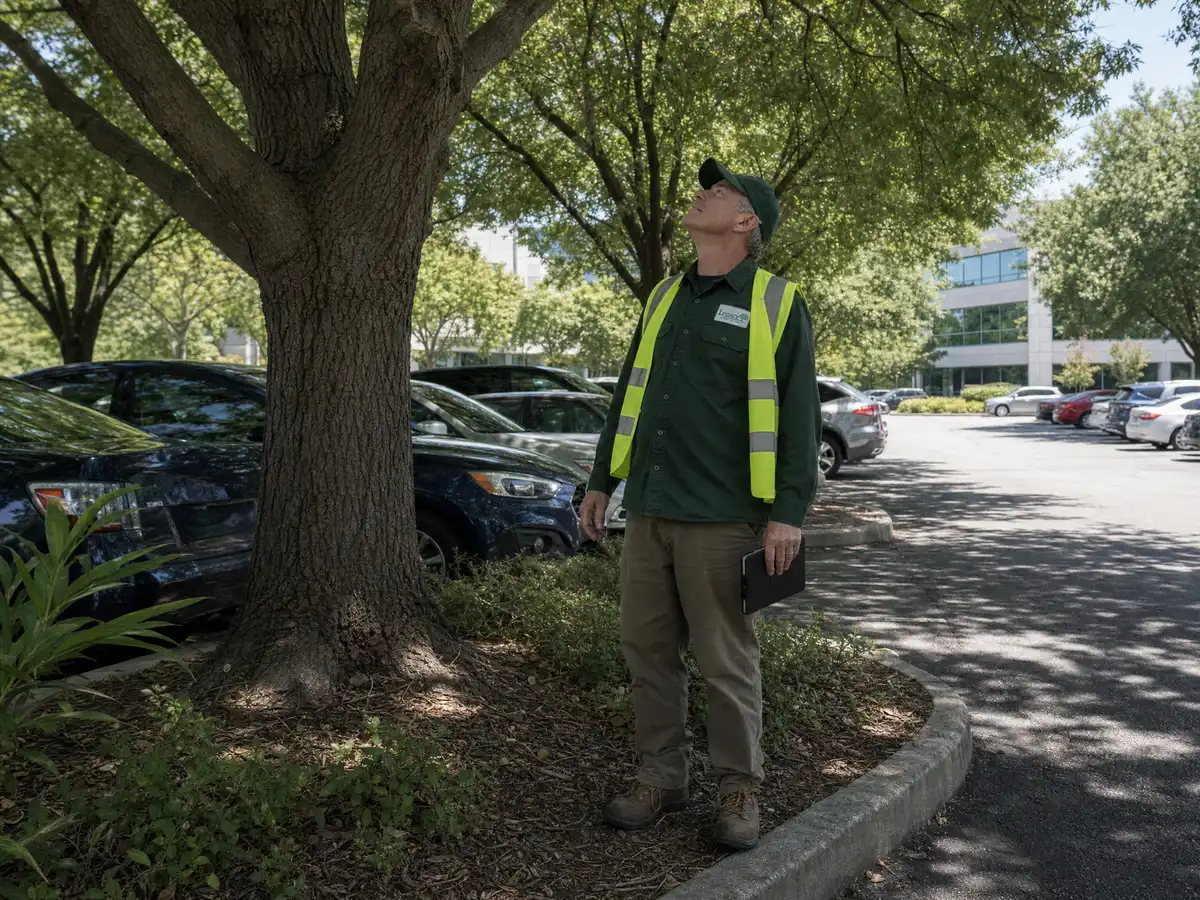
Used to justify planting a large species somewhere it’ll never fit. The barrier doesn’t create rooting volume, and the tree still outgrows the space it was given.
What To Do Instead, Where You Can.
Most of the situations a barrier is proposed for have an alternative that costs less and damages nothing.
Move the path rather than the roots. Use a flexible surface, or a suspended one, over the area the roots occupy. Choose a species whose mature root system suits the space, which is free at specification and impossible afterwards. Or accept the surface will need periodic attention and budget for it, which is frequently cheaper than the barrier.
Barriers earn their place where none of those is available, which is a narrower set of cases than the number of barriers installed suggests.
If One Is Going In
Three conditions worth insisting on.
Depth adequate to deflect rather than divert, because a shallow barrier relocates the problem. Position established from where the roots actually are rather than from a standard offset, which usually means exposing them first. And an honest assessment of what rooting volume remains afterwards, made before the trench is cut rather than after the tree responds.
They Don’t Last Forever
A barrier is a physical object in soil, and it ages like one.
Panels installed decades ago are frequently found displaced, cracked, or with roots grown over the top and back down the far side, which is the failure that produces heave in a spot nobody expected. Nothing about a barrier announces that it has stopped working, so a surface that stayed flat for fifteen years and started lifting is worth investigating rather than simply repairing.
Barriers For Services, Not Just Surfaces.
The version that gets less attention is protecting a service run rather than a walkway, and the reasoning differs.
A root lifting paving is a maintenance cost. A root in a drain or around a shallow service is a failure with a repair excavation attached, and that excavation will cut far more root than a barrier ever would. Where a known service runs through a rooting area, a barrier installed at the time the service goes in is genuinely cheap insurance.
Retrofitting one to protect an existing service is a harder call, because the trench to install it runs exactly where the roots already are, and the tree pays that cost immediately for a benefit that may never be needed.
Protected Trees Change The Calculation
Where the tree is protected under a city ordinance, cutting roots to install a barrier may be a regulatory matter as well as an arboricultural one.
Several cities in this market treat damage as equivalent to removal, and one carries a five-year standard covering acts likely to cause decline. What each city actually requires is worth establishing before trenching inside a root zone, because the barrier that protected a walkway can become the act that triggered a mitigation obligation.
Other Questions We Get Asked
Short answers to the things commercial clients ask before they ask for a price.
- Arborist Or Tree Service
- Job Site Risk Assessment For Tree Work
- Landlord Or Tenant: Who Handles The Trees?
- Can You Do Your Own Tree Survey?
- Deep Root Fertilization
- Who Is Responsible For Trees In An HOA
- Does Insurance Cover Tree Removal?
- Trees Growing Close To A Building
- What Tree Assessments And Reports Cost
- How To Vet A Commercial Tree Contractor
- What Goes In An Arborist Report
- What Happens On The Day Of Tree Work
- Is There A Cheapest Time For Tree Work?
- See All Commercial Tree Questions