

Insurance Is A Gate, Not A Feature.
Below an owner’s required limits the conversation ends regardless of price, and that’s the correct instinct. What goes wrong is the checking rather than the asking.
A certificate proves a policy existed on the day it was issued. It doesn’t prove the policy covers tree work, that it’s still in force, or that your property is named, and all three are worth establishing before a crew arrives.
What To Actually Check
| Item | What To Look For |
|---|---|
| General liability | That the limits meet your requirement, and that the policy period covers the work dates rather than the quote date |
| Workers compensation | Frequently the gap. A subcontracted climber injured on your property with no cover is your problem in practice, whatever the contract says |
| Certificate holder | Whether your entity is actually named, and correctly. A certificate addressed to somebody else proves nothing about your exposure |
| Exclusions | Some policies exclude the operations that matter here. Worth reading rather than assuming |
| Who is on site | Whether the crew arriving is the contractor’s or a subcontractor’s, and whose cover applies to them |
Three Things Worth Asking For
A Scope You Can Compare

Which operations, on which trees, to what clearance, with cleanup stated. A quote that says “trim trees” and a number can’t be compared with anything, including itself six months later.
Credentials, Shown Not Claimed.
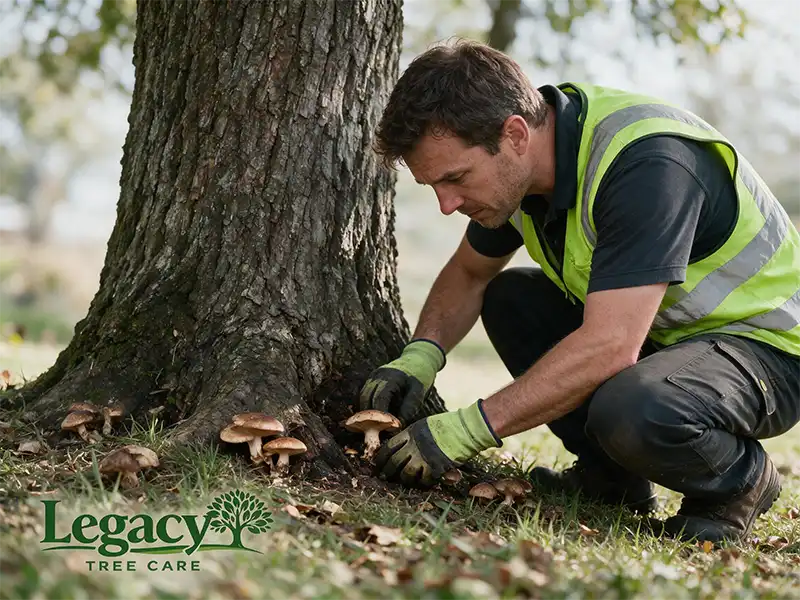
Ask which individual holds what, and ask to see it. A logo on a truck isn’t a credential, and the person assessing your trees may not be the person who holds the qualification.
References From Similar Property

Residential references tell you very little about how a crew behaves around tenants, deliveries and fire lanes. Ask for commercial ones and ask specifically about disruption.
The Questions That Reveal Most
Three, and none of them is about price.
“What would you do if you found something unexpected?” The answer tells you whether work stops and you get a call, or continues and you get an invoice.
“Who is on site, and who is in charge?” Named accountability matters more on an occupied property than crew size does.
“What will we get in writing afterwards?” A contractor who produces nothing beyond an invoice has left you with no record of what was done, which is the gap that matters two years later.
After A Storm, The Rules Change.
Storm response attracts operators who aren’t local, not insured for this, and not returning.
The pressure is real and so is the temptation, because a blocked entrance costs money hourly. The checks that matter compress to two: proof of insurance you can read, and a written scope before work starts, even if that’s a photograph of a handwritten page.
The version of this that goes badly is paying cash to somebody with a chainsaw and a pickup, discovering afterwards that a protected tree was removed, and having no counterparty to pursue. Having a vendor on file before the season is what removes that decision from the worst possible moment.
Price Comparison Fails More Often Than It Works
Commercial tree quotes vary far more in scope than in rate, so the lowest number is usually the smallest job rather than the best value.
The reliable differences are whether insurance is cleared before mobilization, whether cleanup and stump work are included, whether a written assessment comes with it, and who is accountable on site. Those are the lines to compare, and they rarely appear on a one-page quote unless somebody asks.
The Subcontracting Question
Worth asking directly, because the answer changes who is actually on your property and whose cover applies to them.
Subcontracting is normal and not a warning sign in itself. Specialist equipment, crane work and peak storm periods all reasonably involve other firms. What matters is whether you were told, whether their insurance was verified by somebody, and who remains accountable if something goes wrong.
The bad version is discovering after an incident that the crew wasn’t the contractor’s and that nobody checked their cover. That’s a question to ask before the work rather than a fact to establish afterwards.
Ask Us The Same Questions
All of the above applies to us and we’d rather you checked.
Ask for the certificate and read it. Ask which individual holds which credential. Ask for commercial references. A company that hesitates on any of those has told you something useful, and it costs you nothing but the asking.
Other Questions We Get Asked
Short answers to the things commercial clients ask before they ask for a price.
- Arborist Or Tree Service
- Job Site Risk Assessment For Tree Work
- Root Barriers In Construction
- Landlord Or Tenant: Who Handles The Trees?
- Can You Do Your Own Tree Survey?
- Deep Root Fertilization
- Who Is Responsible For Trees In An HOA
- Does Insurance Cover Tree Removal?
- Trees Growing Close To A Building
- What Tree Assessments And Reports Cost
- What Goes In An Arborist Report
- What Happens On The Day Of Tree Work
- Is There A Cheapest Time For Tree Work?
- See All Commercial Tree Questions