

Why There’s No Price List
Because a number that isn’t attached to your site is marketing rather than information, and because the same words describe very different jobs.
“A tree survey” can mean a walkthrough with a summary, or a sealed submission document with every protected tree located by a registered surveyor. Those aren’t the same purchase and they shouldn’t carry the same price, so a published rate would be wrong for one of them by design.
What Actually Moves The Number
| Factor | Effect |
|---|---|
| How many trees, and whether all of them | The biggest single lever. Scoping to trees with a target underneath is frequently a fraction of a full count |
| What the output has to satisfy | An internal record, a board paper and a city submission carry very different requirements and sign-offs |
| Whether seals are required | A surveyor for locations and a credentialed preparer for identification is two professionals rather than one |
| Depth per tree | Visual assessment, versus climbing inspection, versus instrumented decay testing on selected trees |
| Access and site conditions | Occupied property, restricted hours and wooded ground all cost time rather than skill |
| Turnaround | A report needed for a meeting next week is a scheduling problem with a price attached |
Three Ways To Spend Less Without Getting Less
Scope To Consequence

Assess every tree with something underneath it properly, and record the rest as groups. On most commercial sites that answers the questions that get asked at a fraction of a full inventory.
Bring Your Own Baseline

Locations, photographs and a work history collected in house mean the visit is spent assessing rather than reconstructing. On a portfolio that difference shows up as a smaller fee.
Ask What Can Be Waived
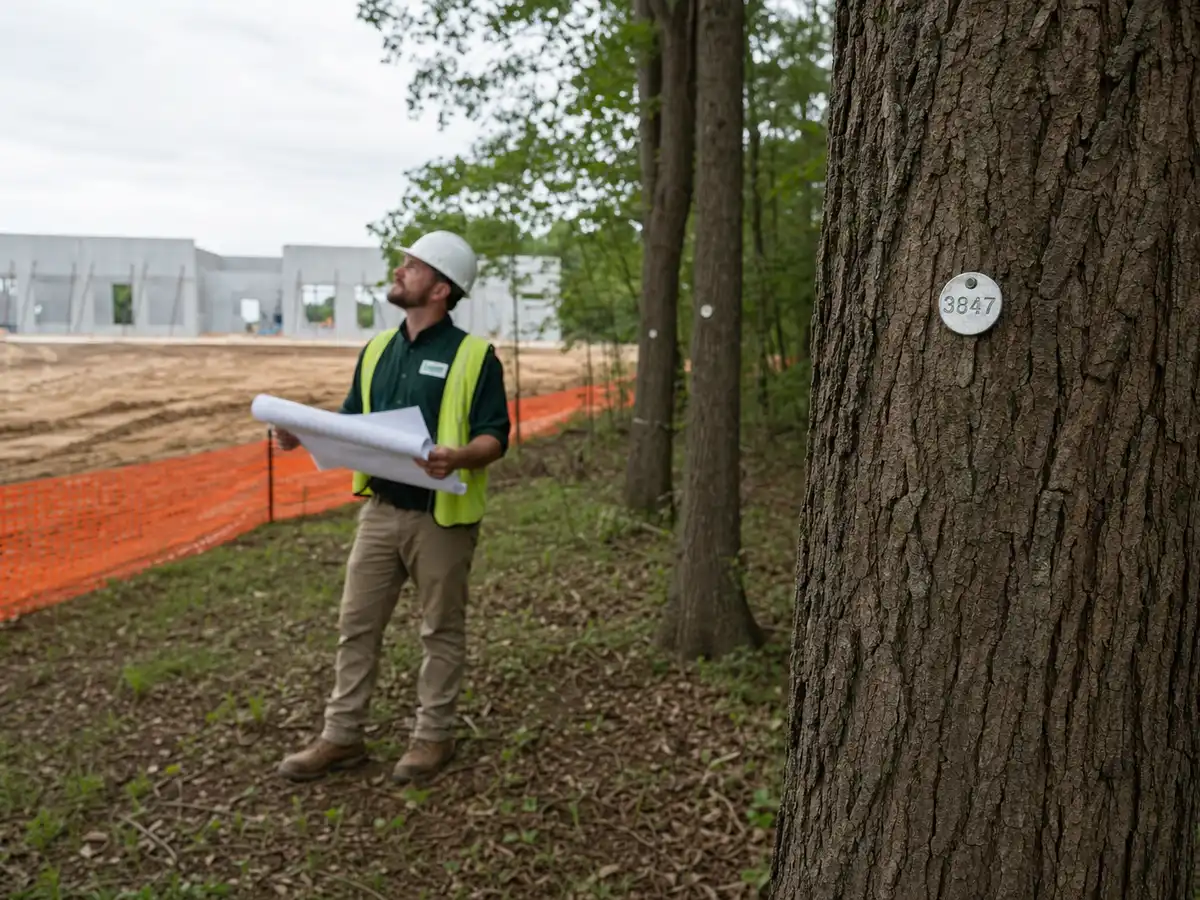
Some cities accept a sampling inventory on wooded ground, and one waives a management plan for five or fewer protected trees. Neither is offered unprompted, and both are worth asking before anything is priced.
The Comparison That Actually Works
Put two proposals side by side and check five things rather than the totals.
How many trees are included and on what basis they were selected. What the deliverable is, precisely. Who signs it and with what credential. Whether instrumented testing is included, excluded or offered as an extra. And what happens if the work uncovers something that changes the scope.
Two quotes that differ on any of those aren’t comparable, and the cheaper one is usually cheaper because it’s smaller rather than because anybody is being generous.
Where The Money Is Genuinely Wasted
Three patterns, and none of them is paying too much per tree.
A full inventory commissioned when the question was about six trees. Instrumented testing on a tree that was coming out regardless of the result. And an assessment commissioned after a layout was fixed, when the findings can no longer change anything except the size of a mitigation bill.
All three are scope failures rather than pricing failures, which is why the useful conversation happens before a quote rather than after one.
What A Proposal From Us Contains
The number of trees and how they were chosen, the deliverable described plainly, who prepares and signs it, what’s excluded, and the turnaround.
Where we think a smaller scope answers your question, the proposal says so and prices that instead. That occasionally costs us the larger engagement, and it’s the reason clients come back with the portfolio rather than the single site.
Why Portfolios Price Differently
Not through a volume discount, though that exists. Through the fixed costs disappearing.
A single site carries travel, setup, the ordinance research for that city, and the overhead of a one-off engagement. Assessing eight properties to one method removes most of that per site, and it produces something a single assessment can’t: results that compare, so spending can be sequenced across a portfolio rather than argued site by site.
The saving is real and it isn’t the main benefit, which is that a manager stops making the case for each property separately to people who have no way to rank them.
The Question Worth Asking Us First
Not what it costs. What decision this is meant to support.
An assessment for a board meeting, for a permit submission, for a purchase decision and for internal budgeting are four different documents. Say which one it is and the scope follows from it, which is both cheaper and considerably more likely to produce something useful than starting from a budget and working backwards.
Other Questions We Get Asked
Short answers to the things commercial clients ask before they ask for a price.
- Arborist Or Tree Service
- Job Site Risk Assessment For Tree Work
- Root Barriers In Construction
- Landlord Or Tenant: Who Handles The Trees?
- Can You Do Your Own Tree Survey?
- Deep Root Fertilization
- Who Is Responsible For Trees In An HOA
- Does Insurance Cover Tree Removal?
- Trees Growing Close To A Building
- How To Vet A Commercial Tree Contractor
- What Goes In An Arborist Report
- What Happens On The Day Of Tree Work
- Is There A Cheapest Time For Tree Work?
- See All Commercial Tree Questions