

What Season Actually Does
Demand in this market isn’t evenly spread. It spikes after storms, which mostly means spring, and it’s quieter in the depths of winter and in high summer.
That affects availability more than price. The week after a serious storm, every commercial crew in the county is committed, and a property competing for that capacity is paying in delay rather than in rate.
Winter has a genuine advantage that isn’t about cost at all: the canopy is bare, so structure is visible and the same assessment produces better information.
What Actually Changes The Number
| Decision | Effect |
|---|---|
| Planned versus urgent | The largest lever by far. Emergency response is priced for mobilizing outside a schedule, not for the tree |
| Batched versus separate | One visit covering eight trees costs far less than eight visits. Access and setup are most of the overhead |
| Flexible versus fixed date | Work that can move within two weeks fits around other jobs. Work fixed to a Tuesday doesn’t |
| Access arranged versus negotiated | Bays cleared in advance rather than a crew waiting. Waiting is charged, and it’s entirely avoidable |
| Whole scope versus phases | Splitting work across visits usually costs more overall, though it can be the right call for a budget cycle |
The Three That Actually Save Money
Do It Before It's Urgent
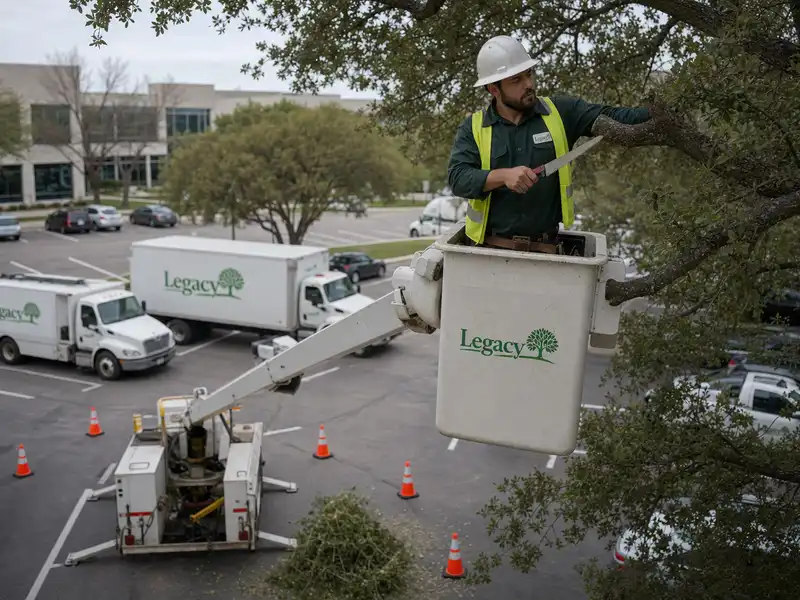
The same limb removed on a planned visit and after it has come down are different invoices, and only one of them includes a closed lane and an emergency call-out.
Batch The Site

Setup, access and travel are most of the cost on small jobs. Eight trees in one visit is a fraction of eight visits, which is the argument for knowing what the site needs before calling.
Give Us A Window

Work that can happen any time in two weeks fits around other commitments. A fixed date on an occupied site sometimes has to be, and where it doesn’t, flexibility is worth real money.
Why Emergency Work Costs What It Does
Not opportunism, and worth explaining because it looks like it.
Responding at midnight means a crew mobilized outside a schedule, other work displaced, and lighting and traffic control that a daytime job doesn’t need. The tree is usually the least difficult part.
Which is the real argument on this page: the cheapest tree work is the work that never became urgent, and that’s a function of inspection rather than of season.
Why Hourly Pricing Costs You More
It looks transparent and it moves every risk onto the client.
Under an hourly rate, weather, access problems, a vehicle nobody moved and anything found on the day all become your cost rather than ours. There’s also no incentive shared between us about how long it takes, which is an uncomfortable position to be in with a crew on site and a lane closed.
A defined scope reverses that. The price answers to what was agreed, and the risk of a difficult day sits with the party who chose the crew, the equipment and the method. That’s why commercial work here is scoped rather than sold by the hour, and why a quote that can’t say what’s included isn’t really a quote.
Two Costs That Never Appear On The Invoice
Both land on the property rather than on us, and both dwarf the difference between two quotes.
The first is disruption: a closed lane, an unusable entrance or displaced parking during trading hours. On a retail site that can exceed the tree work in a single afternoon, which is why timing is worth more than a rate reduction.
The second is repetition. Work done cheaply and badly gets done again, and a tree topped rather than pruned generates a decade of clearance visits and an early removal. The cheapest invoice and the cheapest outcome are frequently different transactions.
The Trap In Waiting For A Cheaper Season
Deferring identified work to a quieter month is reasonable. Deferring it indefinitely because the quote felt high is how a pruning visit becomes a removal.
A defect found in autumn and left through spring has been through the windiest part of the year unaddressed, which is precisely the season it was least able to survive. The saving is theoretical and the risk isn’t.
What We’ll Tell You Honestly
When something can wait, and roughly how long. That isn’t a courtesy, it’s the only way a property can sequence work across budget cycles rather than approving or deferring everything at once.
Where work genuinely shouldn’t wait, we’ll say that too, and explain what we think happens if it does. Both answers are more useful than a discount.
Other Questions We Get Asked
Short answers to the things commercial clients ask before they ask for a price.
- Arborist Or Tree Service
- Job Site Risk Assessment For Tree Work
- Root Barriers In Construction
- Landlord Or Tenant: Who Handles The Trees?
- Can You Do Your Own Tree Survey?
- Deep Root Fertilization
- Who Is Responsible For Trees In An HOA
- Does Insurance Cover Tree Removal?
- Trees Growing Close To A Building
- What Tree Assessments And Reports Cost
- How To Vet A Commercial Tree Contractor
- What Goes In An Arborist Report
- What Happens On The Day Of Tree Work
- See All Commercial Tree Questions