

Risk Has Two Halves, And Both Are Adjustable.
A rating combines how likely a tree is to fail with what happens if it does. That means every rating has two levers, and only one of them involves the tree.
Reduce the likelihood of failure, or reduce what’s underneath it. Most proposals only ever address the first, which is how a property ends up removing a mature tree to protect four parking bays that could have been re-striped.
Four Ways To Bring A Rating Down
| Option | What It Changes |
|---|---|
| Pruning | Reduces the load on a weak part, or removes the dead wood that was the hazard. The lightest intervention and often enough |
| Support systems | Cabling or bracing limits movement at a defective union. Buys time on the defect rather than repairing it |
| Moving the target | Re-striping bays, rerouting a path, moving a bench or a bin store. Changes the consequence without touching the tree |
| Restricting access | Fencing an area or closing it seasonally. Usually a temporary measure while something else is arranged |
Removal sits underneath all four as the answer when none of them gets the rating below the threshold, or when the tree isn’t worth what keeping it costs.
The Option Nobody Offers
Moving what sits under a tree is the cheapest mitigation available and almost never appears on a proposal.
Re-Stripe The Bays
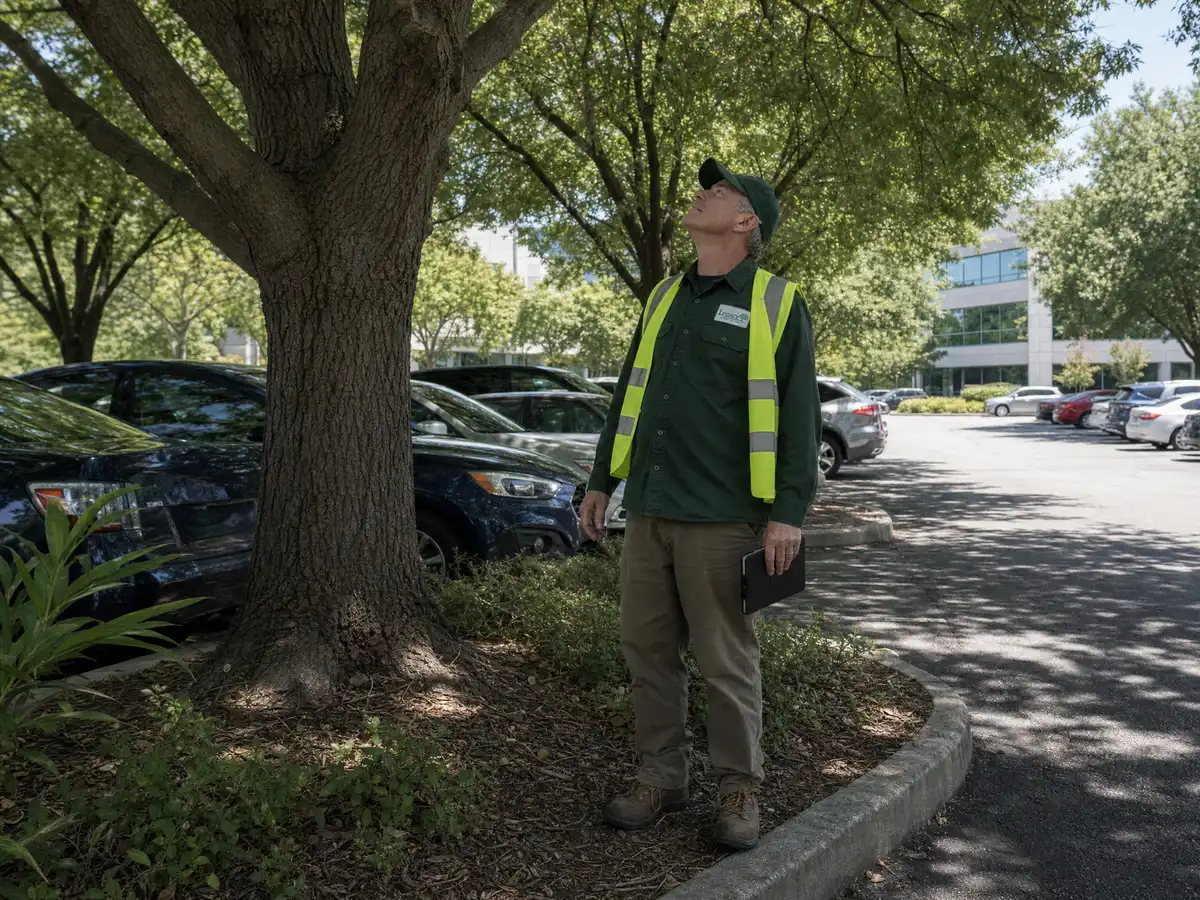
Four bays relocated is a morning with a line marker. A mature shade tree is twenty-five years. The arithmetic is rarely close, and it’s rarely presented.
Move The Path, Not The Tree.

A walkway routed around a canopy solves the target problem and frequently the root heave problem at the same time, which is two line items closed by one decision.
Close It For A Season

Where the target is occasional rather than constant, restricting use during the risky window is a legitimate control while a longer-term answer is arranged.
Why Pruning Is Usually Tried First
It’s the least invasive thing that changes a rating, and on a great many findings it’s sufficient.
Dead wood removal takes away the hazard entirely, since the defect was the dead limb. Reducing the end weight on a long lateral lowers the load at a weak attachment. Clearing a crown of broken hangers removes what would come down first.
What pruning can’t do is repair a union or restore decayed wood, and heavy pruning on a declining tree makes things worse rather than better. Where a proposal answers a structural finding with a large reduction, that’s worth a second opinion.
Support Buys Time, With Conditions.
Cabling and bracing are legitimate mitigation where a mature tree is worth keeping and the defect is one that support can carry.
They come with obligations that belong in the decision rather than after it: the hardware needs inspecting for as long as it’s in the tree, and a system nobody inspects is worse than none because the property believes the risk was handled. What the hardware does and doesn’t do covers it in full.
When Removal Is Genuinely The Answer
Three situations, stated plainly because a page arguing against removal should say when it’s right.
When no combination of the other options gets the rating below the threshold. When the defect is at the base or in the root plate, where nothing can be supported and nothing can be pruned. And when the tree is young or common enough that replacement costs less than mitigation plus decades of monitoring.
That last one is a real answer and it gets under-used, because keeping a tree isn’t automatically the right call either. A middling tree with a bad union in a back corner is a replacement, not a project.
Do Nothing Is Also An Option
It belongs on the list, stated honestly, because it’s what a great many properties choose and pretending otherwise helps nobody.
A finding recorded, a decision taken to monitor rather than act, and a date set to look again is a legitimate position provided it’s deliberate and written down. What makes it indefensible is doing it by default, where nobody decided anything and no record exists of the finding at all.
The difference between those two is a paragraph in a file, and it’s the entire difference between a considered risk and an ignored one.
What Should Be In The Proposal
The options that were considered, not only the one being recommended.
A proposal that names the rating, lists what would bring it down, says what each would cost and why one is preferred, lets an owner make a decision. A proposal that arrives as a removal quote with a photograph attached asks for approval rather than a decision.
Ours are written the first way, which occasionally costs us the larger job. That’s the arrangement.
More On Risk And Documentation
The rest of what a commercial property gets asked to produce, and who asks for it.
- Tree Risk Assessment
- Commercial Tree Inventory
- Commercial Tree Inspection Programs
- Tree Damage And Insurance Claim Documentation
- Recognizing Tree Defects
- Detecting Decay Inside A Tree
- Investigating Why A Tree Failed
- Root Zone And Root Collar Investigation
- Reporting Tree Risk To Owners And Boards
- Arborist Expert Witness And Litigation Support
- What Tree Records To Keep
- Catching Up On Deferred Tree Maintenance
- Seasonal Tree Risk
- See All Risk And Documentation Services