

Seven Types, From The Field Guide.
The USDA Forest Service and Minnesota Department of Natural Resources publish a field guide that names seven main defect types: dead wood, cracks, weak branch unions, decay, cankers, root problems and poor tree architecture.
It also carries the qualifier most people skip, and it matters more than the list: a tree with defects may not be a high-risk situation unless some part of it is within striking distance of a target. A defect is a finding, not a verdict.
What Each One Looks Like
| Defect | What You Can See From The Ground |
|---|---|
| Dead wood | Bare branches in a leafed crown, broken tops, hangers caught in the canopy |
| Cracks | A split in the bark deep enough to reach wood, sometimes running the length of a stem |
| Weak branch unions | Two stems of similar size meeting in a tight V, often with bark turned inward rather than a raised ridge |
| Decay | Cavities, soft or missing wood, and fungal fruiting bodies on the trunk or root flare |
| Cankers | A sunken or discolored area where bark is dead, sometimes with wood exposed |
| Root problems | Lifted soil on one side, severed roots, mushrooms at the base, a lean that looks recent |
| Poor architecture | A crown that grew unevenly, heavy limbs on one side, or a shape that changed after a topping cut |
Dead Wood Is The One With No Judgment Call
The field guide is unusually blunt about it. Dead wood isn’t negotiable: dead trees and large dead branches should be removed immediately.
The reasoning is mechanical. Dead wood is dry and brittle and can’t flex in wind the way living wood does, so it fails at loads a live branch absorbs. It’s also unpredictable, which is the word the guide uses, meaning it can come down on a still day for no visible reason.
On commercial property that turns a maintenance item into a scheduling one. Everything else on the list warrants an assessment; this one warrants a date.
The Three Worth Learning To Spot
If site staff learn to recognize nothing else, these three carry the most consequence.
Bark Turned Inward
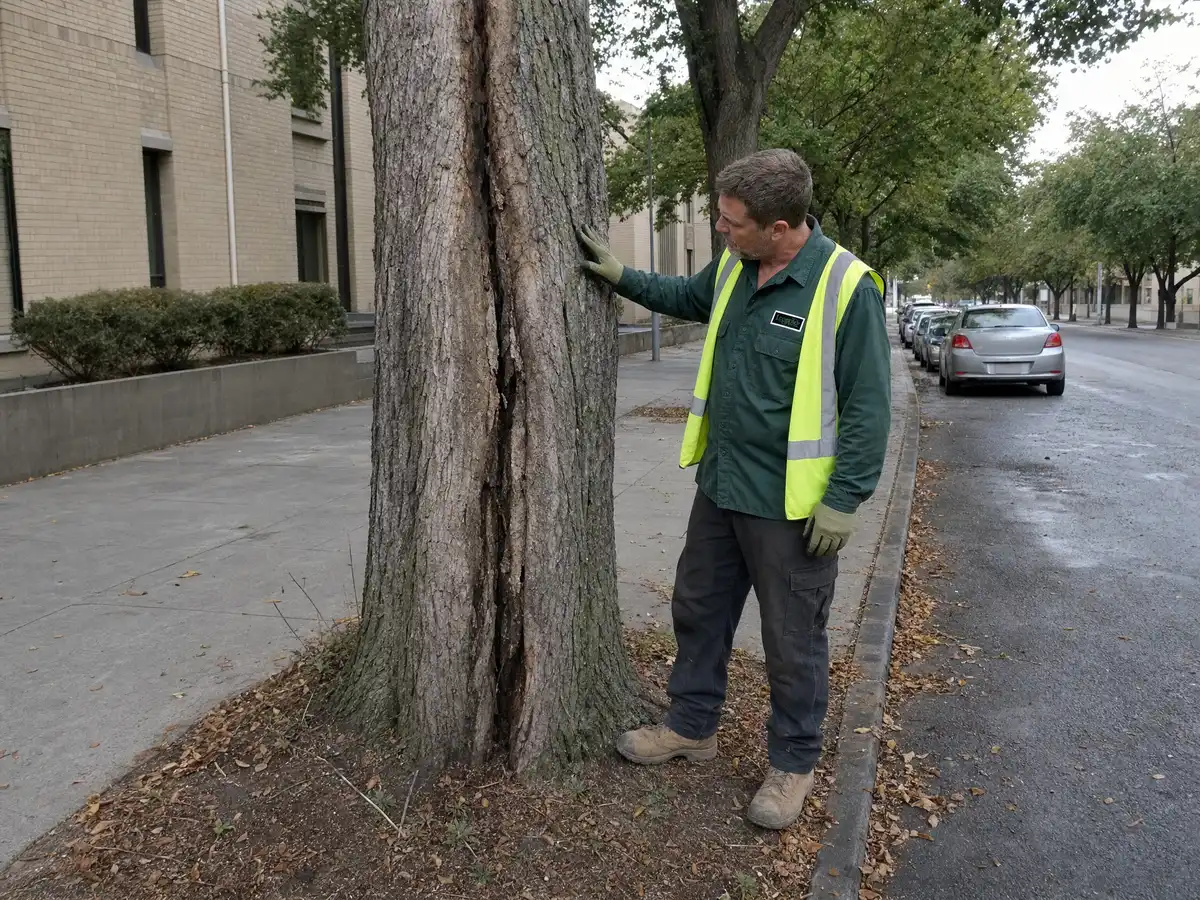
At a strong union the bark forms a raised ridge. At a weak one it turns inward into the join, and there’s no wood connecting the two stems. That’s the failure that takes half a tree.
Anything Growing On The Trunk
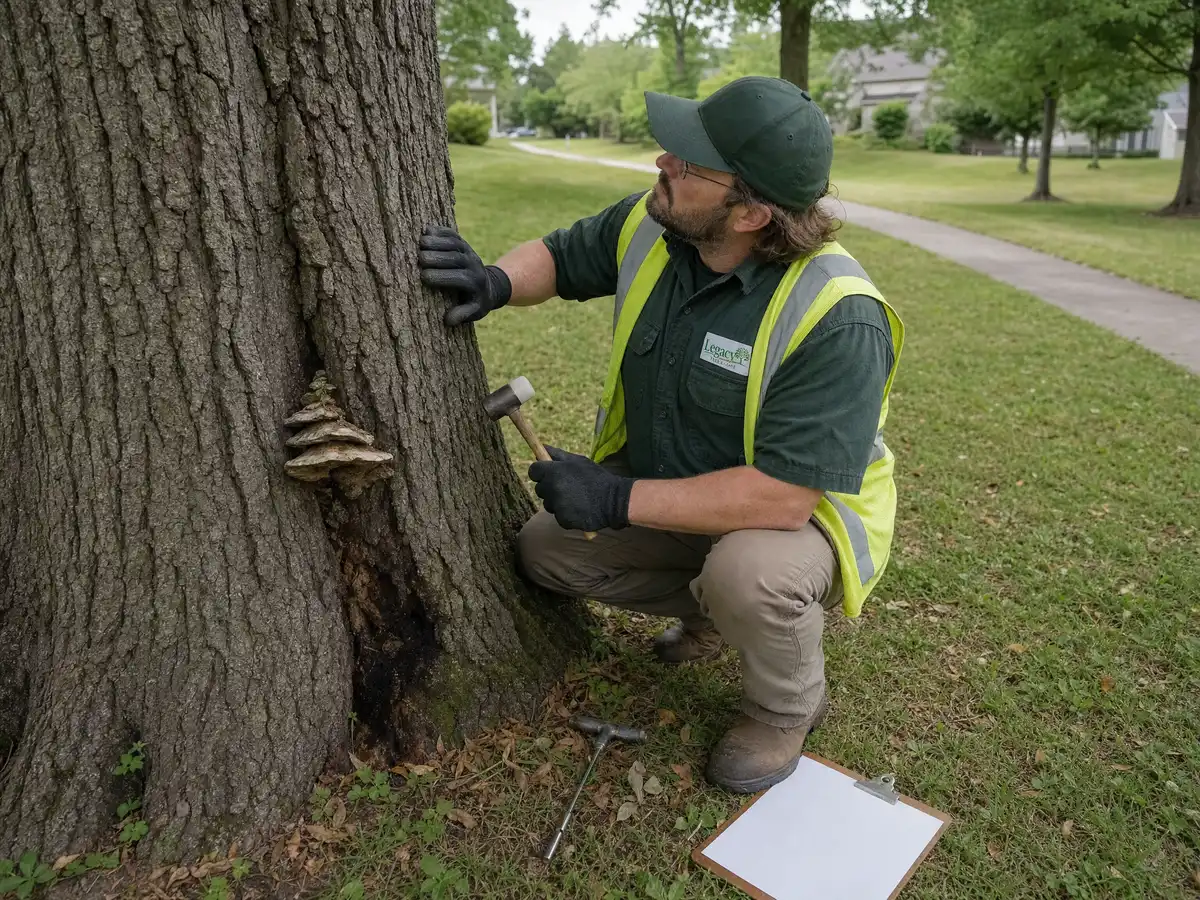
Mushrooms, brackets and conks on a root flare, stem or branch indicate advanced decay inside. The visible part is small and late, which is why it’s a finding to report rather than to watch.
Soil Lifting On One Side
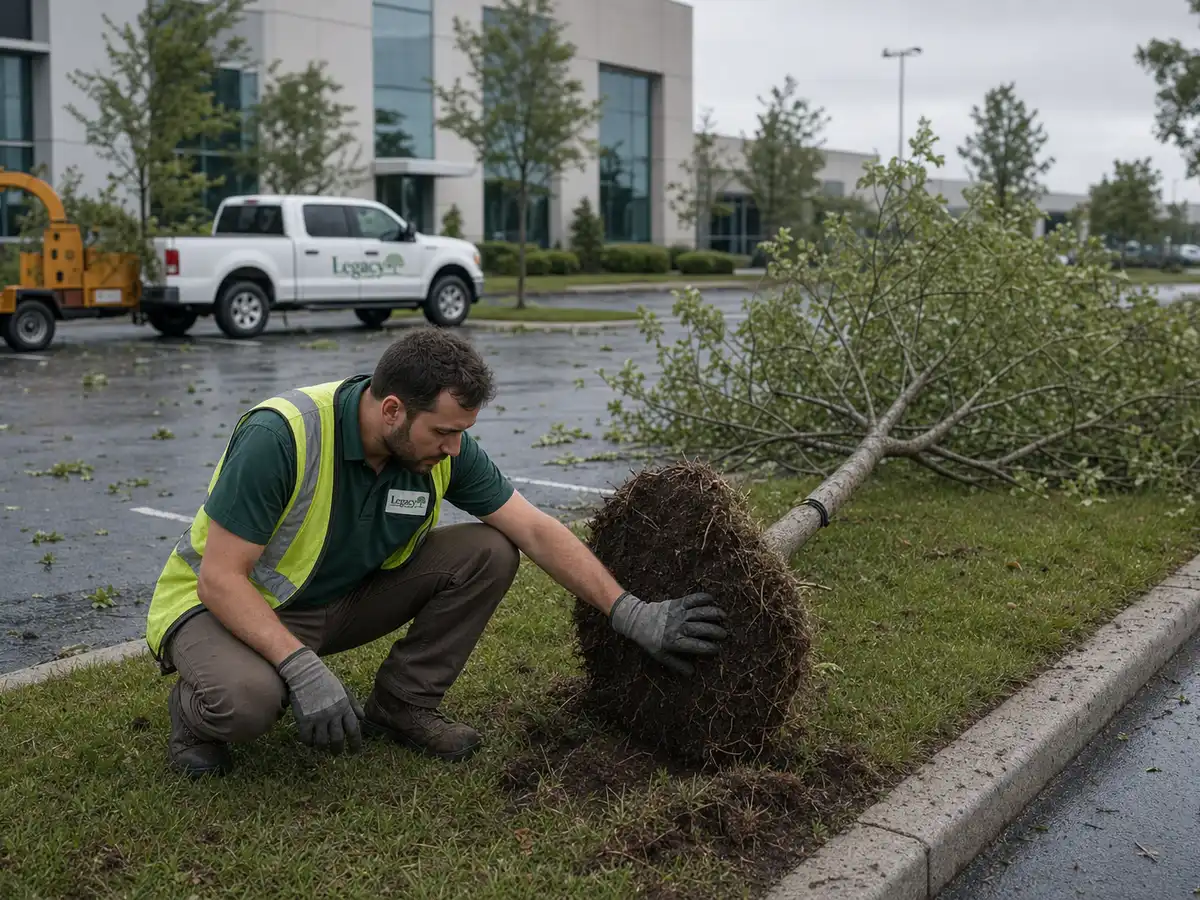
Cracked or raised ground on the opposite side to a lean means the root plate is moving. It’s the least noticed serious defect on this list and the one closest to failing.
Why Older Trees Deserve More Attention
The guide is direct about this too: pay particular attention to older trees, which may carry multiple defects and extensive decay.
That’s worth translating for a commercial site. Defects compound rather than add. A weak union on a sound tree is one problem. The same union on a stem with internal decay, over ground where roots were cut for a service run, is a different proposition, and no single one of those three would have prompted a call.
What Site Staff Can Usefully Do
Look up, walk the same route, and report changes rather than conditions.
A cavity that’s been there for years is background. The same cavity noticeably larger than last quarter is information. So is a crack that has extended, a limb that dropped without a storm, a crown thinner than the tree beside it, or ground disturbed at a base.
What untrained observation can’t do is decide whether a finding matters, and it shouldn’t be asked to. The value is in noticing early and passing it to somebody who can settle it, which is exactly how a scheduled inspection program is meant to work between visits.
Where These Show Up On Commercial Sites
The defects are the same everywhere. Where they cluster isn’t.
Root problems concentrate wherever the ground has been worked: service runs, resurfaced parking, anything regraded. Weak unions show up on trees that were never structurally pruned when young, which is most of what was planted with a building. Dead wood accumulates in the interior of crowns that haven’t been cleaned in a decade.
That pattern is useful because it tells you where to look first, and it’s usually the ground somebody worked on rather than the tree somebody worries about.
What A Defect Doesn’t Mean
It doesn’t mean removal, and treating every finding as a removal is how properties lose trees that had decades left.
Defects are common, particularly on mature trees, and most sit comfortably below any threshold for action once the target is considered. A cavity in a trunk over a lawn and the same cavity over an entrance are the same defect and different situations.
That’s what a risk assessment settles, and it’s why the honest sequence is to notice, report, assess, and only then decide.
More On Risk And Documentation
The rest of what a commercial property gets asked to produce, and who asks for it.
- Tree Risk Assessment
- Commercial Tree Inventory
- Commercial Tree Inspection Programs
- Tree Damage And Insurance Claim Documentation
- Detecting Decay Inside A Tree
- Investigating Why A Tree Failed
- Root Zone And Root Collar Investigation
- Reducing Tree Risk Without Removing The Tree
- Reporting Tree Risk To Owners And Boards
- Arborist Expert Witness And Litigation Support
- What Tree Records To Keep
- Catching Up On Deferred Tree Maintenance
- Seasonal Tree Risk
- See All Risk And Documentation Services