

Why The Question Is Hard From Outside
Trees don’t heal wounds, they seal them. Decay develops behind wood the tree has walled off, so the surface can look sound while a column of it runs up the stem.
The reverse is just as common and matters commercially. A large visible cavity isn’t automatically a structural problem, because a hollow tube retains a surprising amount of strength. What decides it’s how much sound wood remains and where, not how alarming the opening looks from the parking lot.
Three Ways To Ask, In Order Of Cost.
Sounding, With A Mallet.
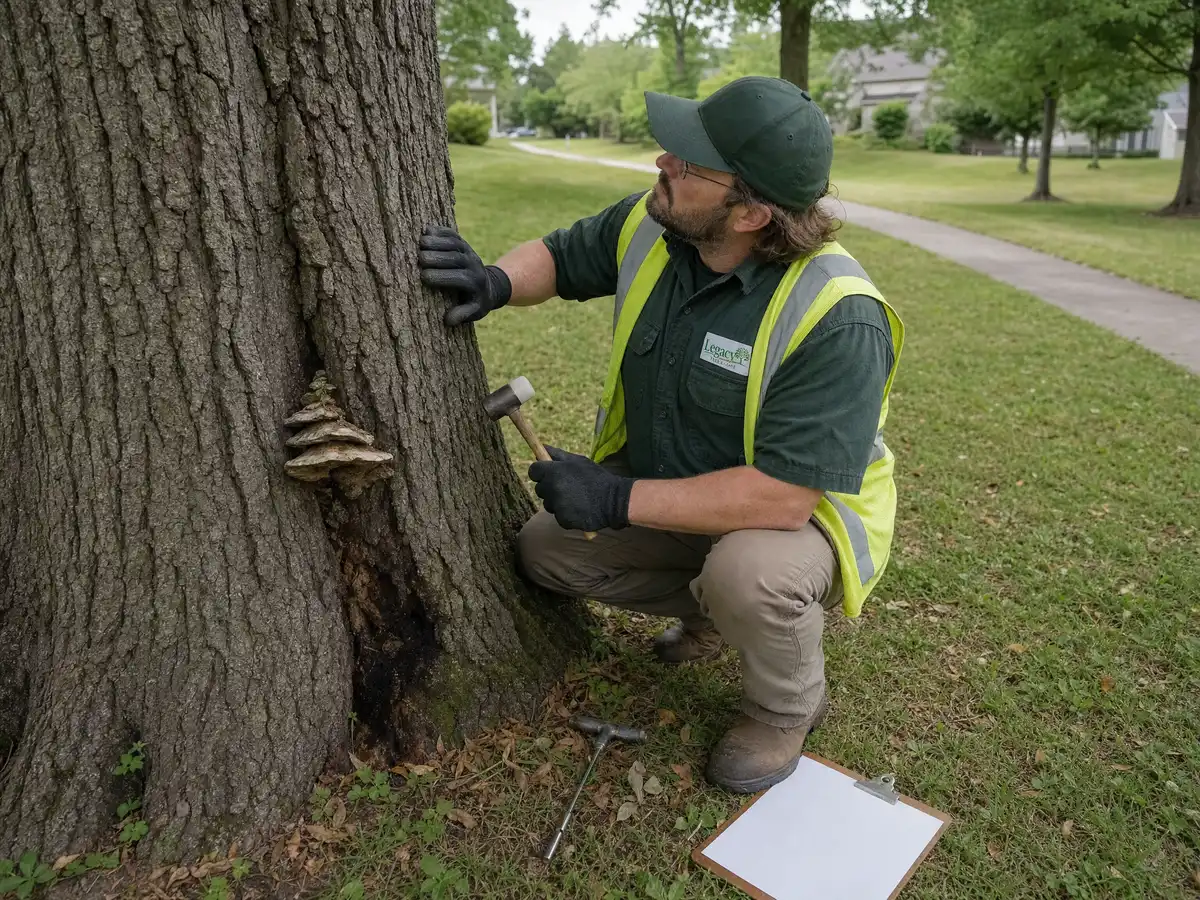
Free, fast, and the screening step that decides whether anything else is worth doing. A trunk that rings solid rarely earns an instrument; one that drums has just justified the next paragraph.
Resistance Microdrilling

A fine needle driven through the stem, recording resistance as it goes. It produces a profile along one line, which is exactly what it can and can’t tell you: excellent depth, one path only.
Sonic Tomography
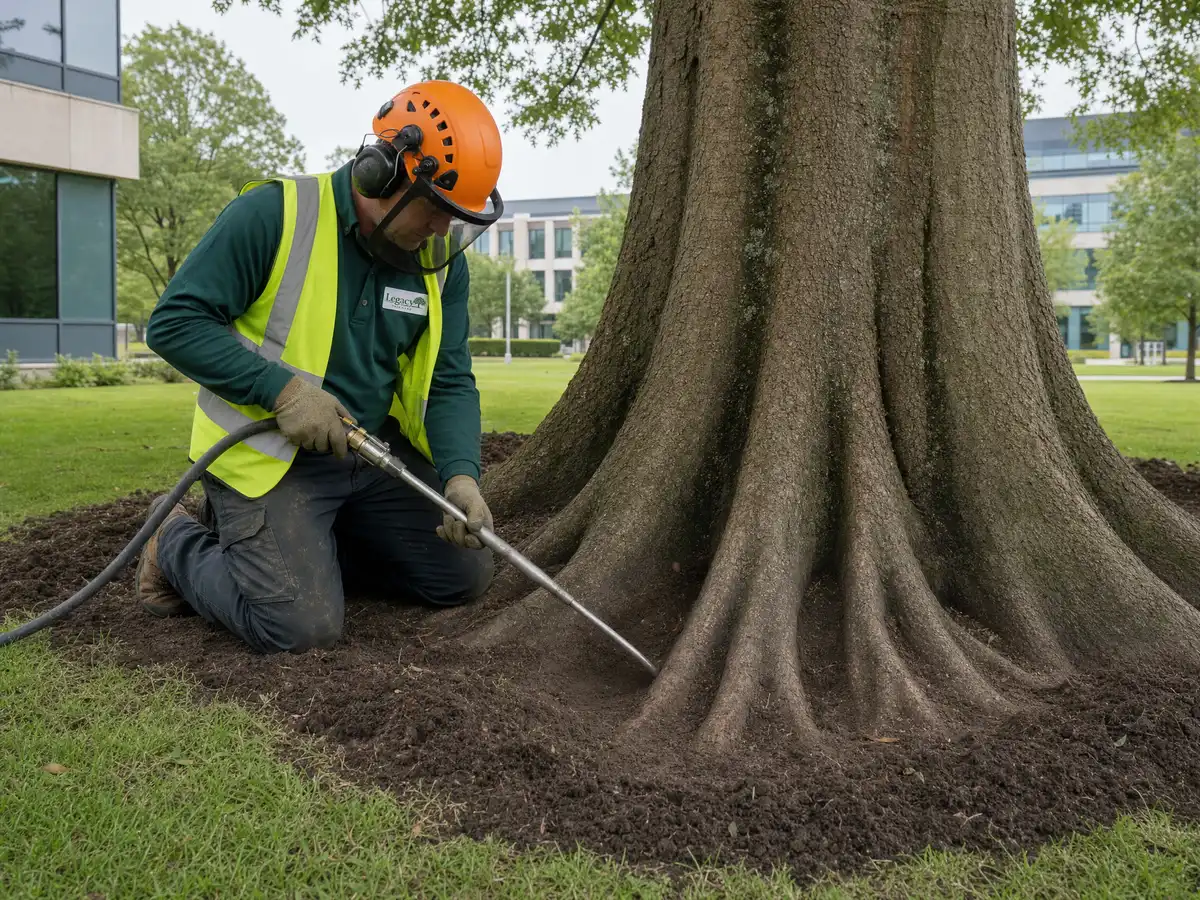
Sensors around the trunk timing sound between them, producing a cross-sectional map. It shows the shape of what remains rather than a single line, and it’s the most expensive of the three.
Sounding First, Always.
Mechanical sounding is a long-established forestry method: tapping a trunk with a wooden or rubber mallet and listening for the telltale drumming that indicates an interior hollow.
It’s crude compared with what follows and it answers the screening question well. A tree that sounds solid rarely justifies an instrument, and a tree that drums has earned one. Skipping straight to equipment on every mature tree is how an assessment budget disappears without changing a single decision.
What The Instruments Actually Add
Both instrumented methods answer the same question and answer it differently, which is why the choice between them isn’t about accuracy.
Resistance microdrilling gives a detailed profile along the single path the needle took. It’s decisive about that line and silent about the rest of the cross-section, so a decay column the drill missed by an inch doesn’t appear.
Sonic tomography builds a picture of the whole cross-section from sound traveling between sensors. It shows shape and extent rather than one transect, at higher cost and with a longer setup, and it’s the method that answers how much sound wood is left and where.
When It’s Worth Paying For
Three conditions, and all three should be true rather than one.
The tree carries a target underneath it that matters. Sounding or visible symptoms suggest something is there. And the answer would change what happens next.
That third one is the test most proposals fail. If a tree is coming out regardless, or staying regardless, then measuring the decay precisely is information nobody will act on. Instruments are for the trees where the decision is genuinely open.
What The Results Don’t Settle
An instrument reports what remains at a moment. It doesn’t tell you whether the tree will fail, because failure depends on loading, and loading depends on wind, canopy and a great deal else.
It also doesn’t settle the question on its own. Research reviewed by the ISA has noted that assessments informed by advanced technologies aren’t automatically more consistent than careful visual work, and that the credentials of the assessor influence outcomes measurably.
The instrument is evidence, not a verdict. Anybody presenting a tomogram as a decision has skipped the part where somebody has to interpret it against the target and the loading.
Decay Is Normal, And That’s The Difficulty.
Almost every mature tree carries some decay. It’s a normal consequence of wounds, pruning cuts and time, and a finding of decay on its own says very little.
What matters is proportion and position. A column in the center of a large trunk with a thick shell of sound wood around it can be structurally unremarkable. A smaller pocket at a union, or one that has reached the root flare, can matter a great deal more.
That’s why a measurement without an interpretation is close to useless, and why the honest answer to “is there decay in this tree” is usually yes, followed by the question that was actually meant.
What You Should Receive
The output, and the reasoning built on it. A tomogram or a resistance trace on its own isn’t a finding, and a report that includes the picture without an interpretation has handed you the raw material and kept the work.
What’s useful is the measurement, what it shows about remaining sound wood, what that means given what stands underneath the tree, and what we recommend as a result, with the date on it so the next assessment can compare.
More On Risk And Documentation
The rest of what a commercial property gets asked to produce, and who asks for it.
- Tree Risk Assessment
- Commercial Tree Inventory
- Commercial Tree Inspection Programs
- Tree Damage And Insurance Claim Documentation
- Recognizing Tree Defects
- Investigating Why A Tree Failed
- Root Zone And Root Collar Investigation
- Reducing Tree Risk Without Removing The Tree
- Reporting Tree Risk To Owners And Boards
- Arborist Expert Witness And Litigation Support
- What Tree Records To Keep
- Catching Up On Deferred Tree Maintenance
- Seasonal Tree Risk
- See All Risk And Documentation Services