

Why A Schedule Beats Attention
Most commercial properties inspect their trees reactively. Something looks wrong, or a tenant complains, or a limb comes down, and somebody is called.
That produces attention without a record. The gaps are invisible and the reasoning is undocumented, so the property can’t say what was looked at, when, or on what basis anything was judged acceptable. A schedule fixes the second problem even more than the first.
What A Cycle Looks Like
Three tiers, because inspecting everything at the same frequency wastes money on most of a canopy.
Trees Over Something

Over parking, walkways, entrances and buildings. The short list, inspected most often, because consequence rather than condition sets the interval.
Trees With A Known Defect
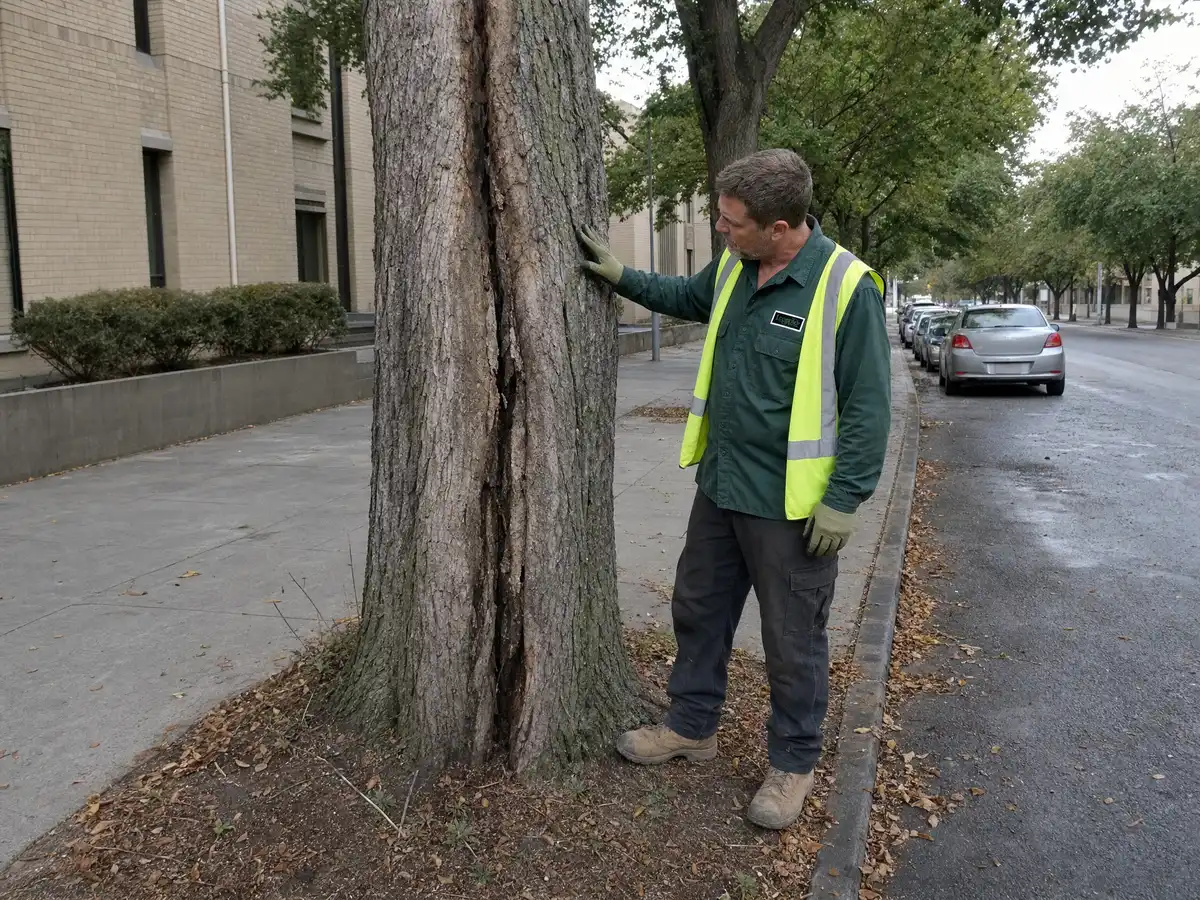
Anything already carrying a finding is on its own clock. The point of recording a defect is to look at it again and see whether it moved.
Everything Else

Boundary strips, screening and back corners. A longer cycle and a lighter look, recorded all the same, because “we walked it and it was fine” only counts if it was written down.
What Shouldn’t Wait For The Cycle
A schedule is a floor rather than a ceiling, and several events should pull an inspection forward regardless of when the last one happened.
Any significant storm, because wind finds defects that were survivable in ordinary weather. Construction anywhere near a root zone, since the damage that matters happens below ground and shows up seasons later. A change in what sits beneath a tree, which alters the consequence without touching the tree. And any visible change in the canopy, which is usually late notice of something that started earlier.
What Actually Changes Between Visits
The useful finding is rarely a new tree. It’s a known one behaving differently.
A crack that has extended. A cavity that has opened further. Deadwood in a crown that was full last year. Soil lifting on one side of a root plate, which is the finding that matters most and the one least likely to be noticed by anybody not looking for it.
Those readings only exist as comparisons. A first inspection establishes very little beyond a snapshot, which is worth saying plainly because it means the first visit is the least valuable one you’ll buy and the reason to buy the second.
Where The Interval Comes From
Not from a standard, because none of these cities set one for private commercial property. It comes from consequence, species, age and known findings.
A mature tree over an entrance with a recorded defect is on a short cycle regardless of how healthy the rest of the canopy is. A young tree in a lawn with nothing beneath it can wait years. Setting one interval for a whole property is the most common way this gets overspent, and the second most common is setting it by the calendar rather than by what changed.
Consistency Is The Point
A record is only useful if the next one can be compared against it, which means the same trees, the same fields and the same rating language each time.
Where that holds, the record starts answering questions no single visit can. Whether a defect is stable or moving. Whether a tree is declining or had one bad season. Whether the work done last year achieved anything. A file of inconsistent notes from three different companies can’t answer any of those, however conscientious each visit was.
What The Record Is Worth Afterwards
The commercial argument for a schedule is planning. The other argument is what exists if a tree fails.
The question then is what the owner knew and when, and a consistent inspection record answers it in a way nothing produced after the event can. It shows the tree was looked at, on a stated interval, by somebody competent, and what was concluded each time.
That’s a considerably stronger position than a property that looked at its trees more often but wrote none of it down.
What A Program Costs To Ignore
The expense people compare against is the inspection fee. The one that actually decides it’s the removal that was avoidable.
A defect found early is frequently a pruning visit. The same defect found after it has propagated is a cabling job, and after that a removal plus replanting plus, in several cities here, a mitigation obligation attached to the tree that came out.
That escalation is the argument, and it’s why the cheapest tier of the cycle is the one covering trees nobody is worried about yet.
Who Should Be Doing It
Not necessarily us, and not necessarily an arborist every time.
A trained member of site staff walking a route and flagging changes is genuinely useful between professional visits, provided they’re looking for the right things and recording what they see. What that can’t do is settle a finding, and a program that relies on untrained observation to decide whether a defect matters has substituted frequency for judgment.
The workable arrangement on most commercial property is a professional cycle with informed observation in between, and clear agreement about which findings stop being an observation and become a call.
More On Risk And Documentation
The rest of what a commercial property gets asked to produce, and who asks for it.
- Tree Risk Assessment
- Commercial Tree Inventory
- Tree Damage And Insurance Claim Documentation
- Recognizing Tree Defects
- Detecting Decay Inside A Tree
- Investigating Why A Tree Failed
- Root Zone And Root Collar Investigation
- Reducing Tree Risk Without Removing The Tree
- Reporting Tree Risk To Owners And Boards
- Arborist Expert Witness And Litigation Support
- What Tree Records To Keep
- Catching Up On Deferred Tree Maintenance
- Seasonal Tree Risk
- See All Risk And Documentation Services