

How Properties Get Here
Rarely through negligence. Usually through ownership changes, a budget that had no line for trees, a manager who inherited a site with no history, or ten years in which nothing failed and so nothing prompted a call.
Trees are unusually good at hiding deferral, because they keep looking approximately the same while the problems compound. A canopy that has been ignored for a decade looks much like one maintained for a decade, right up until the part where it doesn’t.
What Deferral Actually Costs
| What Was Deferred | What It Becomes |
|---|---|
| Structural pruning on young trees | Codominant unions on mature trees. A small cut becomes a cabling job or a removal |
| Deadwood removal | Accumulated hangers and brittle limbs over whatever is underneath |
| Clearance pruning | Repeated one-sided cutting later, and crowns loaded away from the building |
| Any inspection at all | No record of what was known, which is the expensive part after a failure |
| Replacing failed planting | Gaps in screening that become a compliance question rather than a landscaping one |
The first row is the one with the worst multiplier. A competing stem removed at eight years is one cut; the same defect at forty is this entire page.
What To Do First
Not the worst-looking tree. The one with the most underneath it.
Anything Dead, Over Anything.
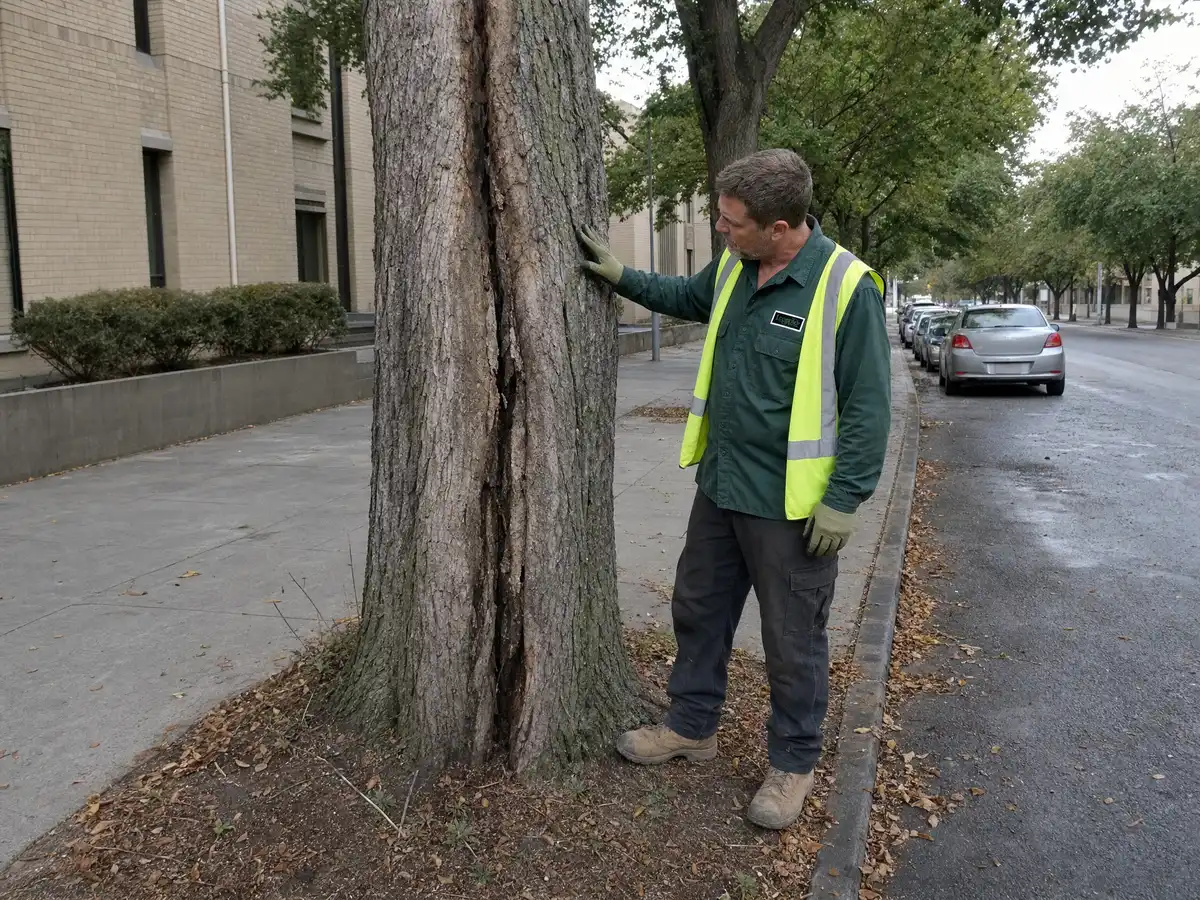
Dead wood over parking, walkways or entrances comes first regardless of what else the survey found. It’s the one category with no judgment call attached and usually the cheapest to clear.
The Short List Of Consequence

Trees over things people use, assessed properly. On most sites that’s a handful, and it’s where the entire first year of budget should go.
A Baseline, Before Anything Else.

The record that turns the next decade into something manageable. Doing work without it means the same discovery exercise happens again in five years.
The Order Matters More Than The Pace
A property catching up rarely has the budget to do everything in one year, and that’s fine. What causes problems is doing it in the wrong order.
Assess first, even if it delays the visible work by a month. Spending a full year’s budget on the trees somebody happened to notice is the most common way a catch-up produces no reduction in risk at all, because the trees that mattered weren’t the ones that looked worst from the office window.
Then work down the list by consequence, not by appearance. The tree over the loading dock beats the ragged one at the back boundary every time, however much worse the second one looks.
What Can Wait, Honestly.
A great deal, and saying so is the difference between a plan and a panic.
Cosmetic pruning can wait indefinitely. Trees with nothing beneath them can go on a long cycle. Crown cleaning on a sound mature tree over a lawn is genuinely optional for years. A proposal that marks everything urgent hasn’t prioritized, it has just listed, and it usually results in nothing being approved at all.
The Trees You’ll Lose
Some of them, and it’s better to hear that at the start.
A decade of deferral produces trees where no intervention available now changes the outcome: decay at the base, a union that has already begun to fail, a root plate that has been moving for years. Those come out, and the honest framing is that the decision was made some time ago and is only being discovered now.
What a catch-up genuinely saves is the middle group: trees with correctable problems that would have joined the first group in another three years.
What To Tell An Owner Or A Board
That the position is normal, that it’s recoverable, and roughly what it costs across how long. All three, because leaving out the first invites a search for who is to blame rather than a decision about what to do.
Deferral on a commercial canopy is close to the default state of the asset class. Presenting it as an unusual failure makes it harder to fund, not easier, and it’s also not true.
What does move a decision is a sequence with numbers on it: what must happen this year, what can wait, and the point at which the annual cost drops. That’s a plan somebody can approve rather than a problem somebody has to own.
Getting Off The Treadmill
The point of catching up isn’t to arrive at a perfect canopy. It’s to reach a state where an ordinary cycle keeps it there.
That’s usually reachable in two or three budget years on a typical commercial property, after which the annual cost drops substantially, because maintaining a canopy costs a fraction of recovering one.
The properties that end up back here are the ones that treated the catch-up as a project with an end date rather than the start of a routine.
More On Risk And Documentation
The rest of what a commercial property gets asked to produce, and who asks for it.
- Tree Risk Assessment
- Commercial Tree Inventory
- Commercial Tree Inspection Programs
- Tree Damage And Insurance Claim Documentation
- Recognizing Tree Defects
- Detecting Decay Inside A Tree
- Investigating Why A Tree Failed
- Root Zone And Root Collar Investigation
- Reducing Tree Risk Without Removing The Tree
- Reporting Tree Risk To Owners And Boards
- Arborist Expert Witness And Litigation Support
- What Tree Records To Keep
- Seasonal Tree Risk
- See All Risk And Documentation Services