Skip To Content
  • Serving Plano and Collin, Dallas, and Denton Counties
(214) 668-8346
A Legacy Tree Care arborist holding down a leafy twig and examining the leaves, beneath a row of mature oaks along a commercial parking island

For Property Managers, HOA Boards and Developers

Oak Wilt in Plano, TX

It doesn't take one tree. It takes the row.

Oak wilt matters more on commercial property than anywhere else, because commercial oaks were planted together, at the same time, close enough that their roots have since joined. The disease uses exactly that.

(214) 668-8346

Crews dispatch in business hours.

Request A Property Walkthrough

Quick Walkthrough Request

Rather talk it through? (214) 668-8346.

  • Insured & Bonded
  • Serving the Plano Area Since 2005
  • Emergency Dispatch
  • Commercial Property Specialists

Two Ways It Moves, And They Need Different Answers.

Oak wilt is a fungal disease, and almost everything practical about managing it follows from how it travels.

Underground, through connected roots. Oaks of the same species growing near each other graft roots together over time, and the fungus moves through those connections from an infected tree into its neighbors. This is the mechanism that takes a row rather than a specimen.

Overland, by insects. Fungal mats form on red oaks, insects visit them, and those insects carry spores to fresh wounds on other oaks. This is the mechanism that starts a new infection center somewhere the disease wasn’t.

Each route has its own control, which is why managing oak wilt is never a single treatment.

What The Source Actually Says

Point USDA and Texas Forest Service guidance
The wounding window All wounding of oaks, including pruning, should be avoided from February through June
Safest times to prune The coldest days in midwinter and extended hot periods in mid to late summer
Wound treatment Regardless of season, all pruning cuts and other wounds, including fresh stumps and damaged surface roots, should be painted immediately
Fungal mats Form most often in spring on red oaks that showed advanced symptoms the previous late summer or fall
Trenching Roots severed by trenching at least 4 feet deep, and deeper where soils require it
Fungicide Propiconazole is the only fungicide scientifically tested and proven effective, applied preventatively to protect live oaks

Why Commercial Canopies Lose More

Three features of how commercial property was planted, each of which favors the disease.

  • Planted Together, Rooted Together.

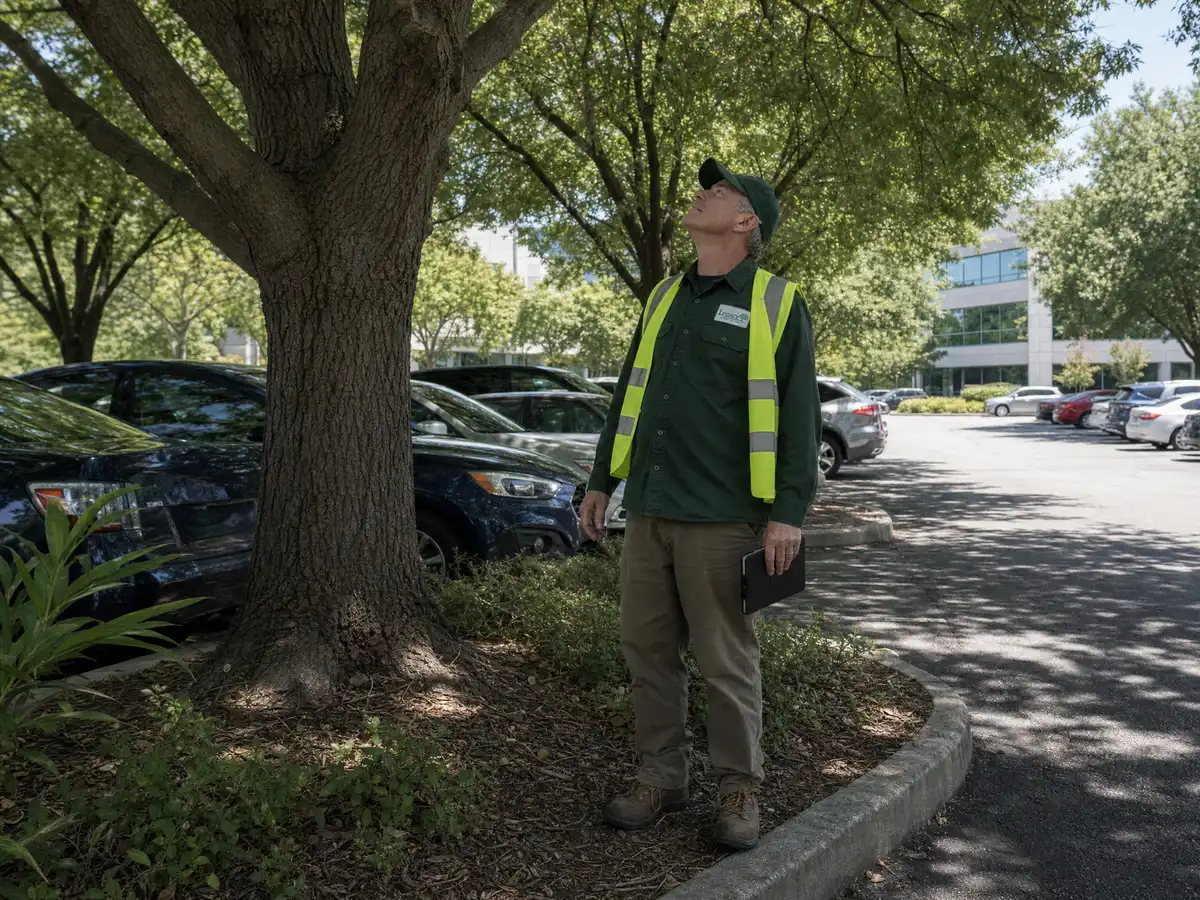
    A Legacy Tree Care arborist looking up into the canopy of a mature tree growing in a curbed parking island, with cars parked around it

    A boundary row or parking island planted at once, at the same spacing, with the same species. Thirty years later the root grafts are extensive, which is precisely the pathway the disease uses.

  • Pruned On A Contract Calendar

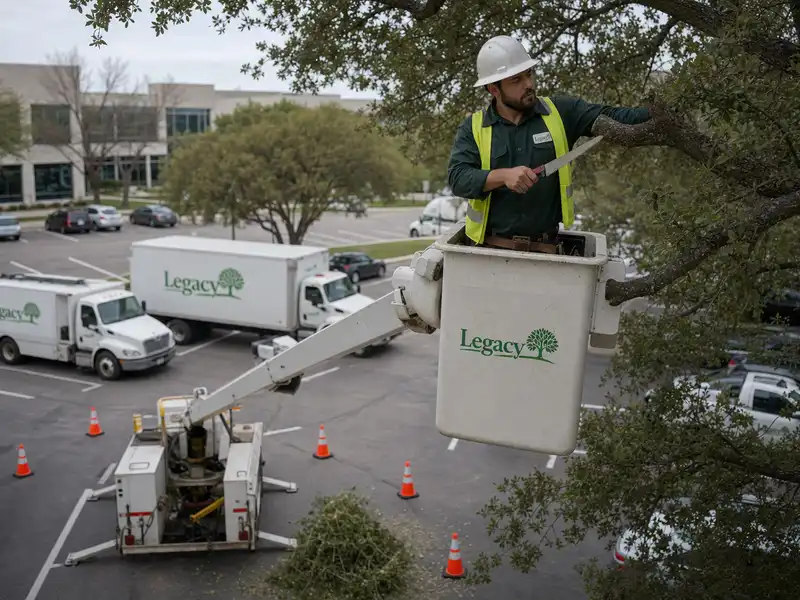
    A Legacy Tree Care arborist pruning a limb by hand from a bucket lift, above box trucks and traffic cones in an office parking lot

    Landscape contracts schedule by the fiscal year rather than by the disease. Spring pruning on oaks is common, convenient, and falls inside the window the guidance says to avoid.

  • Wounded By Everything Else

    A Legacy Tree Care arborist kneeling beside an open trench where cut root ends are exposed in the soil face, next to a mature tree on a construction site

    Trenching, mowers, vehicle strikes and construction all create the fresh wounds insects need. A commercial site produces far more of those than a garden does.

The Window Is Specific, And That’s Useful.

“Prune at the right time of year” is advice nobody can act on. February through June is a date range that goes in a contract.

The guidance names the least hazardous periods as the coldest days of midwinter and extended hot spells in mid to late summer, which for a commercial property means oak work belongs in the winter schedule and can be defended when somebody asks why it wasn’t done in April.

And regardless of season, wounds get painted. That includes cut stumps and damaged surface roots, which is the part landscape crews most often miss because it doesn’t look like pruning.

Three Controls, Used Together.

The guidance sets out control in three parts, and no single one of them is a solution on its own.

Prevent new infections. Deal with diseased red oaks promptly, avoid wounding in the window, paint wounds, and handle oak firewood carefully rather than stacking unseasoned wood from an infected tree beside healthy oaks.

Disrupt the root connections. Trenching at least four feet deep between infected and healthy trees, deeper where soils demand it, to break the underground pathway.

Treat high-value trees. Propiconazole injected into the vascular system through the root flares, which works preventatively rather than as a cure.

What Treatment Can And Can’t Do

Worth stating plainly, because this is where money gets spent hopefully.

The fungicide is described as effective when properly applied prior to infection, with limited success from therapeutic injection in the earliest stages. It protects individual high-value trees. It doesn’t cure a canopy, it doesn’t stop root spread on its own, and it isn’t a substitute for trenching or for the timing rules.

The honest framing for a commercial owner is that the money buys protection for specific trees you’ve decided are worth protecting, alongside the other two controls rather than instead of them.

What This Means For A Property

The decision is rarely about one tree, which is the whole reason this page exists.

An infection in a connected row is a question about how many trees you expect to keep, how far the root connections extend, whether trenching is physically possible through paving and services, and which individual specimens justify injection.

Those are canopy-scale questions with canopy-scale numbers attached, and they’re considerably easier to answer where somebody already knows what species are on the site and where they stand.

Request A Walkthrough

More On Oak Wilt

One disease, four decisions: what it looks like, what stops it, when to cut, and what it does to a whole canopy.

Frequently Asked Questions

Two ways, and they need different answers. Underground through roots that have grafted together between nearby oaks, which is what takes a whole row. And overland, where fungal mats form on red oaks, insects visit them, and spores reach fresh wounds on other oaks, which starts a new infection center.

The USDA Forest Service and Texas Forest Service guidance says all wounding of oaks, including pruning, should be avoided from February through June. It names the least hazardous periods as the coldest days in midwinter and extended hot periods in mid to late summer.

The guidance says yes, regardless of season, and immediately. That includes freshly cut stumps and damaged surface roots, which is the part most often missed because it doesn't look like pruning to whoever caused it.

Because of how commercial sites were planted. A boundary row or parking island planted at once with one species has extensive root grafts thirty years later, and that's the pathway the disease uses. Commercial sites also generate far more wounds, from trenching, mowers and vehicle strikes.

Severing the root connections between infected and healthy trees so the fungus can't move underground. The guidance specifies at least 4 feet deep, and notes trenches deeper than that may be needed to assure control in deeper soils.

Propiconazole is described as the only fungicide scientifically tested and proven effective, applied preventatively to protect live oaks, injected into the vascular system through the root flares. Limited success is noted from therapeutic injection in the earliest stages of infection.

It's a preventative treatment rather than a cure, with only limited success reported for trees treated in the earliest stages. Money spent injecting an advanced case is money spent hopefully, and we'd rather say that than take it.

No, and that's the most common way a property spends a lot and loses the canopy anyway. Injection protects individual trees. It doesn't stop root spread, it doesn't address the wounding window, and it doesn't deal with infected red oaks producing mats.

The guidance is specific about it: handle oak firewood cautiously, burn it before spring, and never store unseasoned oak from infected trees near healthy oaks. On commercial property this usually means being careful about where cleared material is stacked and for how long.

Symptoms differ by oak type and are more distinct on live oaks than on red oaks, and diagnosis can be confirmed by laboratory isolation from diseased tissue. Guessing from a photograph isn't a diagnosis, which matters because the response is expensive and the alternatives look similar.

Where To Start

Three Ways To Get The Oaks Looked At

Oak wilt moves on a calendar rather than on a budget cycle, so the useful thing is usually to look before the next window rather than after it.

Something Is Wrong Now

Call. You'll reach a person at any hour. We respond immediately during business hours, and first thing the next morning if you call overnight.

(214) 668-8346

You Want To Know What You Have

An arborist walks the property, separates what is infected from what is merely at risk, and puts both in writing.

Request A Walkthrough

Nothing Is Wrong Yet

Get on file before the season. Properties we already hold move faster on a storm night, because the crew isn't spending the first hour learning the site.

Set Up A Vendor Agreement

Commercial property only, fully responsible for the outcome, and we call 15 to 30 minutes before we arrive. The insurance clears before a truck moves. (214) 668-8346.

Request A Walkthrough

Tell Us About The Property

We'll walk the site, put the condition of every tree in writing, and give you a scope you can take to a board or a budget meeting. No obligation, and no pressure to decide on the spot.

If a limb is down or a lane is blocked right now, calling is faster than a form.

Call (214) 668-8346

  • Insured & Bonded
  • Serving the Plano Area Since 2005
  • Emergency Dispatch
  • Commercial Property Specialists

Send Us The Details

Tell us the property type and what you're seeing. We'll come back with next steps.

Request A Property Walkthrough
A limb over the entrance, a tree that looks unwell, a permit deadline, storm cleanup, an annual contract you want quoted, or getting set up as a pre-approved vendor before storm season.
Request A Walkthrough Call Now