
What The Treatment Actually Is
Propiconazole, sold as Alamo, is described in the guidance as the only fungicide scientifically tested and proven effective for oak wilt, when properly applied prior to infection, as a preventative treatment to protect live oaks.
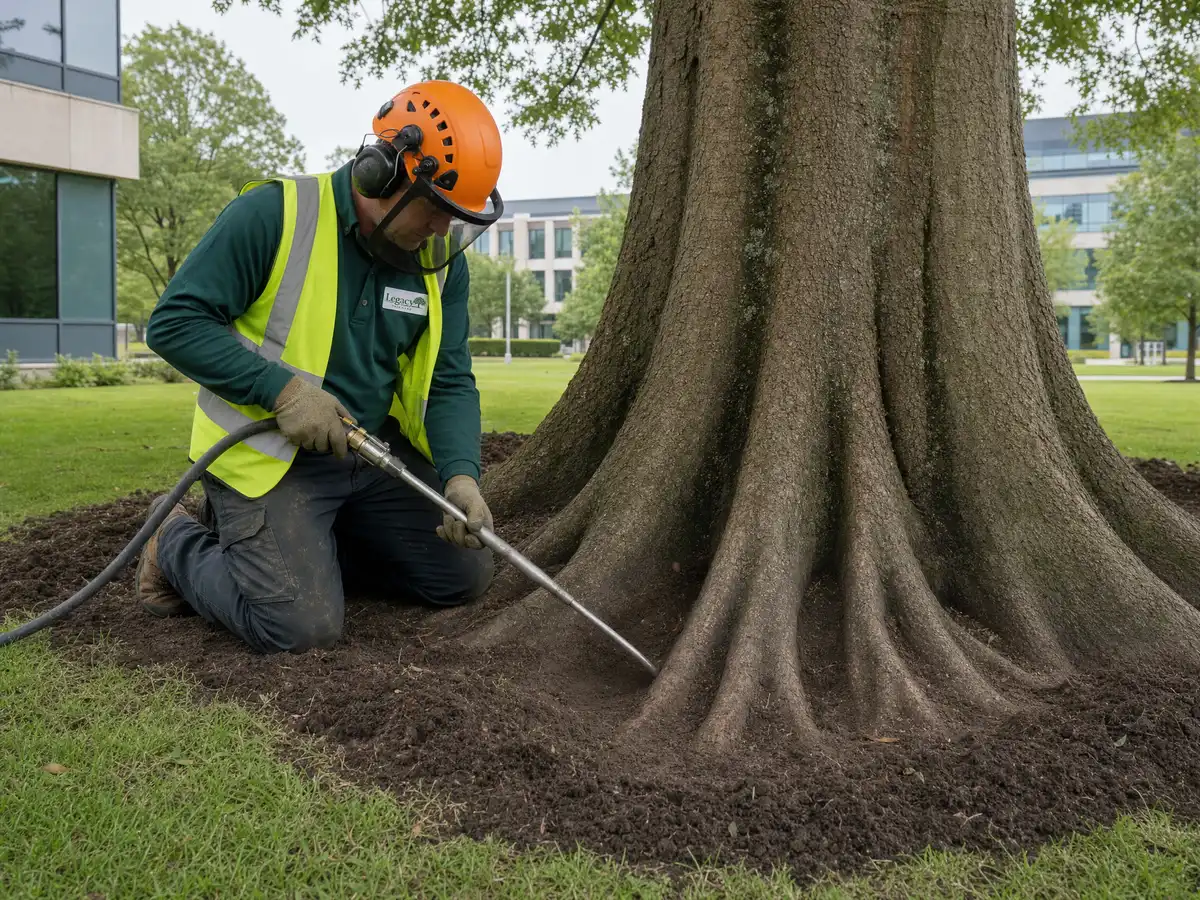
It goes into the tree’s water-conducting vascular system through small holes drilled into the root flares at the base of the trunk, not into the trunk itself and not into the soil. Exposing those flares is part of the job, which is why the work often starts with removing soil and mulch from the base of a tree that has been buried by years of landscape maintenance.
The guidance is direct about who should do it: injection should be done only by trained applicators, and it names a licensed arborist holding a certified applicator’s license. It also notes that treatment may take several hours per tree, that success depends on the health of the candidate tree, the application rate and the injection technique, and that mixing, drilling, connecting the apparatus and monitoring uptake all have to follow label directions.
Preventative Versus Therapeutic
This distinction decides whether the money is well spent, and it’s the part most often glossed over.
Preventative means treating a healthy tree that’s at risk because an infection center is expanding toward it. This is the use the evidence supports, and the guidance says preferred candidates are healthy live oaks at high risk in advance of an expanding center.
Therapeutic means treating a tree that’s already infected. Here the guidance offers only that limited success may be achieved in trees treated during the earliest stages of infection. That’s a carefully hedged sentence and it should be read as one.
The honest version for a property owner is that injection buys protection for trees that are still healthy, and buys a chance for trees caught very early. It doesn’t buy recovery for a tree in visible decline.
The Thirty Percent Rule
There’s a specific threshold in the guidance, and it’s the most useful number on this page.
If symptoms are observed in more than 30 percent of the crown, it’s unlikely a fungicide injection will be effective.
That single line settles a lot of arguments. It gives a defensible reason to decline treatment on a tree somebody is emotionally attached to, and it gives a property manager something concrete to take to a board that wants every tree saved. A tree past that point is a removal conversation, not a treatment conversation.
Which Trees To Treat
| Tree | What the guidance indicates |
|---|---|
| Healthy, 75 to 150 ft from symptomatic trees | Best results for preventative treatment |
| Healthy, immediately adjacent to a symptomatic tree | Should receive therapeutic treatment |
| Showing foliar symptoms | Should receive therapeutic treatment |
| More than 30 percent of crown symptomatic | Injection unlikely to be effective |
| Post oak, bur oak, chinkapin oak | Resistant white oaks, rarely killed by oak wilt |
The counterintuitive row is the first one. The best preventative results come from trees that are some distance from the problem and look completely fine, which is exactly the spend that’s hardest to justify to somebody looking at a healthy tree. It’s also why this decision has to be made while there’s still time to make it.
What Injection Won’t Do
Three limits, each of which costs somebody money every year.
It Doesn't Stop Root Spread

Stated plainly in the guidance. The fungus keeps moving through grafted roots regardless of what’s in the tree, which is why injection is used alongside trenching rather than instead of it.
It Doesn't Cure The Disease
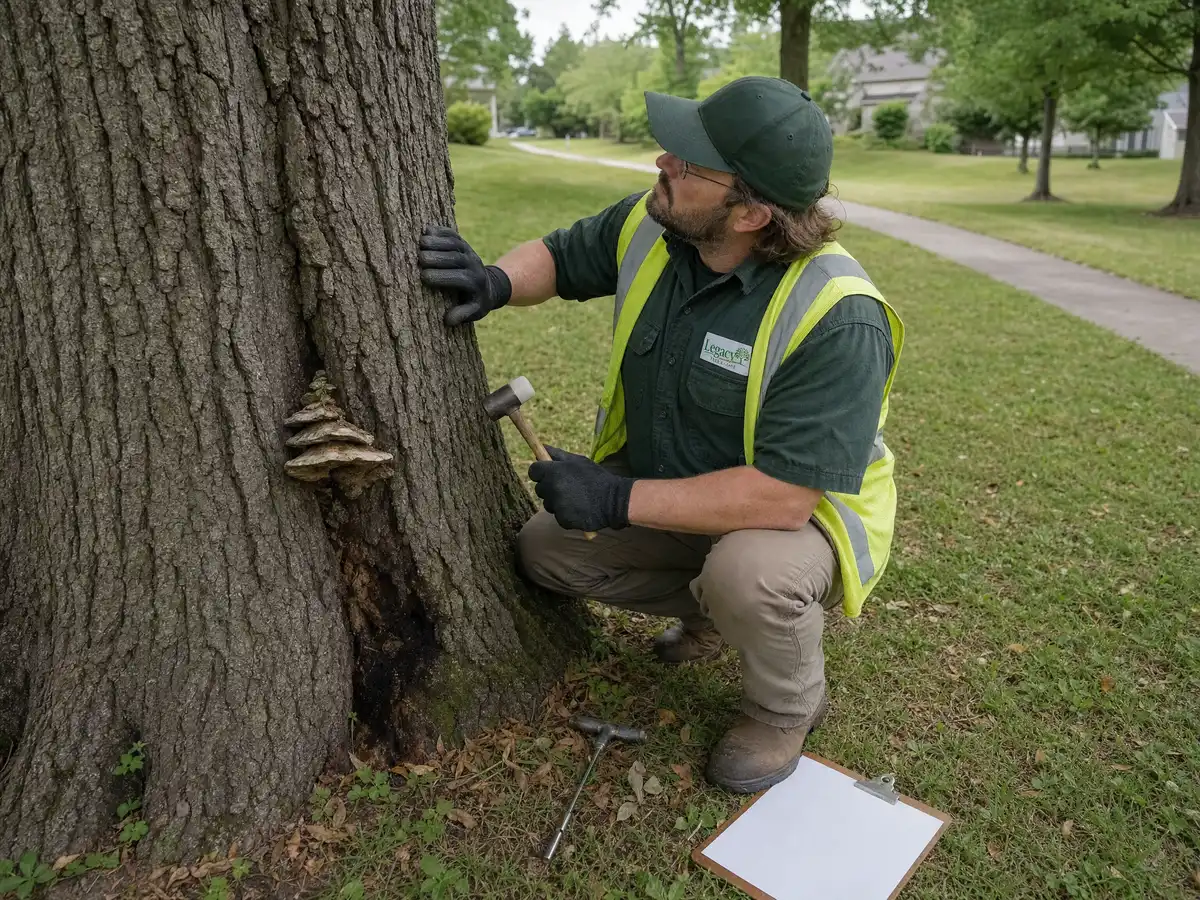
The source says these measures won’t cure oak wilt, but will significantly reduce tree losses. Reducing losses across a canopy is a real result. Saving a declining specimen is usually not on offer.
It's Not Permanent
Protection isn’t a one-time purchase. Treated trees sit inside an ongoing management program, and the area outside a treated zone needs monitoring for several years afterward.
Where It Fits In The Program
The guidance sets out three approaches and says successful control usually depends on an integrated program incorporating measures from all three: preventing new infections, disrupting root connections by trenching, and injecting high-value trees.
Injection is the third of those, and it’s described as best used in conjunction with trenching, or to protect individual high-value trees in situations where trenching is impractical. On commercial property that second case comes up constantly, because a trench four feet deep has to go somewhere, and paving, parking, irrigation, fiber and gas lines routinely make the correct trench line physically impossible.
When that happens, injection stops being the optional third measure and becomes the only tool left. That’s a legitimate use, and it should be entered into knowing the root pathway remains open.
What It Costs To Decide Badly
Two failure modes, and they’re opposites.
Treating too late. Money goes into trees past the 30 percent threshold, which the guidance says are unlikely to respond, while the healthy trees at the advancing edge, the ones with the best evidence behind treating them, go untreated because the budget is gone.
Treating instead of trenching. Injection feels like action and requires no excavation, no closed parking spaces and no removal of trees that still look healthy. It’s by far the easier proposal to approve. It also leaves the root pathway open, which is the route that takes rows rather than individuals.
Both are avoidable with a survey that establishes which trees are symptomatic, how far the center has advanced and where a trench could physically go, before anybody commits to a treatment plan.
More On Oak Wilt
One disease, four decisions: what it looks like, what stops it, when to cut, and what it does to a whole canopy.